Buyers who have only sourced aluminium and steel are usually surprised twice by a titanium quotation: once by the number, and again by how little of it is the machining. On a typical milled titanium part, the metal that ends up as swarf costs more than the spindle hours spent removing it.
This article breaks down titanium CNC machining cost into its real components — grade and stock form, buy-to-fly ratio, cutting behaviour, setups and documentation — and works through the material-utilisation arithmetic that decides most of the price before a tool touches the part.
Key takeaways
- Ti-6Al-4V conducts heat at about 6.7 W/m·K against roughly 167 W/m·K for aluminium 6061, so cutting heat stays at the edge instead of leaving in the chip. That, not hardness, is why cutting speeds are low.
- Buy-to-fly ratio usually dominates the price. The worked example below takes a part from a 9.4:1 ratio to 2.2:1 and cuts roughing removal by about 85%.
- Grade matters twice: Grade 2 commercially pure titanium machines far more easily than Grade 5, and implant work needs Grade 23 ELI to ASTM F136 rather than generic Ti-6Al-4V.
- Specify bar and billet to ASTM B348 or, for aerospace, AMS 4928. “Titanium” alone leaves condition, chemistry and testing undefined.
- Titanium’s specific strength is roughly 214 MPa per g/cm³ against about 115 for 6061-T6 and 69 for 316L — the reason it is chosen, and the number to test a specification against.
- MW+ machines titanium across 60+ machining centres to a ±0.005 mm precision band with Cpk ≥1.67 on controlled characteristics, quoting within 24 hours.
What this article covers
- Why is titanium more expensive to machine than steel or aluminium?
- Which titanium grade does your part actually need?
- The properties that set the cost
- Worked calculation: buy-to-fly ratio and where the money goes
- What drives the quotation, line by line
- How do you reduce titanium machining cost?
- Which specifications belong on a titanium drawing?
- When titanium is the wrong material
- Frequently asked questions
Why is titanium more expensive to machine than steel or aluminium?
Three physical properties, none of which is hardness. Ti-6Al-4V at about 334 HB is not especially hard; plenty of quenched and tempered steels are harder and cheaper to cut.
Thermal conductivity. At roughly 6.7 W/m·K, titanium carries almost no heat away in the chip. The energy of the cut concentrates in a small volume at the cutting edge, which is why cutting speeds are a fraction of those used on steel and why coolant delivery matters more than coolant volume.
Chemical reactivity at temperature. Hot titanium reacts with the tool material, promoting diffusion and adhesion wear and encouraging built-up edge. This is why tool grade and coating selection are not interchangeable between titanium and steel, a distinction covered in our article on CNC tool wear cost by material.
Low modulus. At about 113.8 GPa, titanium’s elastic modulus is roughly half that of steel, so thin walls and long unsupported features deflect away from the tool and spring back. Chatter and dimensional inconsistency follow, and the remedy is lighter cuts and more passes rather than more power.
Which titanium grade does your part actually need?
Table 1 — Common machinable titanium grades
| Grade | Composition | Typical minimum tensile (MPa) | Usual specification | Relative machinability | Typical use |
| Grade 1 | Commercially pure | ≈240 | ASTM B348 | Best of the group; gummy, needs sharp tools | Chemical, plate and forming work |
| Grade 2 | Commercially pure | ≈345 | ASTM B348 | Good | Marine, chemical, heat exchangers |
| Grade 5 (Ti-6Al-4V) | 6% Al, 4% V | ≈895–950 | ASTM B348 / AMS 4928 | Moderate; the industry workhorse | Aerospace structure, motorsport, general high-strength |
| Grade 23 (Ti-6Al-4V ELI) | Extra low interstitial | ≈860 | ASTM F136 | Similar to Grade 5 | Surgical implants, cryogenic service |
| Grade 9 (Ti-3Al-2.5V) | 3% Al, 2.5% V | ≈620 | ASTM B348 / B338 for tube | Better than Grade 5 | Tubing, bicycle and hydraulic components |
Minimum values as specified in the relevant product standards; supplied material commonly exceeds them. Confirm against the mill certificate for the lot.
Two practical points. Grade 23 is not simply “better” Grade 5 — its extra-low-interstitial chemistry gives improved fracture toughness and ductility at slightly lower strength, and it costs more. Specify it because the part is an implant or a cryogenic component, not as an upgrade. And commercially pure grades are genuinely cheaper to machine, so if the strength requirement does not demand an alloy, saying so on the drawing is one of the largest single cost levers available.
The properties that set the cost
Table 2 — Titanium against the usual alternatives
| Material | Density (g/cm³) | Tensile strength (MPa) | Modulus (GPa) | Thermal conductivity (W/m·K) | Specific strength (MPa per g/cm³) |
| Ti-6Al-4V, annealed | ≈4.43 | ≈950 | ≈113.8 | ≈6.7 | ≈214 |
| CP titanium, Grade 2 | ≈4.51 | ≈345 | ≈105 | ≈16.4 | ≈76 |
| Aluminium 6061-T6 | ≈2.70 | ≈310 | ≈68.9 | ≈167 | ≈115 |
| Aluminium 7075-T6 | ≈2.81 | ≈572 | ≈71.7 | ≈130 | ≈204 |
| Stainless 316L | ≈8.00 | ≈485–620 | ≈193 | ≈16.3 | ≈69 |
| Inconel 718, aged | ≈8.19 | ≈1,375 | ≈200 | ≈11.4 | ≈168 |
Typical published values for the stated conditions; property data from MatWeb. Specific strength calculated as tensile strength divided by density.
That last column is the honest test of a titanium specification. 7075-T6 aluminium has a specific strength within a few percent of annealed Ti-6Al-4V and machines several times faster. Titanium wins where the requirement includes corrosion resistance, service above roughly 150 °C, biocompatibility, or a stiffness-per-weight constraint that aluminium’s lower modulus cannot meet — not on strength-to-weight alone.
Worked calculation: buy-to-fly ratio and where the money goes
Buy-to-fly is the ratio of purchased material mass to finished part mass. On milled titanium it is the single most useful number in the quotation, and it is calculable from the drawing before anyone quotes. The inputs below are assumed to make the arithmetic concrete.
Given: a milled bracket in Ti-6Al-4V weighing 0.85 kg finished, machined from rectangular billet 250 × 120 × 60 mm. Density is 4.43 g/cm³. Assume a roughing material-removal rate of 25 cm³/min for this machine, tooling and fixture.
Step 1 — Finished volume. 850 g ÷ 4.43 g/cm³ = 192 cm³.
Step 2 — Billet mass. 250 × 120 × 60 = 1,800,000 mm³ = 1,800 cm³. Mass = 1,800 × 4.43 = 7,974 g = 7.97 kg.
Step 3 — Buy-to-fly ratio. 7.97 ÷ 0.85 = 9.4:1. Nine-tenths of the purchased titanium becomes swarf.
Step 4 — Roughing time. Material removed = 1,800 − 192 = 1,608 cm³. At 25 cm³/min that is 1,608 ÷ 25 = 64 minutes of roughing before any finishing, inspection or setup.
Step 5 — Change the stock form. Suppose a near-net forged preform weighing 1.9 kg is used instead. Preform volume = 1,900 ÷ 4.43 = 429 cm³. Removal = 429 − 192 = 237 cm³, so roughing falls to 237 ÷ 25 = 9.5 minutes. Buy-to-fly becomes 1.9 ÷ 0.85 = 2.2:1.
Step 6 — Total the change. Purchased mass falls by 6.07 kg per part, or 76%. Removal volume falls by 85%, and roughing time with it. Tool consumption, which scales with removal, falls in the same proportion.
Step 7 — Find the break-even quantity. Forging carries non-recurring tooling cost and a lead time the billet route does not. The break-even is Q = NRE ÷ (saving per part), where the per-part saving is the reduced metal purchase plus the reduced machining and tooling. Below Q, billet is correct; above it, the preform is. That calculation belongs in the request for quotation, not in a conversation after the first batch.
Run the same arithmetic in aluminium and the point becomes clearer still: the identical billet in 6061 weighs 1,800 × 2.70 = 4.86 kg and costs a small fraction per kilogram, so material utilisation barely moves the price. In titanium it is the price.
What drives the quotation, line by line
Table 3 — Titanium cost drivers and the lever for each
| Driver | Mechanism | Lever | Who controls it |
| Purchased material | Buy-to-fly ratio against a high price per kilogram | Near-net stock, nesting, wall thickness review | Designer and buyer |
| Grade and specification | Alloy and ELI grades cost more and machine slower | Specify the grade the function needs | Designer |
| Cutting time | Low permissible cutting speed, light depths of cut | Rigid fixturing, high-pressure coolant, adaptive toolpaths | Supplier |
| Tool consumption | Heat and chemical wear at the edge | Correct grade selection, distance-based tool limits | Supplier |
| Setups and fixturing | Deflection under clamping; multi-face geometry | Fewer orientations, multi-axis machining in one setup | Both |
| Tolerance and finish | Extra finishing passes and inspection time | Tolerance only what the function needs | Designer |
| Documentation | First article, material certification, traceability | Define the package at quotation, not after | Buyer |
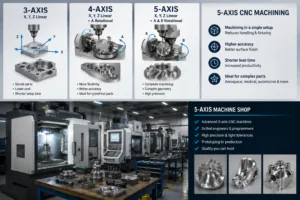
The setups line is where machine capability shows up in the price. A part with features on five faces costs three setups on a 3-axis machine and one on a 5-axis machine, and each setup adds fixturing, re-datuming and a fresh source of positional error. That is the economic case for multi-axis machining on titanium rather than a preference for newer equipment. Small-diameter turned titanium parts follow the same logic on a sliding-head machine, as described under Swiss machining.
How do you reduce titanium machining cost?
Start with the stock form
Because material dominates, the largest reductions come before machining. Plate instead of block where the geometry is flat, bar close to the finished diameter for turned parts, and forged or additively produced preforms for high buy-to-fly geometries. The worked example above quantifies the effect.
Then the geometry
Deep pockets with small corner radii are the expensive pattern: a small radius forces a small cutter, a small cutter forces light cuts, and light cuts in titanium are slow. Increasing internal radii, reducing pocket depth-to-width ratios and avoiding thin unsupported walls all reduce cycle time without changing function. Consolidating what would otherwise be a fabrication into one machined part can also pay, because it removes joints, fasteners and inspection points.
Then the tolerance scheme
Tolerance the features that matter and use general tolerances to ISO 2768-m elsewhere. A blanket tight tolerance applied to every dimension adds finishing passes and inspection time across the whole part, and on titanium those passes are slow. Which characteristics genuinely need capability data is discussed in our article on CNC defect rate benchmarks.
Then the commercial terms
Setup, programming and first-article verification are fixed costs spread across the batch, so release pattern matters as much as annual volume. A blanket order with scheduled call-offs amortises them properly; three separate small releases pays for them three times. The full process envelope is set out under CNC machining services.
Which specifications belong on a titanium drawing?
Table 4 — Specifications for machined titanium
| Specification | Covers | Cite it when |
| ASTM B348 | Titanium and titanium alloy bars and billets | General industrial and commercial work |
| AMS 4928 | Ti-6Al-4V bars, wire, forgings and rings, annealed | Aerospace and defence programmes |
| ASTM F136 | Wrought Ti-6Al-4V ELI for surgical implants | Implantable or implant-contacting parts |
| AS9102 | Aerospace first article inspection | New part numbers on aerospace programmes |
| NADCAP | Special process accreditation | Heat treatment, anodising or NDT is required |
| ISO 2768 | General tolerances | Every drawing, to define undimensioned features |
| ISO 21920-2 | Surface texture parameters | Any finish callout; name the parameter |
| ASME Y14.5 | Dimensioning and tolerancing | Whenever datums and geometric controls are used |
Certification of the supplier is a separate question from specification of the material; the distinction is set out in our comparison of ISO 9001, AS9100 and IATF 16949. The inspection and record-keeping behind a titanium shipment are described on our CNC machining quality control page.
When titanium is the wrong material
When strength-to-weight is the only driver. 7075-T6 aluminium sits within a few percent of annealed Ti-6Al-4V on specific strength, machines several times faster and costs far less per kilogram. If the part is not corrosive-service, high-temperature or biocompatible, aluminium usually wins on total cost.
When stiffness governs. Titanium’s modulus is roughly 113.8 GPa against 193 GPa for stainless. A deflection-limited part in titanium has to be thicker, which erodes the weight advantage that justified it. Run the stiffness calculation before the strength one.
When the part is a bearing or wear surface. Titanium galls against itself and against many counterfaces, and it needs surface treatment or a different material in sliding contact. Where low friction is the requirement, an engineering polymer is often the better answer, as set out in our note on PEEK CNC machining cost and performance.
When the geometry is wrong for machining it. A 9:1 buy-to-fly part at meaningful volume is a forging, a casting or an additively produced preform that gets finish machined — not a solid billet. Continuing to machine from solid because that is how the prototype was made is the most expensive habit in titanium procurement.
Frequently asked questions
Is titanium harder to machine than stainless steel?
It is slower and less forgiving, though for different reasons. Stainless work hardens ahead of the cut; titanium concentrates heat at the edge and reacts chemically with the tool. Both demand sharp tools, rigid setups and effective coolant, but titanium additionally deflects under cutting load because its modulus is roughly half that of steel.
Can titanium be machined on standard CNC equipment?
Yes, within limits. The constraints are rigidity, coolant pressure and thermal stability rather than spindle power, since cutting speeds are low. A machine that cuts aluminium happily may chatter in titanium at any speed if the structure or the fixture is not stiff enough, which is why a supplier’s titanium experience matters more than its machine list.
How much does buy-to-fly ratio really change the price?
Usually more than any other single factor. The worked example above cuts purchased mass by 76% and removal volume by 85% by changing only the stock form. Calculate the ratio from your own drawing — billet volume divided by finished volume — before you assume machining time is the problem.
What lead time should I expect on titanium parts?
Machining time is rarely the constraint. Material availability in the grade, form and certification you need usually is, particularly for aerospace-specified bar and for ELI grades. Ask about stock availability at the quotation stage and treat it as a separate schedule item from machining.
Do I need Grade 23 ELI or will Grade 5 do?
Grade 23 exists for applications needing improved fracture toughness and ductility, principally implants and cryogenic service, and it is specified to ASTM F136. For structural and general high-strength work, Grade 5 to ASTM B348 or AMS 4928 is the normal choice. Specifying ELI without a reason adds cost and narrows supply.
Is titanium worth it outside aerospace and medical?
Sometimes. Marine hardware, chemical process components and some motorsport parts justify it on corrosion resistance or on packaging constraints that no other material meets. The test is whether a specific property of titanium is load-bearing in the design. If the answer is “it seemed like the strong choice”, it usually is not worth it.
What documentation should arrive with a titanium order?
A certificate of conformance tying the shipment to the drawing revision, mill certification traceable to heat and lot against the named material specification, and a dimensional inspection report. Aerospace and medical programmes add a first article inspection report and any special-process accreditation required for treatments performed after machining.
How do I get a titanium quotation that is actually comparable?
Send the drawing with the grade and material specification stated, the stock form you will accept, the tolerance scheme, the quantity and release pattern, and the documentation package required. Request a CNC machining quote on that basis and the replies become comparable engineering proposals rather than four different sets of assumptions. Broader material selection guidance is in our CNC materials guide.