Cost, Materials and Process: What a Buyer Needs to Know
You need precision parts. You have a CAD file, a deadline, and a budget. This guide tells you exactly what CNC machining costs, which material to choose, how the process works end-to-end, and how to avoid the mistakes that double your bill or delay your launch.
What Is CNC Machining — and Is It Right for Your Project?
CNC machining (Computer Numerical Control machining) is a subtractive manufacturing process: computer-guided cutting tools remove material from a solid block to produce a finished part. Unlike injection molding, it requires no expensive tooling. Unlike 3D printing, it delivers real production-grade materials with tolerances and surface quality your end-use application demands.
For buyers, this means three things: fast turnaround (prototypes in 3–5 days), design flexibility (no tooling investment to iterate), and repeatable precision (±0.005mm tolerance held across hundreds or thousands of identical parts).
7 Proven Ways to Reduce Your CNC Machining Cost
- ✂️ Loosen non-critical tolerances. Audit your drawing. Every tight callout on a non-mating surface is wasted budget. Apply tight tolerances only where functionally required; use the general tolerances of ISO 2768-1:1989 for everything else.
- 📐 Reduce setups with smarter geometry. Every repositioning on the machine costs money. Design features accessible from as few sides as possible. Multi-axis machining can take a four-setup part down to one or two, and every setup removed takes its handling, fixturing and re-datuming with it.
- 🔩 Avoid deep, narrow cavities. Pockets with depth-to-width ratios above 4:1 require special tooling and slow feed rates. Ask your supplier if the same function can be achieved with a shallower pocket or a two-piece design — often it can.
- 🧪 Choose the right material, not the most impressive one. Aluminium 6061 cuts far faster and wears tooling far less than titanium, and both differences land in the quotation. Unless the application genuinely requires titanium’s properties, you are paying a premium that does not translate into better performance.
- 📦 Order in batches. Per-unit cost drops sharply from 1 → 10 → 50 → 100 parts. If you anticipate future demand, a slightly larger initial order almost always costs less per unit than two smaller orders placed months apart.
- 🕒 Plan ahead and avoid rush premiums. Express turnaround carries a premium at every shop because it displaces work already on the schedule. Using the standard 3–5 business day prototype route rather than the 48-hour express one removes that premium with no quality trade-off at all.
- 🔍 Get DFM feedback before freezing your design. A DFM review that catches one unmachineable feature, or suggests a material that cuts faster, pays for itself on the first part. MW+ provides free DFM reviews within 24 hours on every quote request.
CNC Machining Materials — What to Choose and Why
Material selection is one of the highest-leverage decisions you’ll make before sending your CAD file. The wrong material can double your machining cost, reduce part life, or fail regulatory requirements. Here’s the buyer’s breakdown of the most common CNC machining materials and when to use each.
| Material | Key Properties | Best For | Cost Level | Machinability |
|---|---|---|---|---|
| Aluminum 6061 | Lightweight, corrosion-resistant, weldable | Structural parts, enclosures, EV, general engineering | 💲 Low | Excellent |
| Aluminum 7075 | Higher strength, aerospace-grade | Aerospace frames, bike components, defense | 💲💲 Medium | Good |
| Stainless 304 | Corrosion-resistant, food-grade, tough | Food processing, consumer products, fittings | 💲💲 Medium | Good |
| Stainless 316 | Superior corrosion resistance, biocompatible | Medical, marine, chemical environments | 💲💲 Medium | Good |
| Titanium Gr5 | High strength-to-weight, biocompatible | Aerospace, orthopedic implants, high-performance | 💲💲💲 High | Moderate |
| Inconel 625/718 | Retains strength at elevated temperature, oxidation-resistant | Jet engines, turbines, oil & gas, defense | 💲💲💲 High | Moderate |
| Brass | Best machinability, excellent conductivity | Connectors, valves, plumbing, electronics | 💲💲 Medium | Excellent |
| PEEK | High-temp plastic, FDA-compliant, chemically inert | Medical implants, semiconductor, high-temp bearings | 💲💲💲 High | Good |
| Delrin (Acetal) | Low friction, dimensionally stable | Gears, bushings, food-contact parts | 💲 Low | Excellent |
MW+ stocks and machines 70+ materials for CNC precision parts — including exotic alloys like Hastelloy, Monel, Zirconium, and Ultem. Every order ships with full material traceability certificates, critical for AS9100D and ISO 13485 compliance.
What Actually Drives CNC Machining Cost?
CNC machining pricing isn’t a black box. Every line on your invoice corresponds to a specific cost driver. Understanding these helps you negotiate intelligently, write better specs, and know when a quote is fair — or inflated.
The 5 Primary Cost Drivers
1. Material. Raw stock is priced by weight at the market rate on the day, so aluminium sits well below titanium and Inconel. What you pay for is the billet, not the finished part — on a heavily pocketed component most of that billet leaves as swarf, and the quotation reflects the billet. 2. Machining time. Spindle hours multiplied by an hourly rate that rises with axis count and with the precision the job demands. More complex geometry means more time, and more time means more cost. 3. Setup & fixturing. Every job requires a setup, and a custom fixture is a one-off cost spread across the order quantity. 4. Surface finishing. Anodising, passivation and plating are priced per batch or per unit. 5. Quantity. Per-unit cost drops with volume because setup and programming are paid for once.
Work the amortisation yourself
The one piece of arithmetic worth doing before you argue about a quotation is the setup spread. Unit cost = per-part machining cost + (setup and programming ÷ quantity). Suppose setup and programming together come to the equivalent of ten parts’ machining time. At a quantity of 10 the setup doubles the unit cost. At 50 it adds 20%. At 200 it adds 5%. The curve is steepest between one part and the first few dozen, which is why moving from a single prototype to a small batch changes the per-part figure far more than any later increase in quantity does — and why asking for a price break at 1,000 when you are buying 20 misses where the money actually is.
Tolerance tightening is the most misunderstood cost driver. Each step down the ladder — from the general ±0.01 mm medium class of ISO 2768-1:1989, to ±0.005 mm, to the ±0.001 mm floor — costs more than the one above it, because each demands lighter cuts, more in-process gauging, more inspection and sometimes grinding rather than milling. Specify a tight band only where function demands it. On non-mating surfaces and clearance holes the general class is perfectly adequate and much cheaper. Where the drawing also needs a general rule for geometrical tolerances, ISO 22081:2021 replaces the withdrawn ISO 2768-2:1989.
Types of CNC Machining Services — Which Do You Need?
CNC Milling
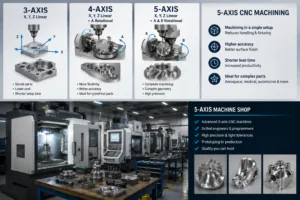
Milling uses rotating cutters to shape a stationary workpiece — handling flat surfaces, pockets, slots, holes, and complex 3D contours. Three-axis CNC milling services cover most standard parts; 4-axis adds rotational indexing; 5-axis simultaneous milling handles aerospace impellers, turbine blades, and multi-face parts where re-fixturing would compromise accuracy. If your part has undercuts or complex curved surfaces, 5-axis is the answer.
CNC Turning
Turning rotates the workpiece against a stationary tool — producing shafts, bushings, connectors, and anything rotationally symmetric. CNC turning services cover that work. For long, slender parts, Swiss machining supports the bar close to the tool so it can be turned to the ±0.001 mm floor without deflecting — the route normally used for bone screws, dental implants and precision sensor housings.
CNC Prototyping
CNC prototyping delivers functional parts in real production materials in 3–5 business days. Unlike 3D-printed prototypes, CNC prototypes can be tested under actual operating loads, submitted for regulatory review, and presented to investors with full confidence. Free DFM analysis is included with every prototype order.
Production Machining & Machine Parts
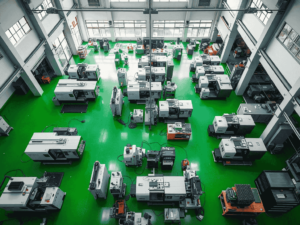
For machine parts manufacturing, volume and consistency become the priority. This requires statistical process control, PPAP documentation, and a supplier with capacity to run to 1,000,000+ identical parts without dimensional drift. MW+ operates 60+ multi-axis machines from its 15,000 m² Shenzhen facility to deliver exactly this.
The CNC Machining Process — From CAD File to Finished Part
Understanding what happens between submitting your file and receiving your parts helps you set realistic timelines, write better specs, and avoid costly surprises. Here’s every step — explained for buyers, not engineers.
-
1CAD File Review & DFM AnalysisYou submit a 3D CAD file (STEP, IGES, or SolidWorks) with a 2D drawing specifying tolerances, surface finish, and material. The supplier runs a DFM (Design for Manufacturability) check — identifying features that are impossible, expensive, or risky to machine as-designed. A good supplier delivers this feedback free of charge within 24 hours. MW+ does.
-
2Quoting & Material SourcingOnce the design is confirmed, you receive a quote covering material, machining time, finishing, and shipping. The raw material — billet aluminum, steel bar, titanium block — is sourced and certified. Full material traceability certificates are issued for aerospace and medical orders.
-
3CAM ProgrammingA CAM programmer generates the G-code — the precise instructions telling the CNC how fast to cut, at what angle, and to what depth. This defines tool paths, feeds, and speeds for every feature on your part. Invisible to buyers, it’s the step that separates precision results from expensive scrap.
-
4Workpiece Setup & FixturingRaw material is secured in a fixture on the machine. Fewer setups mean better accuracy (no re-fixturing error) and lower cost. For complex parts, MW+ engineers design dedicated fixtures to eliminate repositioning entirely — a critical quality advantage on tight-tolerance assemblies.
-
5Machining — Milling, Turning, or BothThe CNC executes programmed tool paths. Milling uses rotating cutters on a fixed workpiece; turning rotates the workpiece against a stationary tool. Complex parts use mill-turn centers that combine both in a single setup. In-process measurements are taken throughout to catch deviations before they become scrap.
-
6Surface FinishingPost-machining finishing enhances appearance, corrosion resistance, or wear performance. Options include anodizing, passivation, electroplating, powder coating, bead blasting, and precision polishing. Finishing is quoted separately and adds 1–5 days to lead time depending on the process.
-
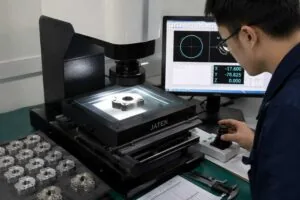
7CMM Inspection & Quality DocumentationEvery part is verified on a CMM (Coordinate Measuring Machine) to confirm critical dimensions are within tolerance. For aerospace and medical orders, First Article Inspection Reports (FAIRs), material certifications, and PPAP documentation are provided. You receive a full quality package with every shipment.
-
8Packaging & Global ShippingParts are cleaned, individually protected, and packed to prevent transit damage. International shipments leave via DHL, FedEx, UPS, or sea freight depending on quantity and timeline. All shipments are tracked and insured. MW+ ships to 50+ countries with a 99% on-time delivery rate.
How to Choose a Supplier for CNC machining services
The global CNC machining market is enormous, and the gap between the best and worst suppliers is enormous. Use this checklist to separate certified manufacturing partners from cheap-quote risks.
Axis capability: Confirm 5-axis is simultaneous, not just indexed. For complex parts, this distinction determines whether you get one accurate setup or multiple error-compounding repositions.
QC documentation: Request a sample CMM report and First Article Inspection Report before placing your order. If a supplier can’t produce one on request, they lack the quality infrastructure for critical parts.
DFM feedback: Any supplier that quotes without reviewing your design for manufacturability is a risk to your timeline and budget. DFM review is a non-negotiable for complex or high-value orders.
Scalability: Your prototype supplier should be able to handle your production order under the same quality system. Switching suppliers mid-product-lifecycle is expensive and resets your qualification process.
MW+ holds ISO 9001:2015, AS9100D, ISO 13485, IATF 16949 and NADCAP approval from its Shenzhen facility, covering every major regulated industry:
Read the full list of CNC machining capabilities, and see how parts are verified and documented under CNC machining quality control. Every shipment includes a certificate of conformance, a CMM inspection report and material certificates; first article inspection to AS9102 and PPAP Level 3 are quoted per programme. If what you need is the purchasing workflow itself rather than the cost and material questions covered here, the companion guide on how to buy CNC machining walks through RFQ, qualification and release. When the drawing is ready you can request a CNC machining quote.