CNC Machining Lead Times:
The Data-Driven Playbook
for Faster Delivery
For engineers and procurement teams, CNC machining lead time is one of the most misunderstood variables in a product development cycle. Most teams treat it as a fixed constant—something only the shop controls. In reality, the majority of lead time is determined by decisions made before the order is placed: material selection, tolerance callouts, finish requirements, and CAD file quality. This guide puts hard numbers behind every stage so you can plan accurately, act strategically, and cut delivery time on your next order for CNC machining services.
What Does CNC Machining Lead Time Actually Include?
Lead time begins the moment you submit a design file or RFQ and ends when finished parts arrive at your facility. It travels through eight distinct production stages—and the non-machining portions routinely take up more of the calendar than the cutting does. A part with three hours of spindle time can still spend a fortnight in the pipeline because of sourcing, revision loops and a finishing queue.
Our integrated machining and finishing workflow is arranged to compress each stage, but the design decisions made upstream matter just as much. For a part-by-part view, see how lead times compare across different CNC machine parts. The breakdown below shows where the time actually goes, and where it is most recoverable.
Stage-by-Stage Lead Time Breakdown
The ranges below are planning guidance, not a quotation. “Fast” assumes ideal conditions, “Typical” is the common case, and “Slow” is what happens when friction compounds at that stage. A real date is confirmed against the actual schedule when the order is placed.
| # | Stage | Fast | Typical | Slow | Primary Delay Trigger |
|---|---|---|---|---|---|
| 01 | CAD Review & DFM | 4 hrs | 1–2 days | 3–5 days | Multiple revision loops; ambiguous tolerances |
| 02 | Material Sourcing | 0 days | 1–4 days | 7–15 days | Exotic alloy not stocked; external PO required |
| 03 | CNC Programming & Setup | 2 hrs | 1–3 days | 4–6 days | Complex 5-axis toolpath; custom fixture design |
| 04 | Machining Operations | 1 day | 2–5 days | 6–14 days | Multi-setup part; shop queue; ultra-tight tolerances |
| 05 | Surface Finishing | 0 days | 2–5 days | 7–12 days | Outsourced anodizing or plating at capacity |
| 06 | Quality Inspection | 2 hrs | 1–2 days | 2–4 days | CMM queue; first article report requirement |
| 07 | Packaging & Labeling | 2 hrs | 4–8 hrs | 1–2 days | Custom protective packaging for fragile geometry |
| 08 | Freight & Transit | 1 day | 2–4 days | 4–7 days | Ground shipping to remote locations; customs |
What Drives CNC Lead Times?
Not all delays are equal. The ranking below is a qualitative one: it reflects where delay most often originates on a machining order rather than a measured average. Material sourcing and drawing quality sit at the top, and both are almost entirely inside the buyer’s control.
- 1Material availability. A grade held on the rack starts machining as soon as the programme is released. A non-stock alloy waits on a mill order first, and that wait is usually the longest single block in the schedule.
- 2Surface finishing. Anodising, plating and passivation are queue-driven. Where the process is outsourced, the part also makes two extra freight journeys before it is finished.
- 3CAD and drawing quality. Missing GD&T, a 2D drawing that disagrees with the 3D model, or an undefined finish stops the job at engineering review and starts a revision loop.
- 4Part complexity. Every extra setup adds its own programming, fixture and inspection step, and each of those is somewhere the schedule can slip.
- 5Tolerance band. Tighter than the ±0.01 mm general band of ISO 2768-1:1989 means lighter cuts, more in-process gauging and often a CMM slot rather than a hand gauge.
- 6Shop queue. Capacity at the moment the order lands. This is the one variable a buyer cannot see from outside, and the reason a confirmed schedule is worth more than a quoted minimum.
- 7Order quantity. Quantity moves the machining hours but rarely the critical path, because programming and setup are paid for once either way.
Material Speed Reference: Stock vs. Special-Order Lead Times
Choosing your material is the fastest single variable you can control before submitting a job. In-stock materials add zero sourcing time. Special-order alloys can add more than two weeks before a single chip is cut. The table below reflects sourcing times from our standard material inventory.
| Material | Grade / Spec | Sourcing Time | Machinability | Common Applications | Availability |
|---|---|---|---|---|---|
| Aluminum | 6061-T6 | 0 days | Excellent | Enclosures, brackets, prototypes | In Stock |
| Aluminum | 7075-T651 | 0 days | Very Good | High-strength aerospace, drones | In Stock |
| Stainless Steel | 303 | 0 days | Good | Shafts, fittings, fasteners | In Stock |
| Stainless Steel | 316L | 0–2 days | Moderate | Medical, marine, chemical | In Stock |
| Cold-Rolled Steel | 1018 | 0 days | Excellent | Gears, shafts, structural | In Stock |
| Brass | C360 | 0–1 days | Excellent | Electrical, valves, fittings | In Stock |
| Delrin (POM) | Natural / Black | 0 days | Excellent | Bearings, guides, wear parts | In Stock |
| Stainless Steel | 17-4 PH H900 | 3–6 days | Moderate | High-strength, corrosion-resistant | Order |
| Tool Steel | A2 / D2 | 3–7 days | Difficult | Dies, molds, cutting tools | Order |
| PEEK | Unfilled / GF30 | 5–10 days | Good | High-temp thermoplastic, medical | Order |
| Titanium | Grade 5 (Ti-6Al-4V) | 7–14 days | Difficult | Aerospace, medical implants | Special Order |
| Inconel | 718 | 10–18 days | Very Difficult | Jet engines, high-temp parts | Special Order |
“The fastest orders we fulfill share one trait: the engineer chose an in-stock material, submitted clean files, and deferred finishing on the first prototype iteration.”
— MW+ Production EngineeringHow Do You Cut CNC Lead Time?
The measures below are ordered by how far they typically move a delivery date. Most need no design change at all — only better decisions before the file is sent. Our free DFM review process catches the most expensive issues before the order enters production.
| Strategy | Effort Required | Typical Effect | Who Benefits Most |
|---|---|---|---|
| Specify in-stock material | Low — design choice | Large | All order types |
| Submit complete STEP + 2D PDF | Low — documentation | Large | All order types |
| Skip cosmetic finish on prototypes | Low — defer decision | Large | Prototype / DVT orders |
| Bundle prototype + production PO | Medium — planning | Moderate | Teams with known volumes |
| Apply tight tolerances selectively | Medium — design review | Moderate | Precision / multi-feature parts |
| Use standard radii & thread sizes | Low — design choice | Small | Complex geometry |
| Consolidate DFM feedback to 1 round | Low — internal process | Moderate | Teams with slow approval loops |
| Communicate real (not padded) deadline | Low — communication | Small | Time-critical orders |
DFM Submission Checklist — What Ships Fast
- ✓STEP + 2D PDF together. The 3D model defines geometry; the drawing defines intent. Submitting both eliminates the single most common clarification request and goes straight to programming.
- ✓All critical tolerances explicitly called out. Don’t rely on title block defaults for functional features. If it matters for fit, form, or function—call it out with a GD&T symbol or bilateral limit.
- ✓Surface finish specified or noted “as-machined.” Undefined finishes require a phone call, and every clarification loop costs at least one working day across time zones.
- !Internal radii ≥ 1/3 of cavity depth. Tighter ratios require slow feed rates or specialty tooling. Widening radii where function allows is the fastest geometry change you can make, and it costs nothing.
- !No unnecessary undercuts. Every undercut requires an additional setup or a specialty cutter, plus the fixturing and inspection overhead that go with it.
- ✓Standard thread sizes only. M-series metric or UN/UNF imperial. Non-standard threads require a custom tap to be bought in before the feature can be cut at all.
CNC Lead Times by Order Quantity
Quantity has a non-linear relationship with lead time. Setup and programming are fixed costs that amortize across the batch, which means small one-off orders sometimes carry more overhead friction than mid-size runs. Understanding this helps you time your orders strategically.
| Quantity | Order Type | Typical Lead Time | Key Variable | Best Strategy |
|---|---|---|---|---|
| 1–3 pcs | One-off prototype | 2–7 days | DFM loop speed | Simplify geometry; defer finish |
| 4–10 pcs | Design verification | 4–10 days | File quality | Bundle with production intent PO |
| 11–50 pcs | Pilot / bridge run | 6–14 days | Fixture amortization | Lock design; include finishing |
| 51–250 pcs | Small production | 10–15 business days | Machine scheduling | Order early; confirm material stock |
| 251–1,000 pcs | Mid-volume run | 10–15 business days | Capacity planning | Discuss dedicated machine block |
| 1,000+ pcs | High-volume / blanket | Scheduled releases | Material & QC scale | Blanket PO with scheduled releases |
How Part Complexity Multiplies Total Shop Time
Complexity doesn’t scale linearly—it multiplies across programming, fixturing, machining, and inspection simultaneously. The table below gives indicative shop time across four complexity tiers for a representative enclosure-style part in aluminium 6061 run on multi-axis machining centres. Treat it as a planning aid, not a quotation.
| Complexity | Typical Features | Setups | Machining | Programming | Inspection | Total Shop Time |
|---|---|---|---|---|---|---|
| Simple | Prismatic, 2D features, 1 face | 1 | 0.5–1 hr | 30 min | 15 min | ~2 hrs |
| Moderate | Pockets, holes, 2 faces, std tolerances | 2 | 2–4 hrs | 1–2 hrs | 30 min | ~6 hrs |
| Complex | Contoured surfaces, tight tols, 3–4 faces | 3–4 | 6–12 hrs | 3–6 hrs | 1–2 hrs | ~18 hrs |
| Highly Complex | 5-axis, deep pockets, undercuts, CMM req. | 5+ | 12–30 hrs | 8–16 hrs | 3–5 hrs | ~50 hrs |
A highly complex part does not merely take longer. It raises the probability of a setup error, a tolerance miss or a first-article rejection, and each of those means rework before anything ships. Design simplification is the only lever that reduces lead time, cost and defect risk at the same time.
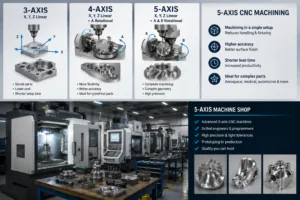
Where a part is genuinely complex the axis count matters more than the feed rate; our comparison of 3-axis vs 5-axis CNC machining sets out when the extra setups disappear and when they do not. For parts that are geometrically simple but tightly toleranced, CNC precision parts production is usually the faster route.
Frequently asked questions
Can you commit to a date before you have seen the drawing?
Not a firm one. A quotation comes back within 24 hours of a complete RFQ package and the schedule is confirmed with it. Before the model and drawing are in hand, any date is a guess about material availability and setup count, and those two variables decide most of the calendar.
What is the fastest realistic turnaround for a prototype?
Three to five business days is the standard prototype window, with a 48-hour express route for simple geometry in a stocked material. Express buys machine time; it does not shorten anodising or plating, so a cosmetically finished prototype is rarely an express job.
Why does a volume order take longer than the prototype?
Not much longer per part — longer in total, because the batch has to be scheduled, inspected and packed as a batch. Volume production runs 10 to 15 business days once the design is frozen. The prototype is quicker because it is one setup and one inspection rather than fifty.
Does loosening a tolerance shorten the schedule, or only the price?
Both, but not by a fixed amount, and anyone quoting you a percentage is guessing. A looser band allows heavier cuts, fewer gauging stops and hand measurement instead of a CMM queue. The effect is largest on parts where a tight band was applied to every feature instead of only the mating ones.
Is it worth paying to expedite when the material is not in stock?
Usually not. Expediting buys machine time, and machine time is not the constraint while the bar is still at the mill. The better move is to ask which grades are on the rack and whether one of them meets the requirement. A 6061 bracket that ships this week generally beats a 7075 bracket that ships in three.
How do I stop revision loops eating the schedule?
Send a STEP file and a dimensioned 2D drawing together, state the general tolerance class on the drawing, and name the surface finish even when the answer is as-machined. Those three things remove most of the questions that stop a job at engineering review. Our guide to requesting a CNC machining quote covers the rest of the package.
Final Recommendations
CNC machining lead time is not one number—it’s the sum of eight production stages, each shaped by decisions made long before the order is placed. The data across this guide points to a consistent pattern: the engineers who consistently receive parts fastest control the upstream variables.
Specifying a stocked material removes the longest single wait in the schedule. Sending a clean STEP file with a dimensioned drawing removes the revision loop. Deferring a cosmetic finish on the first prototype removes the finishing queue. All three decisions are made before the order is placed, and none of them changes a critical dimension. For production quantities held to a tight band, CNC precision parts and custom machine parts are the relevant routes.
For production quantities the calculus shifts to early planning, blanket PO structures, and working with a shop that keeps material on the rack and finishing in the same building. When the files are ready you can request a CNC machining quote: a complete package is quoted within 24 hours, and there is no minimum order quantity.