Affordable CNC Machining & CNC Prototyping:
High Precision Without the High Cost
Everything buyers need to know before sourcing CNC machining services — from first prototype to full production run.
If you’ve been told that CNC machining services are out of budget for low volumes or early-stage prototypes, it’s time for a second opinion. The right CNC machining services partner can deliver tight tolerances, certified materials, and production-ready parts — at a price point that makes commercial sense for your project. This guide walks you through everything you need to make a confident, cost-effective sourcing decision.
What Buyers Should Expect From a Quality CNC Machining Partner
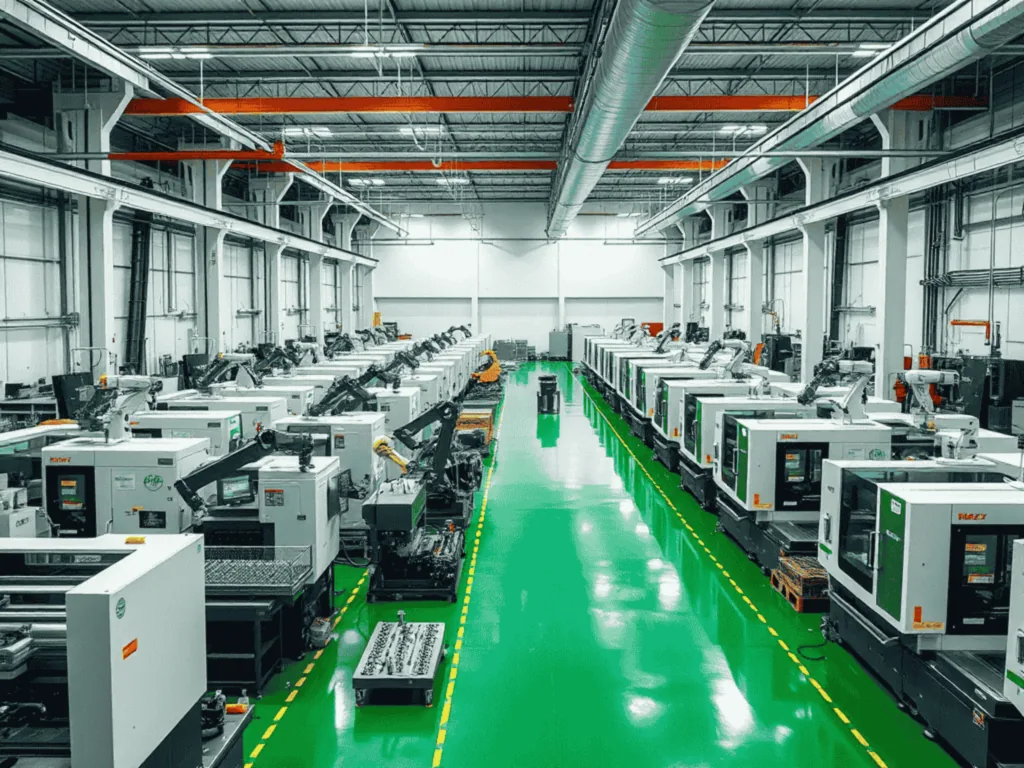
Before selecting a CNC machining provider, buyers must evaluate both equipment capability and operational rigor. The best shops combine high-speed 5-axis mills with experienced programmers who understand how to minimize cycle times while holding GD&T callouts. This balance ultimately translates into per-part affordability and consistent quality across orders.
- Fast, itemised quoting — A complete RFQ package should come back within 24 hours. A slow quoting process usually signals slow production.
- Certified quality system — ISO 9001:2015 or equivalent. Every precision CNC machining supplier you work with should operate under a documented QMS.
- Material traceability — Mill certificates and material certs should accompany every order, not just aerospace or medical runs.
- DFM (Design for Manufacturability) feedback — A good machining partner flags design issues before cutting begins, saving you money and lead time.
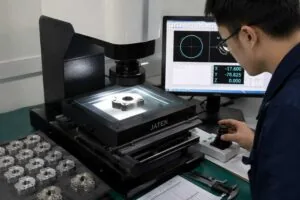
- In-house inspection — CMM, optical comparators, and surface profilometry on-site ensures your CNC machining parts ship to specification every time.
Beyond machine capability, a quality-focused partner provides comprehensive support including tool path optimization, custom fixturing strategies, and first article inspection reports. Investing in the right relationship early reduces long-term supply chain friction and ensures repeatability across production runs.
Why “Affordable CNC Machining” Doesn’t Mean Cutting Corners
The biggest misconception in manufacturing sourcing is that lower cost equals lower quality. In reality, cost efficiency in CNC machining services comes from operational excellence — smarter scheduling, multi-axis capabilities that reduce setups, and digital workflows that eliminate manual overhead. Quality stays the same. The margin that used to pay for inefficiency disappears.
By focusing on waste elimination—whether idle spindle time, redundant setups, or inefficient tool selection—the actual production cost drops while maintaining ISO 9001-aligned quality controls. As a result, customers benefit from consistently tight tolerances and reliable delivery windows without paying premium for overhead-heavy operations.
- Engineering review instead of a sales funnel: Your CAD file goes to an applications engineer who returns a line-item breakdown within 24 hours, so the first answer you get is one you can plan against.
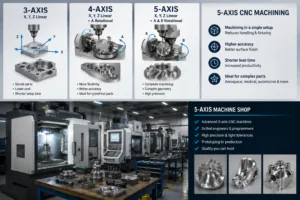
- 5-axis machining centres: Parts that would otherwise need three or four setups are completed in one, which removes the fixturing, handling and re-datuming each extra setup carries. Our comparison of 3-axis vs 5-axis CNC machining sets out when that trade actually pays.
- Scheduling across 60+ machining centres: A machine pool of that size means a job is matched to the right spindle rather than queued behind the wrong one, which is where most idle time is actually lost.
- Stored CNC programmes: A repeat order is re-run from the archived programme and fixture rather than programmed again from the model.
- Vertical integration: In-house deburring, anodizing prep, and inspection eliminates the outsourcing markup that third-party shops pass on to you.
CNC Prototyping: The Fastest Path From Design to a Working Part in Your Hands
There is no substitute for holding your design in the actual production material. CNC prototyping gives engineers and product teams exactly that — a functional, dimension-accurate part machined from the same alloy or polymer specified for full production, available in 3 to 5 business days as standard, or 48 hours on the express route.
Unlike 3D printing, which creates layer-bonded approximations of your geometry, rapid CNC prototyping delivers parts with isotropic material properties, genuine surface finishes, and tolerances that match your production drawings. When you’re validating a fit check, performing a load test, or presenting to stakeholders, a CNC prototype is the only prototype that tells the whole truth about your design.
Rapid CNC Prototyping
- Parts from actual production material
- Tolerances to ±0.01 mm
- 3–5 business day standard turnaround
- DFM review included at no charge
- 1 to 50 parts per run
- No minimum order quantity
When to Choose CNC Prototyping
- Functional load or stress testing
- Assembly fit and clearance validation
- Investor or customer demonstrations
- Pre-production design freeze approval
- Regulatory / certification testing
- Bridge production before tooling
Moreover, rapid CNC prototyping supports iterative development: if a design requires refinement after initial testing, modifications are straightforward. Because the part is machined from solid stock, design changes are implemented without the complexity of altering molds or printed part parameters, giving engineers unmatched agility.
CNC Machining vs. CNC Prototyping: A Buyer’s Side-by-Side Comparison
Both services use the same core technology, but serve distinct stages of your product’s lifecycle. Use this reference table to determine the right service for your current project phase:
| Criteria | CNC Machining (Production) | CNC Prototyping |
|---|---|---|
| Primary Purpose | Delivering final-spec production parts at volume | Validating design before committing to production |
| Typical Order Quantity | 1 – 1,000,000+ units, no MOQ | 1 – 50 units |
| Lead Time | 10 – 15 business days | 3 – 5 business days (48-hour express) |
| Achievable Tolerance | ±0.005 mm (production grade) | ±0.01 mm to ISO 2768-m |
| Cost per Part | Lower at higher volumes | Higher per-unit; far lower overall project risk |
| Material Scope | Full range incl. exotic alloys, PEEK, titanium | Aluminum, stainless steel, brass, engineering plastics |
| DFM Feedback | Available on Request | Always Included |
| Inspection Report | Included Standard | Included Standard |
| Best Suited For | Production runs, repeat orders, bridge production | R&D, design validation, investor demos, pre-production |
For projects in early development, CNC prototyping is often the more economical choice overall, despite higher per-unit costs, because it prevents expensive tooling or production errors. Meanwhile, high-volume production benefits from economies of scale—optimized toolpaths, batch processing, and reduced inspection overhead per part. The key is aligning the service to the product lifecycle stage.
Aluminum CNC Machining: The Highest Value Starting Point for Most Buyers
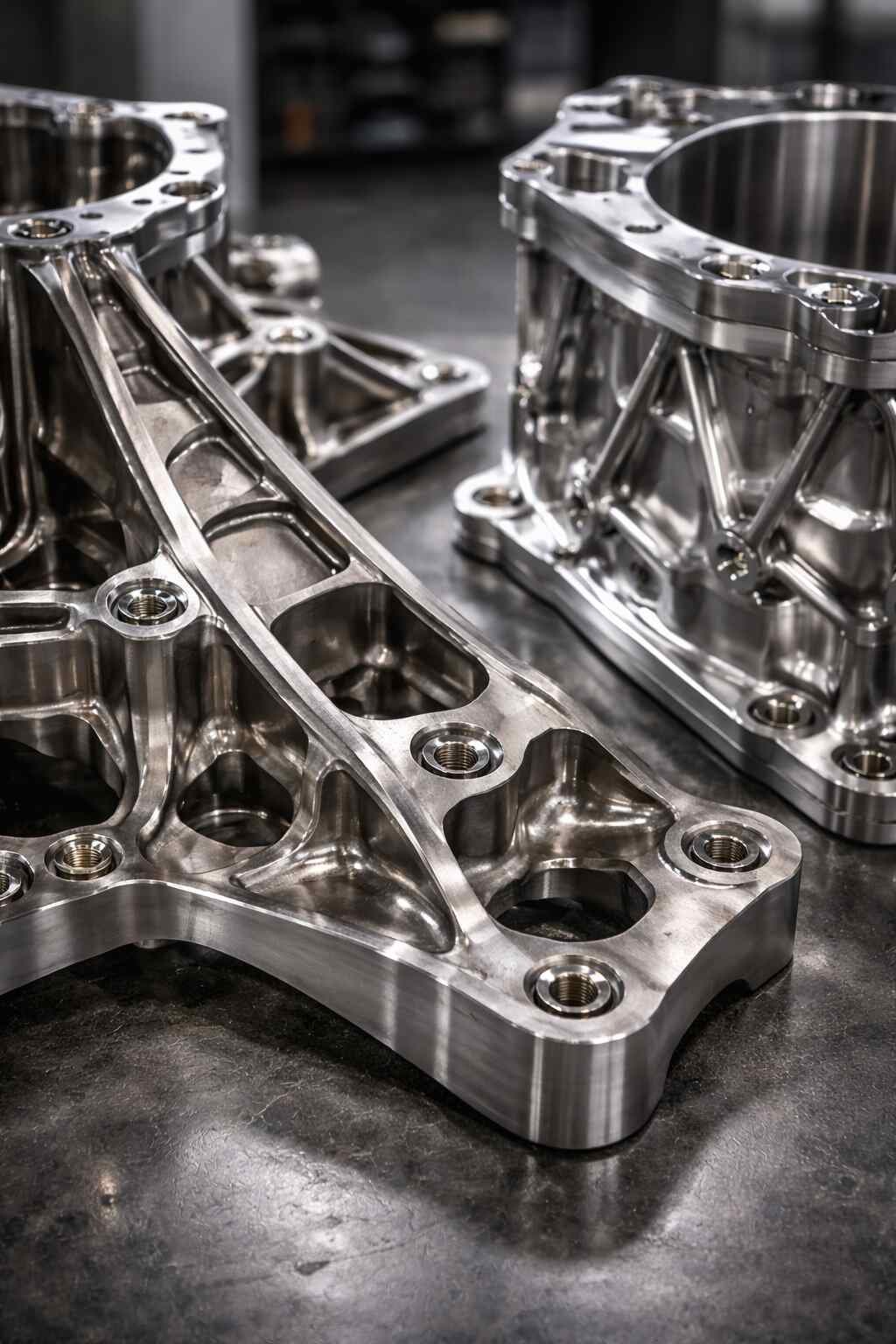
If you’re sourcing custom CNC machining for the first time — or optimizing costs on an existing product — aluminum CNC machining is almost always the most commercially intelligent starting point. Aluminium alloys carry a far higher machinability rating than low-carbon steel, which means faster cycle times and lower tool wear — and that difference shows up directly in what the part costs to make.
Why Aluminum Machines Faster
- Much higher machinability rating than low-carbon steel
- Lower cutting forces = less tool wear
- Higher feed rates reduce cycle time
- Excellent chip evacuation properties
- Anodizable for premium surface finish
- Lightweight: ideal for weight-critical designs
Common Aluminum Grades We Machine
- 6061-T6 — General purpose, structural
- 7075-T6 — High-strength aerospace
- 2024 — Fatigue-resistant applications
- 5052 — Marine / corrosion environments
- MIC-6 — Precision tooling & fixture plates
- 6063 — Architectural & extruded profiles
Beyond material selection, aluminum offers excellent thermal conductivity and corrosion resistance when anodized. For parts requiring cosmetic surfaces—such as enclosures, consumer-facing brackets—aluminum CNC machining paired with Type II or Type III anodizing delivers a durable, premium finish at a fraction of the cost of stainless steel.
Buyer’s Guide: 7 Ways to Lower Your CNC Machining Cost Without Changing Suppliers
Beyond design adjustments, working with a partner that offers transparent pricing and DFM support removes cost before it is ever quoted. The seven points below are the ones that change a quotation most often. None of them requires changing supplier, and none of them requires giving up a functional requirement.
- Design internal radii to match standard end-mill sizes. Corner radii of 1 mm, 2 mm, 3 mm, or 4 mm allow standard tooling. Non-standard radii require special tool purchases — and that cost appears in your quote.
- Only specify tight tolerances where functionally required. Applying ±0.005 mm tolerances across a whole drawing when only one feature requires it adds significant inspection time to every part.
- Minimize the number of part setups. Every re-fixturing is non-cutting time that still has to be paid for, and it is also where datum error creeps in. Designs reachable from two or fewer directions machine in a fraction of the time that highly complex multi-sided parts take.
- Start with aluminum, upgrade material later. Validate your design geometry in aluminum CNC machining before moving to steel or titanium. An aluminium prototype is cheaper to run and will still expose almost every geometry and assembly problem the production material would.
- Order 5 prototypes instead of 1. Setup and programming are paid once whatever the quantity. Spreading them across five units in rapid CNC prototyping rather than one lowers the cost of each part and leaves you spares for destructive testing.
- Submit clean STEP or IGES files. Files with geometry errors or ambiguous features require engineering time to interpret. That time is billed. A clean CAD model gets to production faster and cheaper.
- Plan your production schedule in advance. Rush-order premiums exist at every CNC machining services provider. Releasing the order a few days earlier usually removes the surcharge altogether, and our breakdown of how to reduce CNC lead time shows where those days are hiding.
Consolidating multiple part numbers with a single custom CNC machining supplier — rather than splitting between several vendors — typically unlocks volume pricing, faster communication, and lower per-shipment administrative costs. Request a blanket order agreement for recurring parts to lock in pricing and lead times.
Industries That Trust MW+ for CNC Machining Parts
Our CNC machining parts and CNC prototyping services are specified across demanding sectors where dimensional accuracy, material integrity, and on-time delivery directly affect product performance and customer commitments:
Aerospace & Defense
Flight-critical components machined to AS9100 standards with full material traceability
Medical Devices
Surgical instruments and implant fixtures to ISO 13485, with biocompatible material certs
Automotive & Motorsport
Engine components, brackets, and structural parts for OEM and aftermarket applications
Consumer Electronics
Aluminum enclosures, heatsinks, and structural frames with tight cosmetic tolerances
Industrial Equipment
Custom machine parts for pumps, valves, actuators and automated systems
Energy & Power
Components for renewable energy systems, oil & gas, and power generation equipment
Each of these industries demands specific certifications, documentation and material sourcing. MW+ holds ISO 9001:2015, AS9100D, ISO 13485, IATF 16949 and NADCAP approval. Every order ships with a certificate of conformance, a CMM inspection report and material certificates; first article inspection to AS9102 and PPAP Level 3 are quoted per programme, and capability studies are run to Cpk ≥1.67 where the drawing calls for them.
How Our CNC Machining Process Works: From File Upload to Delivery
We’ve designed our workflow to remove every friction point that delays your order and adds to your cost. Here is exactly what happens when you place an order with MW+:
Upload Your CAD File & Configure Your Order
Send your STEP, IGES, DXF, DWG, SolidWorks or PDF files together with the material, tolerance class, surface finish and quantity you need. Anything ambiguous is raised at this point rather than after the first cut.
Receive an Itemised Quote Within 24 Hours
A complete package is quoted within 24 hours, broken out by material, machining time, inspection and any post-processing, so you can see which line to attack if the number is wrong.
DFM Review & Order Confirmation
Our applications engineers review your design for manufacturability and flag any issues that could affect cost, lead time, or function — before a single chip is cut.
Precision Machining & In-Process Inspection
Your CNC machining parts are programmed, fixtured, and machined to specification. Critical dimensions are verified in-process using calibrated gauging and CMM.
Final Inspection, Documentation & Dispatch
Every part undergoes final dimensional inspection. Material certs, inspection reports, and packing lists ship with your order. Tracking provided at confirmation.
Our quality management system tracks each part from raw material receipt to final packaging. We maintain a library of cutting tools, fixtures, and inspection protocols to ensure repeatability across order runs, whether you require a single prototype or recurring production batches.
Frequently asked questions
Does a lower quote mean a thinner specification?
It should not, and the way to check is to compare what the two quotations include rather than the totals. Ask whether the CMM inspection report, the material certificate and the certificate of conformance are in the price or added later. A quotation that is cheap because the inspection has been removed is not cheaper; it has simply moved the cost to whoever finds the problem.
Is there a minimum order quantity?
No. A single prototype is a legitimate order, and the same programme can later run to 1,000,000+ units. What changes with quantity is the share of setup and programming carried by each part, not the willingness to take the job.
Should I prototype in the production material or in aluminium?
Prototype in the production material whenever the test is about strength, fatigue, thermal behaviour or regulatory approval, because an aluminium stand-in will not tell you the truth about any of those. Prototype in aluminium when the question is about geometry, fit and assembly, which is most first iterations.
Will a repeat order be quoted the same way?
A repeat of an unchanged part re-runs from the archived programme and the existing fixture, so the engineering work is not repeated. What can move is the material, since bar stock is bought on the open market. Ask for the quotation to separate material from machining and the repeat comparison becomes straightforward.
Is it cheaper to split parts across several suppliers?
Rarely, once the administrative cost is counted honestly. Each additional supplier means another qualification, another set of inspection conventions, another shipment and another round of emails at every revision. Consolidating a family of parts with one supplier usually wins on total cost even where a single line item looks better elsewhere.
When is affordable machining the wrong call?
When the part is flight-critical, implantable or safety-related and the programme depends on qualification paperwork rather than unit price. In that case the right question is which supplier can produce the AS9102 first article and the PPAP package on schedule, and price is decided only after that list is short.