Engineering polymers get specified for three reasons metals cannot cover: they do not corrode, they do not conduct, and they weigh about a fifth of steel. PEEK sits at the top of that family, and it is also the one most often specified when a cheaper polymer would have done the job.
This article covers PEEK CNC machining as an engineering and procurement decision: how PEEK and its filled grades actually behave, how they compare with PEI, PAI, POM, PTFE and PPS on measurable properties, what makes a polymer part expensive to machine to tolerance, and where PEEK is the wrong answer.
Key takeaways
- PEEK has a glass transition around 143 °C and melts around 343 °C, giving a continuous service temperature near 250 °C — well above PEI, POM and most other machinable thermoplastics.
- Its coefficient of thermal expansion, roughly 45–55 µm/m·K unfilled, is around four times that of steel. On a 25 mm feature an 8 °C difference between shop and inspection room shifts the dimension by about 9 µm, which is worked through below.
- All published dimensional specifications refer to 20 °C under ISO 1. For polymers that reference is not a formality — it is the difference between conforming and not.
- Implant-grade PEEK is specified to ASTM F2026 and carbon-fibre-reinforced implant grades to ASTM F3333, with biological evaluation under ISO 10993-1. A generic “PEEK” callout is not an implant specification.
- Carbon-fibre-filled PEEK roughly doubles tensile strength and multiplies stiffness several times, but the fibre is abrasive and pushes tooling cost up sharply.
- MW+ machines more than 70 materials including PEEK and its filled grades, holds ISO 13485 alongside ISO 9001:2015 and AS9100D, and returns a quotation within 24 hours.
What this article covers
- Why is PEEK specified, and when is it over-specified?
- How does PEEK compare with other machinable engineering polymers?
- PEEK grades: unfilled, glass-filled, carbon-filled and bearing
- Worked calculation: thermal expansion and the tolerance you can hold
- What makes a polymer part hard to machine to tolerance?
- What actually drives the cost of a machined PEEK part?
- Which standards should appear on a PEEK drawing?
- When PEEK is the wrong choice
- Frequently asked questions
Why is PEEK specified, and when is it over-specified?
PEEK is a semi-crystalline thermoplastic in the polyaryletherketone family. The properties that earn its price are a high glass transition temperature, resistance to almost all organic solvents, low outgassing, good hydrolytic stability in steam, inherent flame resistance and biocompatibility in implant grades. It is also machinable in bar and plate form, which is why it appears in one-off and low-volume parts where injection moulding cannot be justified.
It is over-specified when the requirement is merely “a strong plastic”. PEI reaches around 170 °C of continuous service at a fraction of the material cost; POM is stiffer than PEEK per unit cost at room temperature and machines beautifully; PPS covers much of PEEK’s chemical resistance at lower temperature. The honest test is whether the part actually sees the temperature, the chemistry or the regulatory requirement that PEEK exists to satisfy.
How does PEEK compare with other machinable engineering polymers?
Table 1 — Machinable engineering polymers, typical published properties
| Polymer | Continuous service temp (°C) | Tensile strength (MPa) | Tensile modulus (GPa) | Density (g/cm³) | Notable property |
| PEEK, unfilled | ≈250 | ≈90–100 | ≈3.6–4.0 | ≈1.30 | Steam and solvent resistance; implant grades available |
| PAI (Torlon) | ≈250 | ≈150–190 | ≈4.5–5.0 | ≈1.42 | Highest strength of the group; needs post-cure |
| PEI (Ultem) | ≈170 | ≈100–110 | ≈3.2–3.6 | ≈1.27 | Transparent, dimensionally stable, lower cost than PEEK |
| PPS | ≈200–220 | ≈65–90 | ≈3.5–4.0 | ≈1.35 | Excellent chemical resistance; brittle when unfilled |
| POM (Delrin, acetal) | ≈90–100 | ≈65–70 | ≈2.8–3.1 | ≈1.41 | Best machinability in the group; poor acid resistance |
| PTFE | ≈260 | ≈20–35 | ≈0.4–0.6 | ≈2.16 | Lowest friction; creeps under sustained load |
| PVDF | ≈150 | ≈45–55 | ≈2.0–2.4 | ≈1.78 | Chemical service, high purity fluid handling |
| Nylon (PA66) | ≈100 | ≈70–85 | ≈2.8–3.3 | ≈1.14 | Cheap and tough; absorbs moisture and moves |
Typical published values for unfilled grades at room temperature; tensile data per ISO 527-2 conditions. Exact values vary by supplier grade and form. Property data from MatWeb and manufacturers’ published datasheets.
Two entries deserve comment. PTFE has outstanding chemistry and the worst mechanical behaviour in the table: it is soft, creeps under sustained load and is dimensionally unstable, so tight tolerances on PTFE are a specification problem before they are a machining problem. Nylon looks attractive on strength per cost until moisture absorption is considered — it takes up water and grows, which is why it is a poor choice wherever a dimension must hold.
PEEK grades: unfilled, glass-filled, carbon-filled and bearing
Table 2 — PEEK grade families
| Grade family | Typical tensile strength (MPa) | Typical tensile modulus (GPa) | Thermal expansion (µm/m·K, below Tg) | Best suited to | Machining note |
| Unfilled (natural / 450G type) | ≈90–100 | ≈3.6–4.0 | ≈45–55 | Chemical, electrical, implant and food-contact work | Most forgiving; watch heat and stress |
| 30% glass fibre | ≈150–170 | ≈9–11 | ≈20–25 | Static structural parts, higher temperature stiffness | Abrasive; glass wears edges quickly |
| 30% carbon fibre | ≈200–240 | ≈20–24 | ≈12–18 | Stiff structural parts, implants to ASTM F3333 | Highly abrasive; diamond-coated or PCD tooling |
| Bearing grade (carbon / PTFE / graphite) | ≈100–130 | ≈6–8 | ≈25–35 | Unlubricated bearings, seals, wear rings | Softer but abrasive; chip control matters |
Indicative ranges across commercial grades; confirm against the specific supplier datasheet for the lot being machined.
The important trade in that table is not strength but expansion. Filling PEEK with carbon fibre reduces its thermal expansion by roughly two-thirds, which brings it close to aluminium and makes tight tolerances far more realistic across a temperature range. That is often the real reason a filled grade is chosen, and it is rarely the reason stated on the drawing.
Worked calculation: thermal expansion and the tolerance you can hold
Under ISO 1, every dimension on a drawing refers to the part at 20 °C. For steel that convention is usually ignorable; for PEEK it is not. The following inputs are assumed to make the arithmetic concrete.
Given: a bore of nominal 25.000 mm in unfilled PEEK with a coefficient of thermal expansion of 47 µm/m·K. The tolerance is ±0.010 mm. The machine shop runs at 28 °C, the metrology room at 20 °C, and the part is used at 90 °C.
Step 1 — The formula. ΔL = L × α × ΔT, with L in metres, α in µm/m·K and ΔT in kelvin.
Step 2 — Shop floor against the reference temperature. ΔT = 28 − 20 = 8 K. ΔL = 0.025 m × 47 µm/m·K × 8 K = 9.4 µm. The bore machined to exactly 25.000 mm on the floor measures about 24.991 mm once it has equalised at 20 °C in the metrology room — already at the bottom of a ±0.010 mm band before any process variation.
Step 3 — Compare with steel. At 12 µm/m·K the same 8 K difference on the same feature gives 0.025 × 12 × 8 = 2.4 µm, comfortably inside the band. The material, not the machine, is what changed.
Step 4 — Service temperature. From 20 °C to 90 °C is 70 K. ΔL = 0.025 × 47 × 70 = 82 µm. The bore in service is about 25.082 mm — more than eight times the drawing tolerance. If it mates with a steel shaft, which grows by only 0.025 × 12 × 70 = 21 µm, the clearance opens by roughly 61 µm.
Step 5 — Convert into decisions. Three follow. First, state the inspection temperature on the drawing and let parts stabilise before measuring. Second, if the fit matters at temperature, dimension for the service condition and note it, rather than assuming 20 °C nominal will behave. Third, if neither is practical, move to a filled grade: at 15 µm/m·K the Step 4 figure falls from 82 µm to 26 µm.
This calculation is why polymer parts and metal parts with identical tolerance blocks are not equally difficult, and why a supplier who does not ask about service temperature has not understood the part.
What makes a polymer part hard to machine to tolerance?
Table 3 — Polymer machining failure modes and controls
| Problem | Cause | Effect on the part | Control |
| Thermal softening at the cut | Thermal conductivity around 0.25 W/m·K keeps heat in the cut | Smearing, poor finish, size drift | Sharp positive tooling, high feed, generous coolant or air blast |
| Stress relief after machining | Residual stress in extruded or moulded stock | Distortion after the part comes off the fixture | Annealed stock, rough then stress relieve then finish |
| Fixture deformation | Modulus around a twentieth of steel’s | Clamping pushes the part out of shape | Broad low-force clamping, vacuum or soft jaws |
| Edge abrasion from fillers | Glass and carbon fibre are abrasive | Rapid flank wear, drifting dimensions | Diamond-coated or PCD tooling, distance-based tool limits |
| Delamination and fibre pull-out | Dull edge in a fibre-filled grade | Fuzzy edges, exposed fibre, cosmetic reject | Retire the edge early; climb milling; sharp geometry |
| Chip welding and recutting | Long stringy chips in ductile grades | Scored surfaces, tool damage | Polished flutes, high helix, positive chip evacuation |
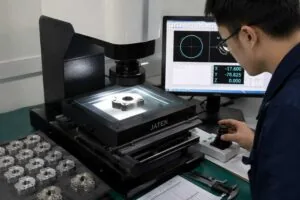
| Measurement error | Contact force deflects a soft surface | Apparently out-of-tolerance good parts | Low probing force or non-contact metrology, stabilised temperature |
The stress-relief row is the one that catches new buyers. A PEEK part can be in tolerance on the machine and out of tolerance the next morning because internal stress in the stock has redistributed. Annealed stock and a roughing-then-finishing split with a stabilisation step in between is the standard remedy, and it costs time that has to be in the quotation rather than discovered later. The measurement side of that problem is covered in our note on CMM inspection and first article inspection.
What actually drives the cost of a machined PEEK part?
Four things, roughly in this order. Stock cost and utilisation comes first: PEEK bar and plate are expensive per kilogram, so a design that machines 80% of the billet into chips is paying mostly for swarf. Nesting, near-net stock sizes and rethinking wall thicknesses move this line more than any cutting parameter.
Tooling comes second and only for filled grades. Unfilled PEEK is not hard on tools; 30% carbon fibre is, and it shifts the job into diamond-coated or polycrystalline diamond tooling. The mechanism is the same abrasive wear discussed in our article on CNC tool wear cost by material.
Process time comes third: stress relief cycles, stabilisation before inspection and lighter finishing passes all add hours that are invisible on the drawing. Documentation comes fourth and can exceed everything else on a regulated part, where material traceability to an implant specification, cleanliness validation and a first article report are the real deliverables.
Component families produced under those controls are listed under CNC precision parts, the equipment and process envelope under CNC machining services, and small-feature polymer work under micro machining services. MW+ holds general tolerances of ±0.01 mm to ISO 2768-m with a ±0.005 mm precision band, which on polymers is achievable only with the temperature control described above.
Which standards should appear on a PEEK drawing?
Table 4 — Standards relevant to machined PEEK parts
| Standard | Governs | When to cite it |
| ASTM F2026 | PEEK polymers for surgical implant applications | Any implantable or implant-contacting part |
| ASTM F3333 | Chopped carbon-fibre-reinforced PEEK for implants | Load-bearing implant components |
| ISO 10993-1 | Biological evaluation of medical devices | Any patient-contacting device, in a risk-management framework |
| ISO 13485 | Medical device quality management system | The supplier’s certification, not the material |
| ISO 527-2 | Tensile property test conditions for plastics | When quoting or verifying mechanical data |
| ISO 1 | Standard reference temperature of 20 °C | Every dimensioned polymer drawing |
| ISO 2768 | General tolerances where none is stated | To stop undimensioned features being interpreted loosely |
| ISO 21920-2 | Surface texture parameters | Whenever a finish is called out; name the parameter |
Certification of the supplier and specification of the material are different things, and buyers conflate them regularly — the distinction is set out in our comparison of ISO 9001, AS9100 and IATF 16949.
When PEEK is the wrong choice
When the temperature never justifies it. If the part lives below about 150 °C and sees no aggressive chemistry, PEI or PPS will usually do the same job for materially less, and POM will beat both on machining cost if the chemistry allows.
When the part is exposed to UV or concentrated acids. PEEK weathers poorly under prolonged ultraviolet exposure without pigmentation or coating, and concentrated sulphuric acid attacks it. Chemical resistance is not universal, and the specific service fluid has to be checked rather than assumed from the general reputation.
When stiffness is the requirement. Unfilled PEEK has a tensile modulus of roughly 4 GPa against about 70 GPa for aluminium. If the part must not deflect, a metal is often lighter in practice once the polymer section has been thickened enough to compensate — and where the application genuinely demands a metal in a biocompatible role, the comparison is with titanium, whose cost structure is set out in our article on titanium CNC machining cost.
When the volume justifies moulding. Machining is the right process for prototypes, low volumes and geometries a mould cannot produce. Past a few thousand pieces of a mouldable design, injection moulding of a PEEK compound changes the economics entirely, and continuing to machine is a decision that should be made deliberately rather than by default.
Frequently asked questions
What tolerance can realistically be held on a machined PEEK part?
General machining to ±0.05 mm is routine, and ±0.01 mm is achievable on stabilised, annealed stock with temperature-controlled inspection. Below that, the thermal and clamping effects described above dominate, and the meaningful question becomes at what temperature the dimension is to be verified. Always state that temperature rather than assuming the standard 20 °C reference will be met.
Is carbon-filled PEEK always better than unfilled?
No. It is stiffer, stronger and far more dimensionally stable with temperature, but it is abrasive to tooling, is not transparent to the same chemical and electrical arguments, is electrically conductive rather than insulating, and costs more in both stock and machining. Choose the filler for the property you need, not as a general upgrade.
Why do my PEEK parts change size after machining?
Residual stress in the stock redistributing once material is removed. Extruded bar in particular carries internal stress from its production. Specifying annealed stock, splitting roughing and finishing with a stabilisation period between them, and avoiding heavy single-side removal all reduce it. Where the geometry is unavoidably asymmetric, an intermediate anneal is the reliable answer.
Can PEEK be used for food-contact or medical parts?
Specific compliant grades exist for both, and the compliance belongs to the grade and its documentation, not to “PEEK” in general. For implants, specify to ASTM F2026 and require biological evaluation under ISO 10993-1. For food contact, require the supplier’s declaration for the specific grade and lot.
How should PEEK be specified on a purchase order?
Grade and filler content, stock form and condition (extruded or compression moulded, annealed or not), the applicable material specification where one exists, and the certification you require with the shipment. “PEEK” alone leaves the supplier to choose among grades whose properties differ by a factor of two.
Does PEEK machine faster or slower than aluminium?
Slower in practice, despite being softer. Cutting speed is limited by heat, not force: the polymer’s low thermal conductivity keeps heat at the cut and softens the material rather than carrying it away in the chip. Light depths of cut, sharp positive geometry and effective cooling matter more than spindle speed.
What documentation should arrive with a machined PEEK order?
A certificate of conformance tying the shipment to the drawing revision, a material certificate identifying the grade and lot, and a dimensional report stating the inspection temperature. Regulated parts add cleanliness and packaging validation plus a first article report. The underlying quality controls are described on our CNC machining quality control page.
How do I get a useful quotation for a polymer part?
Send the drawing with the grade and filler stated, the service temperature and chemistry, the tolerance scheme with its reference temperature, and the quantity. Request a CNC machining quote on that basis and the reply can state the stock form, stabilisation steps and inspection method rather than assuming them — which is where most of the price difference between suppliers actually lives.