Choosing a CNC machining supplier in China comes down to four verifiable things: whether the company owns the machines it quotes, whether its quality system is certified and current, whether it can hold your specific tolerances with evidence rather than assertion, and what documentation ships with every order. Everything else — responsiveness, presentation, price — is downstream of those four. This article gives you the questions to ask, the answers that indicate a real factory, and the answers that should end the conversation.
Key takeaways
- Ask for the certificate number and issuing body for every certification claimed, then verify it. A supplier that names ISO 9001:2015 without producing a current certificate has not been audited by anyone.
- MW+ holds general machining to ±0.01mm under ISO 2768-m, precision features to ±0.005mm and critical features to ±0.001mm, at a process capability of Cpk ≥1.67.
- MW+ is certified to ISO 9001:2015, AS9100D, ISO 13485, IATF 16949 and NADCAP. Each covers a different industry; none of them is a general guarantee of quality.
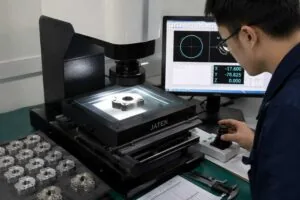
- Every MW+ order ships with a certificate of conformance, a CMM inspection report and material certificates. FAI to AS9102 and PPAP Level 3 are available on request and quoted per programme.
- The fastest factory-versus-trader test is a live, unscripted video walk of the shop floor showing your material on a machine, plus a business licence whose scope covers manufacturing.
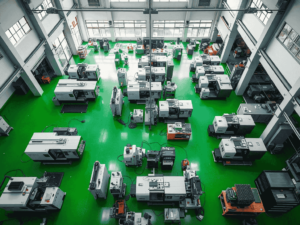
- MW+ operates a 15,000 m² facility in Guangming, Shenzhen, founded in 2015, with 60+ machining centres, 120+ engineering and quality professionals, 70+ material grades and customers in 50+ countries.
On this page
- What should you ask a CNC machining supplier in China?
- How do you tell a real factory from a trading company?
- Matching machine capability to your part
- Which certifications actually matter, and for what?
- What should ship with every order
- How do you protect your IP and your tooling?
- Sending an RFQ that produces comparable quotes
- When sourcing from China is the wrong choice
- Frequently asked questions
What should you ask a CNC machining supplier in China?
Ask ten questions, and judge the supplier on the specificity of the answers rather than their enthusiasm. A capable factory answers with certificate numbers, machine counts, named standards and documents it can send today. A broker answers with adjectives. The table below is the evaluation checklist, written so you can run it in a single call.
| What to ask | A good answer sounds like this | Red flag |
|---|---|---|
| Do you own the machines that will cut my part? | A machine count and types, and an offer to show them running | “We work with a partner factory” without naming it |
| Which certifications do you hold, and can I see the certificates? | Certificate numbers, issuing body and expiry dates sent unprompted | Logos on a website but no certificate produced |
| What tolerance can you hold on this specific feature? | A figure tied to the feature, plus how it will be verified | A single tolerance claimed for every part they make |
| What ships with the parts as standard? | Certificate of conformance, CMM report, material certificates | “We can provide reports if you need them” |
| How do you handle a part that fails inspection? | A containment, root-cause and corrective-action process | “That does not happen to us” |
| Who owns the fixture and the CAM program? | A clear contractual answer, in writing, before the order | Vagueness, or ownership assumed by the supplier |
| Can you quote my actual drawing, not a similar part? | A quote referencing your datums and specific features | A price returned in minutes with no questions asked |
| What is your lead time, and which phase governs it? | A phase-by-phase answer naming the limiting step | A single number with no conditions attached |
| Where does the material come from, and can you trace it? | Mill certificates traceable to the lot, shown from a past job | “Our material is all high quality” |
| Who will I speak to when something goes wrong? | A named engineer, and their working hours in your time zone | A generic sales inbox |
Run this list before you compare prices, not after. Two of these questions — machine ownership and standard documentation — eliminate most unsuitable suppliers in under ten minutes, and they cost you nothing to ask.
How do you tell a real factory from a trading company?
You tell a real factory from a trading company by asking for a live, unscripted video walk of the shop floor during working hours, and by checking that the business licence scope covers manufacturing rather than trade only. A factory can show you a machine cutting your material and name the operator. A trading company will offer photographs, a scheduled visit later, or an explanation of why the floor cannot be shown today.
Trading companies are not automatically a bad choice — a good one aggregates capacity you could not access alone. The problem is undisclosed intermediation: when the party quoting you does not control the machines, engineering questions get relayed rather than answered, and a tolerance query that should take ten minutes takes three days. Ask the question directly and judge the honesty of the answer, not the answer itself.
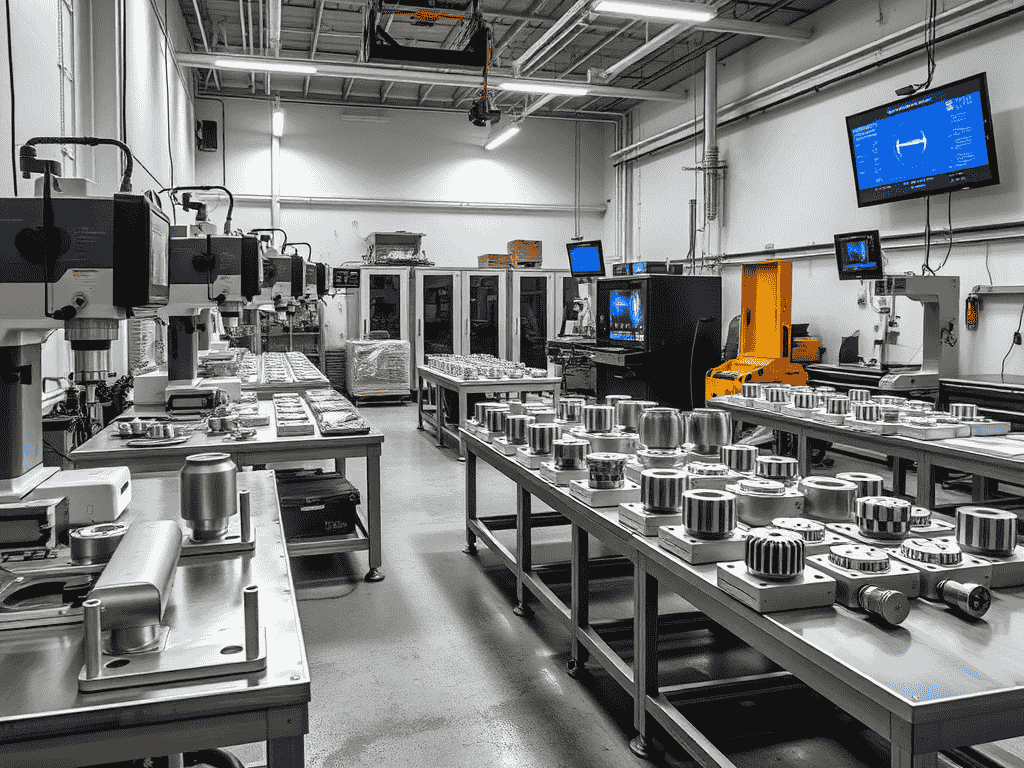
Three checks that take an afternoon
Ask for a video walk that starts at the goods-in area and ends at the inspection room, with the camera never cutting. Ask for a redacted inspection report from a past job in your material. Ask a technical question that only an engineer can answer, such as how they would fixture your part and which datums they would use. All three are free, and together they are more informative than an audit questionnaire.
Matching machine capability to your part
A supplier’s capability is only relevant where it touches your part. A shop with excellent 5-axis capacity is the wrong choice for a family of small turned pins, and a shop built around bar-fed turning is the wrong choice for a complex prismatic housing. Match the process to the geometry first, and only then compare suppliers within that process.
| Process | Suits these geometries | MW+ tolerance capability (mm) | What to verify |
|---|---|---|---|
| 3-axis CNC milling | Flat profiles, prismatic housings, plates | ±0.01 general, ±0.005 on called-out features | Number of setups needed for your part |
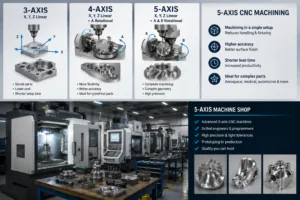
| 4-axis and 5-axis machining | Contoured surfaces, undercuts, multi-face parts | ±0.005, to ±0.001 on critical features | Whether it removes setups or just adds cost |
| CNC turning | Shafts, bushings, cylindrical bodies | ±0.005 on journals and fits | Live tooling for cross-drilled features |
| Swiss-type turning | Small-diameter, high length-to-diameter parts | ±0.005, to ±0.001 on critical features | Guide bushing support for your L:D ratio |
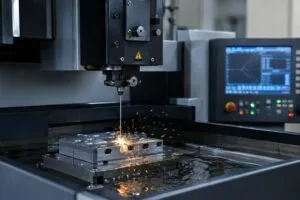
| Wire and sinker EDM | Hardened steel, sharp internal corners, carbide | Per feature callout, CMM verified | Whether it is in house or subcontracted |
The fifth column is the one buyers skip. A process listed on a website is not the same as a process performed in the building; ask which operations are subcontracted, because every subcontracted step adds a queue and a handover to your lead time. The MW+ capabilities overview sets out which processes run in house across 60+ machining centres.
Which certifications actually matter, and for what?
Certifications matter because each one tells you a specific thing, and none of them tells you everything. ISO 9001:2015 says a quality management system exists and has been audited. AS9100D adds aerospace requirements on top of it. ISO 13485 covers medical devices, IATF 16949 covers automotive, and NADCAP accredits special processes. A supplier holding all of them has been audited repeatedly; that is a signal, not a guarantee about your part. The scope differences between the three management-system standards are compared in ISO 9001 vs AS9100 vs IATF 16949.
| Certification | What it actually covers | Require it when |
|---|---|---|
| ISO 9001:2015 | A general quality management system, externally audited | Always; treat it as the entry condition |
| AS9100D | Aerospace quality management, built on ISO 9001 | Aerospace and defence supply chains |
| ISO 13485 | Quality management for medical devices | Medical device components |
| IATF 16949 | Automotive quality management and control plans | Automotive Tier 1 and Tier 2 work |
| NADCAP | Accreditation of special processes such as heat treat and NDT | When a special process is in the routing |
| Measurement traceability | Gauges and CMMs traced to national standards | Any part with a tight tolerance you must trust |
Measurement traceability is the row most often ignored and the one that decides whether an inspection report means anything. Ask how gauges and coordinate measuring machines are calibrated and against what, which should trace to national standards of the kind maintained through NIST calibration services or an equivalent national metrology institute.
What should ship with every order
A certificate of conformance, a CMM dimensional inspection report and material certificates should ship with every order as standard, not on request and not as a chargeable extra. If a supplier treats routine evidence as an upgrade, you are buying parts you cannot verify, and the price advantage you thought you had is a scope difference.
Programme-level documentation is different and legitimately sits outside the unit price. First article inspection to AS9102 and PPAP Level 3 submissions scale with the number of characteristics and with your own template, so MW+ quotes them per programme. Ask for them at RFQ stage so they appear as a visible line rather than a change request after award. The MW+ quality assurance process describes what is captured and reported on each lot.
How do you protect your IP and your tooling?
Protect your intellectual property with a signed non-disclosure agreement before any CAD file is sent, and settle ownership of fixtures, CAM programs and any special tooling in writing before the first order rather than after. Those two documents cover the realistic risks in an overseas machining relationship: uncontrolled distribution of your geometry, and being unable to move a part to another supplier because the fixture is not yours.
Ask who inside the supplier can see your files
An NDA is only as good as the file handling behind it. Ask how CAD files are stored, who has access, and what happens to them when a programme ends. A supplier that can describe its access control specifically is treating the question seriously; one that simply reassures you has not thought about it.
Settle tooling ownership before it exists
If you pay for a fixture, say in the purchase order that you own it and that it will be released on request. Tooling ownership disputes surface at exactly the wrong moment — when you are already trying to move a part — and they are trivially avoided by one sentence written before the fixture is built.
Sending an RFQ that produces comparable quotes
Quotes are only comparable when every supplier received the same information, so send a complete package to all of them at once. MW+ accepts STEP, IGES, DXF, DWG, SolidWorks and PDF, and returns a quote within 24 hours when the package is complete. An incomplete package does not produce a cheaper quote; it produces a quote padded for the unknowns. What belongs in that package, and what each omission costs you, is itemised in the CNC machining quote checklist.
- 3D geometry in STEP or IGES, plus a 2D drawing as PDF.
- A datum scheme and geometric tolerances to ISO 1101 or ASME Y14.5 on every functional feature.
- Material grade and temper, stated exactly, with any certification requirement.
- Surface finish and coating specification, including masked areas and cosmetic zones.
- Quantity, target date, and the Incoterm the price should be quoted against.
- The documentation level required: standard, FAI to AS9102, or PPAP Level 3.
Then ask every supplier to break the quote into setup, machine time, material, finishing and inspection. Suppliers who will not separate those lines are asking you to compare totals built on different assumptions, which is not a comparison at all.
When sourcing from China is the wrong choice
Sourcing CNC machining from China is the wrong choice when regional content rules apply to your programme, when the design is still changing and every iteration has to cross an ocean, when the part is so cheap to machine that freight dominates its landed cost, or when you cannot commit anyone to manage the relationship. These are ordinary constraints, and a supplier who never mentions them is selling rather than advising.
| Situation | Better route | Why |
|---|---|---|
| Regional content or export-control requirements | A qualified domestic supplier | No quality or cost argument overrides a contractual rule |
| Design changing between weekly reviews | Local shop until the drawing is frozen | Freight time per iteration outweighs the unit saving |
| Small, simple, low-value parts in tiny quantities | Local or stock components | Freight, duty and admin exceed the machining content |
| No one internally owns supplier management | Do not start until someone does | Offshore relationships fail on attention, not capability |
| Emergency replacement needed this week | Local rapid machining | Machining can be expedited; international transit cannot |
| Part requires a special process the shop subcontracts | Supplier who performs it in house | Each handover adds a queue and a traceability gap |
Where none of those apply, the decision reduces to whether a specific supplier can show evidence for its claims. That is what the questions in this article are for, and it is the same test whether the shop is in Shenzhen, Stuttgart or Ohio. You can read more about MW+ or send a drawing to the MW+ engineering team to see how the answers come back.
Frequently asked questions
How do I verify a certification without visiting the factory?
Ask for a scan of the certificate showing the certificate number, the issuing certification body, the scope of registration and the expiry date, then check the number against the issuing body’s own register. The scope line matters as much as the standard: a certificate whose scope does not include the processes you need is not evidence for your part.
Is the cheapest quote usually the problem?
Not necessarily, but an unexplained cheapest quote usually reflects a different scope rather than a better process. Check whether it includes the inspection report and material certificates, how many setups it assumes, and whether finishing is in house. Once the scope is normalised, most large gaps between quotes shrink to a much smaller and more explainable difference.
How fast should a supplier respond to an RFQ?
MW+ returns quotes within 24 hours when the package is complete. Speed alone is not the signal, though — a quote that arrives in ten minutes with no questions about your datums or your finish is a price scaled from a similar job. A quote that arrives with two intelligent questions attached is worth more than one that arrives silently.
Can a supplier in China source specialised Western alloys?
Often yes, through distributor relationships, and MW+ machines 70+ material grades. The question to ask is not whether they can obtain it but whether they will supply the mill certificate traceable to the delivered lot. Ask to see the traceability chain on a completed job in a comparable material before you rely on it for yours.
Should I start with a prototype or go straight to production?
Start with a CNC prototype, both to prove the design and to audit the supplier cheaply. MW+ delivers prototypes in 48-hour express or 3–5 business days as standard with no minimum order quantity, so a single part is a normal order. How the supplier handles that one part tells you most of what a formal audit would.
What if a part arrives out of tolerance?
Agree the process before it happens: containment of the affected lot, a documented root-cause investigation, corrective action, and who pays for return freight or rework. A supplier certified to ISO 9001:2015 already runs that loop internally, so asking them to describe it costs nothing and shows immediately whether the system is real or decorative.
How many suppliers should I shortlist?
Three is usually enough to price a part properly, and more than five stops being informative because you cannot give each one a complete brief and a fair conversation. Shortlist on capability match and evidence quality first, then send the identical RFQ package to the survivors on the same day so the quotes are genuinely comparable.
Does a big supplier handle small orders?
It depends on whether they apply a minimum order quantity. MW+ applies none and scales to 1,000,000+ units, so a single prototype and a production programme can sit with the same supplier. That continuity matters, because requalifying a part with a new shop reintroduces every fixture and datum assumption you already settled.