Cost and lead time are the same decision seen from two directions. Every lever that shortens a CNC machining schedule is bought with money, and almost every lever that lowers unit price is bought with time. The useful question is never “how do I get this cheaper and faster” — it is “which of the two am I actually short of, and what is the other one worth to me this week”.
This guide is for the moment you are holding a quote with a standard date on it and someone upstream wants the parts sooner. It sets out what each phase of a CNC job costs in days, which of those days can be bought back, and where expediting money buys nothing. For the machines behind the numbers, see the MW+ manufacturing capabilities page.
Key takeaways
- Four numbers bound almost every expediting conversation with MW+: a quote within 24 hours, a 48-hour express prototype, a standard prototype in 3 to 5 business days, and volume production in 10 to 15 business days.
- Expediting compresses queue time, setup sequencing and transit. It does not compress cutting time, heat treatment soaks or plating tank cycles.
- Tolerance moves both axes at once. Going from the ±0.01mm general class of ISO 2768-m to ±0.005mm precision or ±0.001mm critical adds machine passes and inspection time, so it raises price and lengthens the schedule together.
- Expedite when the cost of being late — line downtime, a missed qualification window, a contractual penalty — exceeds the premium. If you cannot put a number on lateness, you are not ready to expedite.
- Setup cost is fixed and spread across the batch, so unit price falls sharply over the first hundred pieces and then flattens.
- A certificate of conformance, a CMM inspection report and material certificates ship with every MW+ order. First article inspection to AS9102 and PPAP Level 3 are on request, quoted per program, and each adds a step to the schedule.
- What actually drives CNC machining cost and lead time?
- Which phases can money compress, and by how much?
- When is paying to expedite worth it?
- What expediting buys, and what it cannot touch
- How much does a tighter tolerance add to cost and lead time?
- Volume, unit price and the setup crossover
- When expediting is the wrong choice
- What to send so cost and lead time come back accurate
- Frequently asked questions
What actually drives CNC machining cost and lead time?
CNC machining cost is driven by machine hours, setup count, material grade and form, tolerance and the inspection it forces, and secondary finishing. CNC machining lead time is driven by material availability, programming and fixturing, queue position on the machine, inspection depth, and transit. The two lists overlap in only three places — setups, tolerance and material — and those three are where expediting money does real work.
That overlap is why the trade is negotiable at all. If your delay sits somewhere cost has no leverage, such as a plating vendor’s tank cycle, paying more changes nothing. If it sits in setups, queue or freight, paying more changes a great deal. The same three levers set the quote in the first place, which is why a CNC machining services price and its promised date move together.
The three levers that move both at once
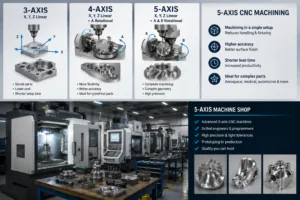
- Setup count. Every re-clamping adds fixture time and a datum pickup. Consolidating four operations into one on a 5-axis machining centre removes labor hours and calendar days together.
- Tolerance. Tighter bands mean more finishing passes, slower feeds and a longer CMM routine.
- Material. A stocked grade releases on order confirmation; a bought-in grade becomes the critical path whatever you pay for machine priority.
Which phases can money compress, and by how much?
The duration of each phase, and how prototype and production schedules differ from each other, is set out separately in the comparison of prototype and production CNC machining lead times. What matters here is the exchange rate: which of those phases will give up days in return for money, and which will not move at any price.
This table shows where the compressible days live, so the conversation moves off “can you go faster” and onto “which phase are we attacking”.
| Phase | Standard route | Expedited route | What drives the variance |
|---|---|---|---|
| Quotation and DFM review | Within 24 hours | Within 24 hours | Drawing completeness. A missing datum scheme is the commonest cause of a re-quote |
| Material release | On order confirmation, from 70+ stocked grades | Same, if the grade is stocked | Non-stock grade, oversized billet, or a demanded heat number |
| Programming and fixturing | Inside the 3 to 5 day prototype window | Compressed into the 48-hour express window | Setup count; soft jaws versus a dedicated fixture |
| Machining | Queued across 60+ machining centres | Queue priority, parallel setups on several machines | Cycle time is fixed, queue position is not. Most bought days come from here |
| Inspection and documentation | COC, CMM report and material certificates with every order | Same documents, inspected inline rather than batched | Toleranced feature count. AS9102 FAI or PPAP Level 3 is a discrete added step |
| Order total | Prototype 3 to 5 business days; production 10 to 15 business days | 48-hour express prototype; production quoted per program | Geometry, material availability, secondary finishing |
Notice what is missing from every row: transit. Freight sits outside the manufacturing schedule and is the easiest thing to buy back, a pure money-for-days exchange with no engineering consequence. If you are three days short, look at the carrier before the machine shop. See also MW+ CNC prototyping.
When is paying to expedite worth it?
Paying to expedite is worth it when the quantified cost of being late exceeds the expedite premium. Line downtime, a missed qualification window, a contractual penalty and a lost design review slot can all be priced. If nobody on the program can name that figure, the request is a preference rather than a business case, and the standard date should stand.
The second test is whether the delay is reachable at all. Money spent on a phase that cannot be compressed is wasted twice: once in cash, once in the supplier goodwill you will want on the genuinely urgent job later.
| Situation | Recommendation | Why |
|---|---|---|
| Design review in 5 days, form and fit only | 48-hour express prototype, loosened tolerances, as-machined Ra 3.2µm | Premium is small on one or two parts, and relaxed tolerances remove the inspection time that would blow the window |
| Assembly line stopped for one missing component | Expedite everything, air freight, split the order | Downtime per day dwarfs any machining premium. A split shipment gets first parts moving |
| First ever build, tight geometric tolerances | Do not expedite the first article | Compression removes the proving time that catches a fixture or datum error |
| Part needs heat treatment and hard anodizing | Expedite machining, accept the finishing queue | Third-party cycles have fixed dwell times a premium does not move |
| Non-stock alloy or specific mill heat required | Fix the material problem first | Machine priority is worthless while the billet is still in transit |
What expediting buys, and what it cannot touch
Expediting purchases scheduling priority, parallelism and labor overtime, not faster physics. A 40-minute cycle is 40 minutes at any price, a stress-relief soak is a fixed time at temperature, and an anodizing line racks parts in the order the tank allows.
| Expediting lever | Days it removes | Cost effect | Where it stops working |
|---|---|---|---|
| Queue priority on the machine | Waiting days before the job reaches a spindle | Premium on the machine time line | Once you are next in queue there is nothing left to buy |
| Express prototype route | Programming, fixturing and proving compressed to 48 hours | Higher NRE, charged as overtime | Parts needing a dedicated fixture or a subcontracted finish |
| Parallel setups on several machines | Serial operation time on multi-setup parts | Extra setup charges, one per machine | Single-setup parts and batches too small to split |
| Air freight instead of ocean | Transit weeks | Freight per kilogram plus handling | Heavy, low-value shipments where freight exceeds part value |
| Scope reduction on non-critical features | Finishing passes and CMM routine length | Reduces cost as well as time | Genuinely functional features, where loosening moves risk downstream |
The phases no premium compresses
- Cutting time, once feeds and speeds are already at the material’s limit.
- Heat treatment soak and controlled cooling, which are metallurgically fixed.
- Anodizing, plating and passivation tank cycles — chemistry plus a shared queue.
- Thermal stabilisation before precision inspection. The traceability chain behind that measurement runs back to national standards such as NIST calibration services.
- Customs clearance, a documentation problem rather than a money problem.
How much does a tighter tolerance add to cost and lead time?
Each step down the tolerance ladder adds finishing passes, slower feed rates, more in-process gauging and a longer CMM routine, so it raises unit price and lengthens the schedule at the same time. Tolerance is the one specification that cannot be traded: you cannot buy a tighter band with time, or a faster date by paying for precision. Review it first when a quote comes back wrong on both axes.
Applying the tightest band across a whole drawing, rather than to the three features that carry function, is the most expensive specification error in a CNC RFQ.
| Tolerance class | Band (mm) | Typical use | Effect on cost and schedule |
|---|---|---|---|
| General, per ISO 2768-m | ±0.01 | Clearance holes, cosmetic faces, non-mating surfaces | Baseline. No inspection beyond the standard CMM report |
| Precision | ±0.005 | Bearing seats, sealing faces, locating features | Extra finishing pass and feature-level gauging |
| Critical | ±0.001 | Interference fits, optical mounts, high-speed rotating assemblies | Temperature-controlled inspection, process control at Cpk ≥1.67, real scrap risk |
| Fit-based, per ISO 286 | Shaft and hole classes | Mating pairs where assembly clearance matters more than absolute size | Often cheaper than a symmetric band — lets the shop centre its process |
| Geometric, per ASME Y14.5 | Position, flatness, profile | Assemblies where relationship matters more than size | Adds CMM time but usually cuts cost by removing over-tight linear dimensions |
Surface finish behaves identically. As-machined Ra 3.2µm is the baseline, Ra 0.4µm needs fine machining and Ra 0.1µm needs polishing, each an added operation with its own hours. Specify the roughest finish the function tolerates; see MW+ quality assurance.
Volume, unit price and the setup crossover
Setup and programming are a fixed charge spread across the batch, so unit price falls steeply over the first hundred pieces and then flattens once machine time dominates. MW+ operates with no minimum order quantity and runs to 1,000,000+ units, so the same part can be quoted at either end of that curve — and the expediting arithmetic is completely different at each end.
| Order quantity (pieces) | What dominates unit price | Lead time character | Expediting arithmetic |
|---|---|---|---|
| 1 to 5 | NRE: programming, fixturing, proving | 3 to 5 business days, or 48-hour express | Cheap in total, expensive per part; usually worth it |
| 100 to 500 | Machine time and material | Approaching the 10 to 15 business day window | Buy freight and queue priority, not parallel setups |
| 1,000+ | Machine time, material, finishing throughput | 10 to 15 business days, scheduled in releases | Split deliveries beat a blanket expedite |
| Up to 1,000,000+ | Cycle time per part and finishing line capacity | Run against a release plan, not a single date | Reserve capacity; premiums stop being the lever |
Geometry moves the crossover as much as quantity does. Small-diameter turned parts run continuously on a sliding headstock, so the curve flattens earlier — see MW+ Swiss machining. Prismatic parts needing three or four CNC milling setups carry NRE far up the volume curve, which is why their low-volume quotes look expensive.
When expediting is the wrong choice
Expediting is the wrong choice whenever compression removes the step that catches errors, or the delay lives somewhere a premium cannot reach. Both end the same way: money spent, date still slipped, buffer gone.
| Situation | Why expediting fails here | Do this instead |
|---|---|---|
| First article of a new, complex part | Compression removes proving time; a fixture error found after the batch is cut costs more days than it saved | Prove one piece at standard pace, then expedite the balance |
| Parts needing AS9102 FAI or PPAP Level 3 | The documentation package has its own review cycle, and rushing it produces a rejected submission | Start the documentation conversation at RFQ, not at shipment |
| Bottleneck is a subcontracted finish | Anodizing, plating and heat treatment queues sit outside the machine shop’s control | Reserve finishing capacity, or qualify an in-house alternative finish |
| The drawing is still changing | Expedited programming and fixturing is thrown away by the next revision, and paid for twice | Freeze the drawing, then expedite |
| Recurring monthly demand quoted job by job | Repeated premiums cost more over a year than a release plan, and destroy price stability | Move to scheduled releases with reserved capacity |
There is also a relationship cost that appears on no quote: a buyer who expedites everything becomes a buyer whose dates mean nothing, and the genuinely urgent request arrives with no credibility behind it.
What to send so cost and lead time come back accurate
Most quote delays come from an incomplete package rather than a busy shop. A quote returned within 24 hours depends on the supplier reading intent from what you sent, without a round trip to ask which dimensions matter. The full package is itemised item by item in the CNC machining quote checklist; what follows is the short version, weighted towards the entries that move price and date.
The package
- A 3D model in STEP or IGES, plus a 2D drawing in DXF, DWG or PDF carrying tolerances, datums and finish callouts. SolidWorks files are accepted.
- Material grade and condition written in full — 6061-T6, not “aluminium”; 316L, not “stainless”. Nominal property values are published in references such as MatWeb; work from the mill certificate when a property is load-bearing.
- Quantity for this order and expected annual volume, stated separately.
- The required-on-site date, and if it is firm, why. A supplier who knows the constraint can propose a route to it.
- Documentation requirements up front. COC, CMM report and material certificates ship with every order; AS9102 FAI and PPAP Level 3 must be requested and quoted.
The three sentences that save the most money
Say which features are critical and which are not. Say whether a design change is permitted. Say the real date rather than a padded one. Those three sentences change a quote more than any negotiation on price, because they let the shop plan the cheapest route instead of the safest one. For tight-tolerance work see MW+ CNC precision parts, and for the case where small batches make setup dominate unit price, the low-volume cost versus speed trade-off. To send a package, use MW+ contact.
Frequently asked questions
How much does expediting a CNC order add to the price?
There is no single percentage, because expediting charges land on specific quote lines rather than on the total. An express prototype adds programming and fixturing overtime to NRE, queue priority adds a premium to machine time, and air freight replaces ocean at its own rate. Ask which lines move, then drop the ones not buying you days.
Why did my quote come back with a longer lead time than last time for the same part?
The three usual causes are material, queue and specification drift. A grade that was in stock last time may now need buying in, machine loading changes week to week, and a revision that added one geometric callout can add a CMM routine. Ask which of the three it is; a supplier who cannot answer has not scheduled the job yet.
Can I get a lower price by accepting a longer lead time?
Usually yes, and it is the most underused lever in CNC procurement. A flexible date lets the shop nest your job into gaps in the machine schedule, batch your material purchase with others in the same grade, and use ocean freight instead of air. Say the date is flexible; suppliers assume urgency otherwise.
Is a 48-hour express prototype held to the same tolerances as a standard one?
MW+ holds the same tolerance classes on express work: ±0.01mm general to ISO 2768-m, ±0.005mm precision and ±0.001mm critical, at a process capability of Cpk ≥1.67. What compresses is programming, fixturing and queue time, not inspection standards. Where express does change things is scope, because a part needing heat treatment or a subcontracted finish will not fit a 48-hour window at any tolerance.
Should I split a large order into an expedited batch and a standard batch?
Split delivery is usually cheaper than a blanket expedite when only part of the quantity is genuinely urgent. You pay the premium on the pieces that unblock the line, and the balance runs at standard rate. Watch the extra freight and packaging on the second shipment, which can outweigh the saving on low-value parts.
Does a certified supplier cost more, and does certification slow anything down?
Certification affects documentation depth rather than machining speed. MW+ operates to ISO 9001:2015, AS9100D, ISO 13485, IATF 16949 and NADCAP, and ships a certificate of conformance, a CMM inspection report and material certificates with every order. The steps that add schedule are the optional ones, AS9102 FAI and PPAP Level 3, which are quoted per program.
How far ahead should I place a repeat order to avoid expedite premiums?
Work backwards from the 10 to 15 business day volume production window, add your transit mode, then add a buffer for one revision cycle or one inspection query. For recurring demand a release schedule with forecast visibility removes the question, because capacity is reserved rather than competed for.