




The ten suppliers below are the CNC machining companies in China most worth shortlisting in 2026, judged on what each publishes about its own certifications, facility and tolerance capability. There is no single best supplier. A shop holding AS9100D and ISO 13485 is the right call for a flight-critical bracket and the wrong call for 5,000 zinc die-cast housings.
Disclosure. This article is published by MW+ (MetalWorks Plus), one of the ten companies on it, and we have not ranked ourselves first. Competitor figures are quoted from their own websites; where none is published, the table says not stated.
Key takeaways
- ISO 9001:2015 is the baseline, not a differentiator. AS9100D and ISO 13485 are what narrow a shortlist. Ask for the certificate scope, not the logo.
- Check units first. One supplier here publishes ±0.001 in (0.0254 mm) and another ±0.001 mm; they read identically and differ by a factor of 25.
- A realistic tolerance ladder is ±0.01 mm general, ±0.005 mm tight-tolerance, ±0.001 mm on selected features. Homepage figures are best cases.
- Four of the ten publish no tolerance figure, no facility size, or neither. Treat the absence as data and ask in writing.
- The cheapest due diligence is a paid sample order, with a first-article report to AS9102 required before production.
- How this shortlist was built
- The ten suppliers compared
- Which shops are built for aerospace and medical work?
- Which shops are built for volume and casting?
- Which shops are built for EDM, Swiss and quick-turn work?
- How do you verify any of these claims?
- When this shortlist is the wrong place to look
- Frequently asked questions
- The short version
How this shortlist was built
Most articles titled “top 10 CNC machining companies in China” are written by CNC machining companies in China, who put themselves at number one and never say so. Here is the method, so you can judge it.
- Verifiable specifics only. “High precision” with no tolerance figure and no lead time is not shortlist material.
- Claims are quoted, not paraphrased. Nobody’s numbers have been upgraded, and nobody’s corrected.
- Certifications listed by exact standard. ISO 9001:2015 is a general quality-management standard almost every exporter holds.
- Sorted by year established. Age is a fact; “best” is an opinion, and we cannot rank our own competitors neutrally.
- Gaps shown as gaps. Several suppliers publish no tolerance and no facility size anywhere. That absence is information.
This is not an audit. Nobody has walked these factories or read their non-conformance logs. It is a starting point for your due diligence, not a substitute.
The ten CNC machining companies in China compared
Tolerances are the tightest each supplier claims anywhere on its site, usually a best case on one feature rather than a figure to expect on every part.
| Company | Established | Base | Facility as published | Certifications stated | Tightest tolerance claimed |
|---|---|---|---|---|---|
| China Machining Parts | 1944 (as stated) | Shenzhen | Not stated | ISO 9001:2015 | 1–100 micron |
| Yijin Solution | 25+ years | Shenzhen | 25,000 m² | AS9100D, IATF 16949, ISO 13485:2016, ISO 9001:2015, ISO 14001 | ±0.001 mm |
| HMaking | 20+ years | Not stated | 200+ staff, 100+ CNC | ISO 9001:2015, ISO 14001, ISO 45001, TS16949 | ±0.005 mm |
| Lewei Precision | 21 years | Dongguan | Not stated | ISO 9001:2015, ISO 13485, ISO 14001, IATF 16949 | ±0.001 in (0.0254 mm) |
| Tuofa CNC | 2006 | Shenzhen | 50,000 sq ft | ISO 9001:2015, IATF 16949 | ±0.01 mm |
| PTJ Hardware | 2007 | Dongguan | 5,000 sq ft | ISO 9001 | 0.005 mm |
| JUNYU | 2008 | Dongguan | 70+ machines | ISO 9001:2015, TS16949 | ±0.002 mm |
| RapidDirect | 2009 | Shenzhen | 10,000 m², 500+ machines | ISO 9001:2015, ISO 13485:2016 | Not stated |
| JTR Machine | 2015 | Chongqing | 70+ machines | ISO 9001:2015, IATF | Not stated |
| MW+ (MetalWorks Plus) | 2015 | Shenzhen | 15,000 m², 60+ machining centres | ISO 9001:2015, AS9100D, ISO 13485, IATF 16949, NADCAP | ±0.001 mm |
Two things to read carefully. Units: Lewei states ±0.001 inch, twenty-five times looser than ±0.001 mm, and both are written “±0.001”. Certification counts are not quality scores: ISO 14001 covers environmental management and ISO 45001 health and safety, neither of which predicts whether a part comes back in tolerance.
Which shops are built for aerospace and medical work?
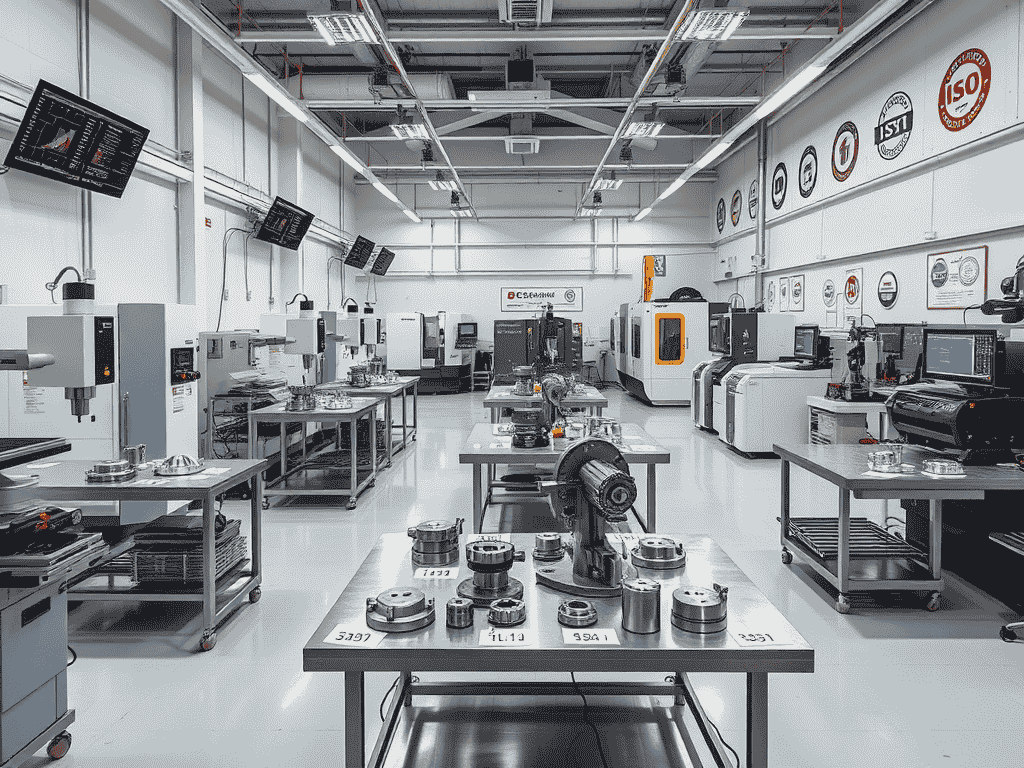
If your part carries a flight-critical function or goes inside a human body, the certification list is the shortlist. AS9100D and ISO 13485 require traceability and first-article records a general ISO 9001 shop is not obliged to keep.
Yijin Solution, Shenzhen
The broadest published certification set here: AS9100D, IATF 16949, ISO 13485:2016, ISO 9001:2015 and ISO 14001. States a 25,000 m² facility with 136+ machining centres and 80+ Swiss-type lathes, claims ±0.001 mm, and lists offices in Florida and Hong Kong. Check first: a plant that size runs many lines. Ask which one your parts run on and whether the AS9100D scope covers it.
MW+ (MetalWorks Plus), Shenzhen
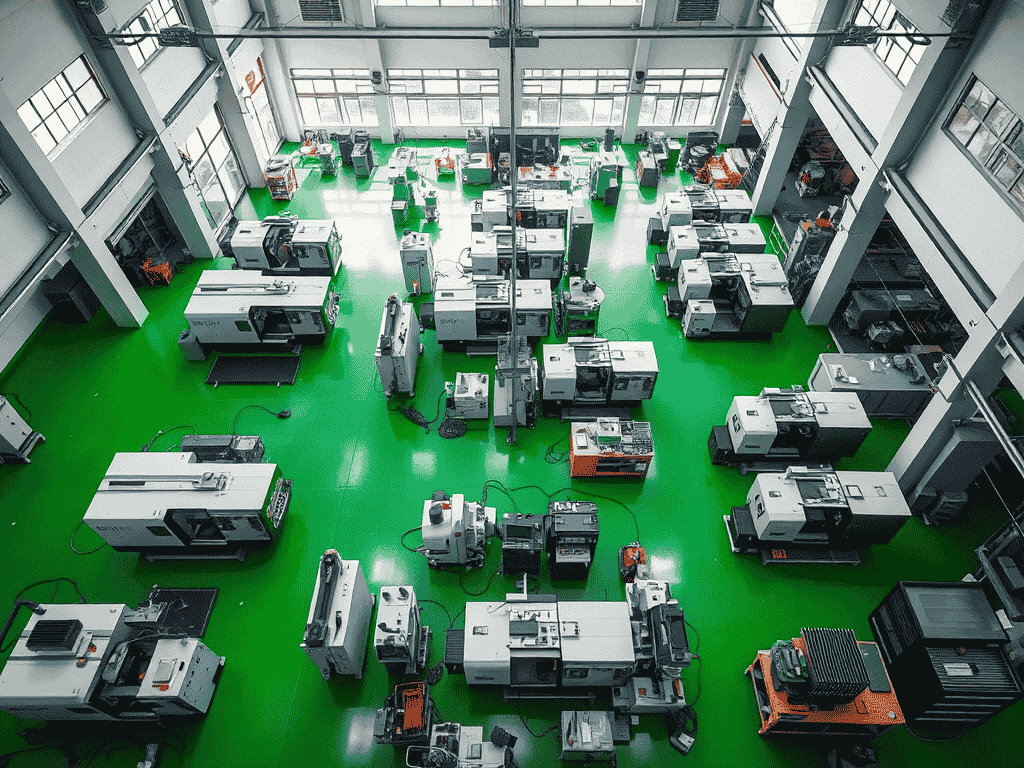
Our own entry, so read it critically. Founded 2015, a 15,000 m² facility in GuangMing District, Shenzhen, with 60+ machining centres and 120+ engineers and machinists, certified to ISO 9001:2015, AS9100D, ISO 13485, IATF 16949 and NADCAP. We hold ±0.001 mm on suitable features, ±0.005 mm as a precision figure and ±0.01 mm to ISO 2768-m generally. Quotes return within 24 hours, standard prototypes in 3–5 business days and volume production in 10–15 business days; every order ships with a certificate of conformance, a CMM report and material certificates. Our Swiss machining and micro-machining lines carry the tightest work.
Check first: we are the youngest company here alongside JTR. If two decades of trading history is a hard requirement in your approval process, that is a legitimate reason to rule us out. Ask instead for CMM reports and a first article on a sample part.
Lewei Precision, Dongguan
States 21 years, with ISO 9001:2015, ISO 13485, ISO 14001 and IATF 16949. Breadth is the selling point: machining, moulding, sheet metal, 3D printing, die casting and wire EDM under one roof, with prototypes in 24 hours or less. Check first: the headline tolerance is ±0.001 inch (0.0254 mm), not ±0.001 mm. Facility size is not published.
Which shops are built for volume and casting?
Different problem, different supplier. When the part is not flight-critical but the quantity is five figures, what matters is casting capability, finishing under one roof and a price that holds.
HMaking
States 20+ years, 200+ factory employees and 100+ sets of CNC equipment, with ISO 9001:2015, ISO 14001, ISO 45001 and TS16949. Aluminium and zinc die casting sit alongside machining, quoted at ±0.005 mm. Check first: no headquarters city or facility size is published, and the site quotes a “0.002 um” tolerance elsewhere, which is two nanometres and not a machining figure.
JUNYU, Dongguan
Founded 2008, more than 70 types of precision CNC equipment, ISO 9001:2015 and TS16949. The tooling side is the interesting part: optical profile grinding to ±0.002 mm, precision EDM to ±0.005 mm, progressive die stamping moulds. Check first: TS16949 was superseded by IATF 16949 in 2018, so a site still listing it may have stale copy or may not have transitioned.
JTR Machine, Chongqing
Founded 2015, more than 70 precision CNC machines, ISO 9001:2015 and a stated IATF transition audit in 2017. High-pressure, gravity and precision die casting sit next to machining and sheet metal. Check first: no tolerance figure and no facility size are published anywhere. Ask for both.
Which shops are built for EDM, Swiss and quick-turn work?
Process specialism is a separate axis from certification. Our own electric discharge machining and CNC prototyping pages set out how these trade-offs play out on the floor.
RapidDirect, Shenzhen
Established 2009, a 10,000 m² operation with 500+ machines across processes, the largest machine count published here, holding ISO 9001:2015 and ISO 13485:2016 with an instant-quote platform. Check first: no tolerance figure and no standard lead time. Ask which machines are CNC and whether your job is machined in-house or brokered out.
Tuofa CNC, Shenzhen
Trading since 2006 from Longhua, Shenzhen, in a facility stated at over 50,000 square feet, with ISO 9001:2015 and IATF 16949. Publishes ±0.0004 in (0.01 mm), lead times from one business day and a material list including PEEK and PTFE. Check first: ±0.01 mm is an honest shop tolerance and ten times looser than the ±0.001 mm claimed elsewhere here.
China Machining Parts, Shenzhen
States a history since 1944 and ISO 9001:2015. The capability list is narrow and deep: wire EDM, sink and ram EDM, Swiss machining, micromachining, 5-axis milling and super-precision lathe work, at 1–100 micron accuracy. Check first: a 1944 founding date predates the city of Shenzhen, established in 1979. Facility size and lead times are not published.
PTJ Hardware, Dongguan
Machining since 2007 in a 5,000-square-foot facility, the smallest published footprint here, with ISO 9001 and a stated 0.005 mm capability across 4- and 5-axis work. Check first: 5,000 sq ft is roughly 465 m², so capacity is limited. ISO 9001 alone will not satisfy an aerospace or medical audit.
How do you verify any of these claims?
Everything above is self-reported. Here is how to turn a marketing page into evidence. Apply it to us too.
Ask for the certificate, not the certification
A logo is not a certificate. Request the PDF and check three fields: certificate number, expiry date and scope statement. Scope is the one people skip, because a certificate can cover sheet metal fabrication at a company that also machines. Verify the number against the registrar’s own register.
Make them state the tolerance against your feature
Send the drawing and ask them to confirm in writing the achievable tolerance on the dimensions you care about, and what happens if one comes back out. A supplier who narrows the claim when they see a real drawing is being honest, not evasive.
Ask who actually cuts the metal
Several companies here broker work to partner factories. That is not automatically bad, but it changes who controls quality and how a problem gets fixed. Two questions settle it: is this machined in your own facility, and which building?
Require a first-article report before production
Ask for a dimensional report against your drawing, from a CMM, with calibration traceability stated; NIST sets out what traceability requires. For regulated work that means a full first article to AS9102. A supplier who cannot produce it for a sample cannot produce it for a lot. It is what our quality assurance process is built around.
Check the units, then buy one part
Inches, millimetres, microns and thousandths are used interchangeably on these sites, so convert to one unit before comparing anything. Then place a paid sample order on a real drawing with a real deadline. For the cost of one part you learn how they quote, how they handle a DFM question and whether the date holds.
| What to ask | A good answer sounds like | Red flag |
|---|---|---|
| Send me the certificate PDF and its scope | Number, expiry, scope naming CNC machining | A logo, or “we follow ISO standards” |
| What tolerance can you hold on this dimension? | A figure tied to the feature, with a material caveat | Repeating the homepage number unchanged |
| Is this machined in your own facility? | Yes, plus the building and machine type | “We have a partner network” |
| Can I have a first article to AS9102? | Yes, with a sample report attached | “Our process is stable, inspection is not needed” |
| How is your CMM calibrated and traceable? | Named lab, interval, traceability chain | “The machine is very accurate” |
When this shortlist is the wrong place to look
Sourcing machining from China is the wrong decision more often than a Chinese machine shop usually admits. Here is where we would tell you not to bother, including where we would tell you not to use us.
| Your situation | What to do instead | Why |
|---|---|---|
| One or two parts needed in under a week | A local shop, even at three times the unit price | Freight and customs eat the saving and the calendar |
| Design still changing weekly | Prototype locally, transfer once the drawing is frozen | Each revision costs a full shipping cycle |
| Export-controlled or defence-scoped work | A supplier approved under your own export regime | MW+ makes no export-control claim and will not take it |
| Total spend under a few thousand dollars | Domestic supply | Qualification effort outweighs the saving |
| You cannot fund a paid sample round | Postpone the transfer | Without a first article you are buying claims |
| Approval requires 20 years of trading history | Yijin, Lewei, HMaking or Tuofa rather than MW+ | We were founded in 2015 and cannot meet that filter |
| If your job is… | You need… | Which is why |
|---|---|---|
| A flight-critical or implantable part | AS9100D or ISO 13485 in scope, plus a first article | ISO 9001 alone will not survive your auditor |
| 10,000 die-cast and machined housings | In-house casting and finishing | Every vendor handoff adds cost and risk |
| A micro feature under 0.5 mm | Swiss turning, EDM or micromachining | General 3-axis shops cannot hold it |
| A part that must match an existing lot | CMM reports and documented process control | Repeatability is measured, not promised |
| Lowest unit price at volume | A larger plant with its own material buying | Scale is where the price comes from |
Frequently asked questions
Who is the best CNC machining company in China?
There is no single answer, and any article that gives you one is selling something. The right supplier depends on your certification requirement, tolerance, volume and timeline. For regulated aerospace or medical parts, shortlist suppliers holding AS9100D or ISO 13485 in the relevant scope. For die casting at volume, HMaking and JTR Machine. For EDM and Swiss work, China Machining Parts and JUNYU.
How do I know a supplier’s certification is genuine?
Ask for the certificate PDF, then verify the number with the issuing registrar rather than trusting the document. Read the scope statement to confirm it covers CNC machining at the site your parts will run in, and check the expiry against your production window. A certificate that expires mid-programme, or whose scope names a different process, is genuine and still does not cover you.
What tolerance can Chinese CNC shops actually achieve?
A competent shop holds ±0.01 mm routinely on general machining, which is roughly ISO 2768-m, then ±0.005 mm on tight-tolerance work with process control, and ±0.001 mm on selected features with the right machine, fixturing and temperature control. Anyone claiming microns on every feature is describing a best case as though it were a standard. Ask them to confirm against your drawing before you release the order.
What certifications should a Chinese CNC supplier hold?
ISO 9001:2015 is the baseline: necessary, and not distinguishing, since nearly every exporter holds it. Beyond that, match the standard to the sector. AS9100D covers aerospace, ISO 13485 covers medical devices, IATF 16949 covers automotive. ISO 14001 and ISO 45001 indicate a well-run business but say nothing about part quality. Always ask for the scope, not just the standard number.
How long does CNC machining from China actually take?
Prototype lead times published on this list range from 24 hours to seven days, and production is usually quoted in weeks rather than days. At MW+ the published figures are 3–5 business days for a standard prototype, 48 hours on the express route, and 10–15 business days for volume production. Add roughly a week for air freight or a month for sea. What matters is whether the supplier hits the date, not what it quoted.
Is it cheaper to machine parts in China?
Usually yes on unit price, and the gap narrows once you include freight, duties, tooling, inspection and the cost of a delay. The saving is real at volume and much less compelling for one or two urgent parts. Compare landed cost against your domestic quote rather than ex-works price, and price in the cost of a batch arriving out of tolerance.
Should I use a marketplace platform or go direct to a factory?
Platforms quote faster and are useful when you need several processes or do not yet know which supplier fits. Going direct gives you a named engineer, control over process decisions and someone accountable when a dimension drifts. For repeat production of a part that matters, direct is generally better; for one-off prototypes across mixed processes, a platform wins on convenience. Our CNC machining services page sets out what direct engagement involves.
The short version
Ten suppliers, all real, all publishing enough detail to be worth a conversation. None is the best, because “best” is not a property of a machine shop. It is a match between what you need made and what that shop is built to make. For machine builders and contract shops outside China, see our list of CNC machining and milling companies worldwide.
Use the table to narrow to two or three on certification and tolerance. Then apply the verification steps, buy one sample part from each, and let the parts decide.
About this article. Published by MW+, a CNC machining company in GuangMing District, Shenzhen. We are one of the ten listed and did not place ourselves first. Competitor figures are quoted from their own websites and not independently verified. No company paid to appear here.
To test us against this list rather than take our word for it, send a drawing and ask for a quote. An engineer replies within 24 hours with a free DFM review and a straight answer on your tolerance.
Where MW+ sits on this list
MW+ machines from a 15,000 m² Shenzhen plant with 60+ multi-axis machines and 120+ engineers, certified to ISO 9001:2015, AS9100D, ISO 13485 and IATF 16949, holding Cpk 1.87 at ±0.005 mm. Those are the figures to hold every shop on this list to, including this one.
Where MW+ sits on this list
MW+ operates a 15,000 m² plant in Shenzhen with 60+ machining centres and 120+ engineers, certified to ISO 9001:2015, AS9100D, ISO 13485, IATF 16949 and NADCAP. Full capability detail is on our CNC machining services and manufacturing capabilities pages, and the three product families we build to drawing are listed separately.