Key takeaways
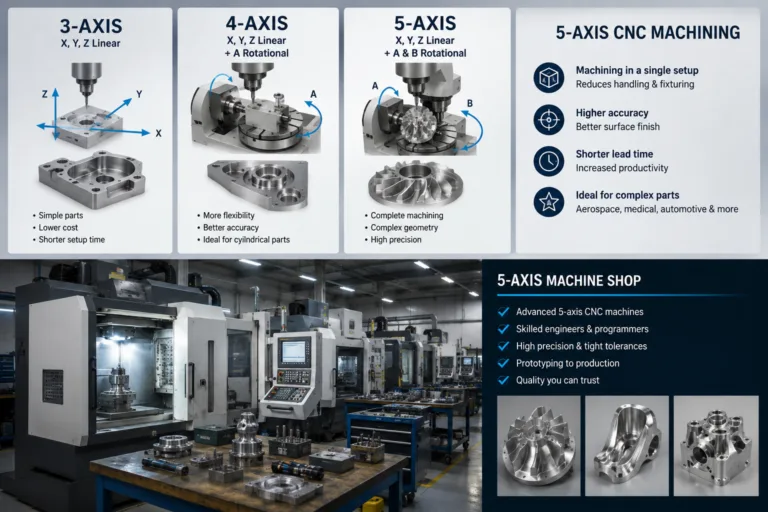
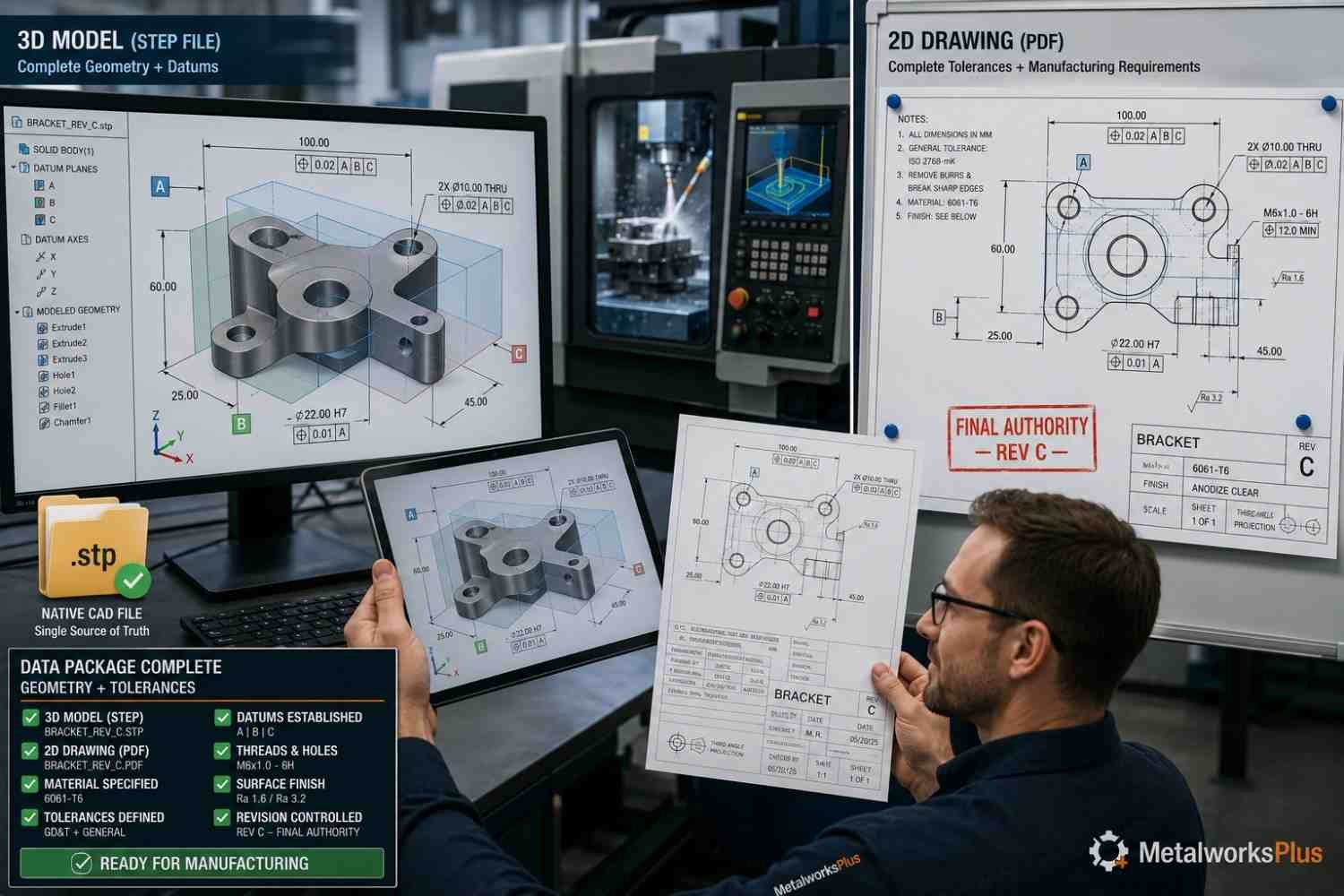
- A complete CNC machining RFQ package carries 2D drawings with GD&T to ASME Y14.5 or ISO 1101, a 3D model in STEP or IGES, material grade and condition, surface finish in Ra, the certificates you require, and the quantity ladder.
- Ask suppliers for process capability data on the features you actually care about, not a general claim. MW+ holds Cpk ≥1.67 on critical dimensions.
- MW+ returns quotations within 24 hours. Express prototypes ship in 48 hours, standard prototypes in 3–5 business days, and volume production runs 10–15 business days.
- Certification is scope-specific, not a badge count: ISO 9001:2015 is the floor, AS9100D covers aerospace, ISO 13485 covers medical devices and IATF 16949 covers automotive. MW+ holds all four plus NADCAP.
- Every MW+ order ships with a certificate of conformance, a CMM inspection report and material certificates. First article inspection per AS9102 and PPAP Level 3 are available on request and quoted per programme.
- Score quotations on a weighted matrix before you compare unit prices. Price per unit and cost per unit are different numbers.
On this page:
- What is a CNC machining RFQ evaluation?
- What must a complete CNC machining RFQ package contain?
- The six criteria that decide a CNC supplier shortlist
- How do you score competing CNC quotes objectively?
- Lead time: what you can hold a supplier to
- Documentation: what should arrive with the parts
- Why is the cheapest CNC quote rarely the lowest cost?
- When is a formal RFQ process the wrong approach?
- Frequently asked questions
What is a CNC machining RFQ evaluation?
A CNC machining RFQ evaluation is a structured comparison of supplier quotations against weighted criteria — dimensional capability, certification scope, lead time, material traceability, engineering support and volume flexibility — rather than against unit price alone. The evaluation happens before award, and it is the stage at which most sourcing failures are created rather than discovered.
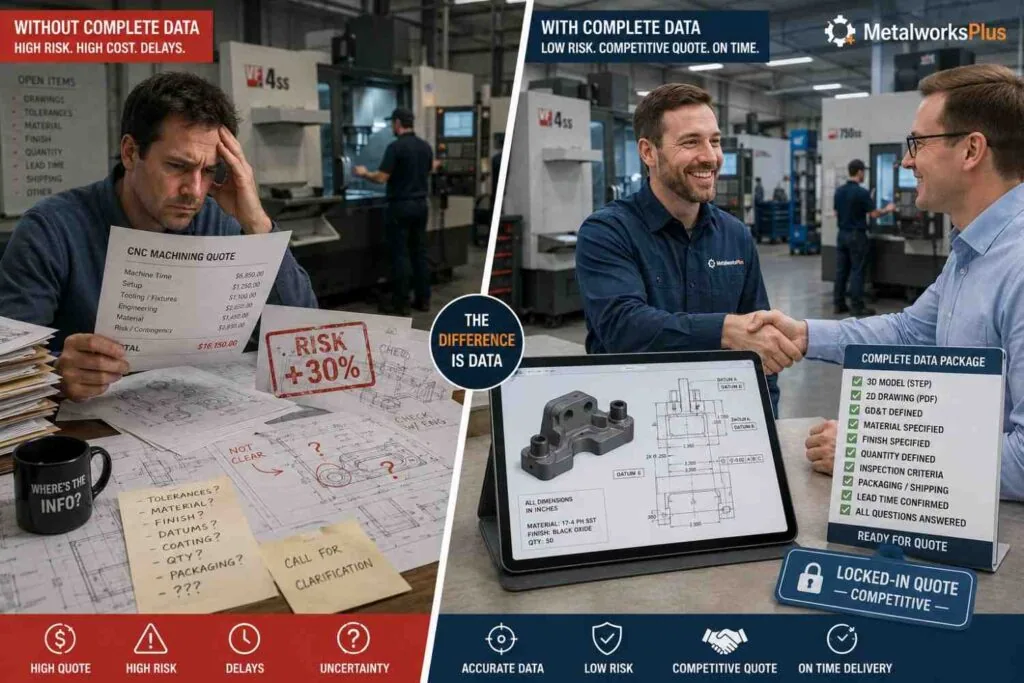
A quotation is a compressed statement of assumptions. A price per part encodes a machine class, a fixturing plan, an inspection frequency, a material source and a batch size. Two quotes that differ sharply often differ because one supplier assumed 100% CMM inspection and the other assumed a first-piece check.
Force those assumptions into the open before a purchase order exists, because afterwards every one of them silently becomes your problem. A good CNC machining supplier answers assumption questions in writing; one that treats them as interrogation is telling you something useful.
What must a complete CNC machining RFQ package contain?
A complete CNC machining RFQ package contains seven items: a 2D drawing carrying GD&T callouts, a 3D solid model, the material grade and heat-treat condition, surface finish requirements in Ra, the certificates and inspection reports you require, the quantity ladder from prototype through annual volume, and packaging or country-of-origin requirements. An RFQ missing any one of these will be quoted on assumption.
Each item removes a specific class of ambiguity:
- 2D drawing with GD&T. State the scheme you are working to — ASME Y14.5 or ISO 1101 — because datum interpretation differs between them and a misread datum frame is expensive to discover at first article.
- 3D model. MW+ accepts STEP, IGES, DXF, DWG, SolidWorks and PDF. Send the native format alongside a neutral one where you can; translation artefacts on fillets and threads are a common source of quoting error.
- Material grade and condition. “Aluminum” is not a specification. “Aluminum 6061-T6” is. Where the property is load-bearing, say so, and require the mill certificate rather than a nominal value from a datasheet.
- Surface finish. Give Ra per surface and mark cosmetic against functional. ISO 21920-2 (superseding ISO 4287) defines the parameters; MW+ delivers Ra 3.2µm as-machined, Ra 0.4µm fine-machined and Ra 0.1µm polished.
- General tolerance class. If unmarked dimensions default to ISO 2768-m, write that on the drawing. Leaving it implicit invites the supplier to choose the loosest defensible class.
- Documentation requirements. Name them explicitly: COC, CMM report, material certificates, and whether you need FAI per AS9102 or PPAP Level 3.
- Quantity ladder. Give the prototype quantity, the first production lot and the annual forecast. Pricing tiers move sharply across those three numbers, and a supplier quoting only your prototype quantity is quoting a different business.
The six criteria that decide a CNC supplier shortlist
Six criteria separate suppliers that will hold your programme from suppliers that will hold only your first order. Each has a verifiable answer attached.
1. Dimensional capability and process capability
Process capability index (Cpk) is a statistical measure of how much of a tolerance band a process actually consumes, calculated from measured variation against the specification limits. A Cpk of 1.33 is widely treated as the entry point for a capable process; MW+ holds Cpk ≥1.67 on critical dimensions, which leaves more of the tolerance band as margin against tool wear and thermal drift.
Ask which feature the Cpk figure refers to, how many parts were measured, and on what gauge. A capability number without a feature, a sample size and a measurement system is not evidence. The table below maps tolerance level to process and to cost.
| Tolerance level | Typically achieved on | Typical application | Cost impact |
|---|---|---|---|
| ISO 2768-m (general) | 3-axis milling, standard turning | Non-critical faces, covers, brackets | Baseline |
| ±0.01mm | 3-axis and 4-axis machining centres | Locating features, bores, mating faces | Low |
| ±0.005mm | 5-axis machining, Swiss-type turning | Bearing seats, sealing surfaces, shafts | Moderate: added inspection, slower finishing passes |
| ±0.001mm | Temperature-controlled finishing with in-process CMM verification | Critical fits, optical mounts, medical features | High: reduced feeds, 100% inspection, higher scrap risk |
Specify ±0.001mm only where it is needed. Applying the tightest class across a whole drawing is the most common way buyers inflate their own quotations.
2. Certification scope, not certification count
A certificate covers a defined scope at a defined site. Ask for the certificate number, the registrar and the scope statement, then verify it with the issuing body rather than accepting a logo. ISO 9001:2015 is the general quality management floor. AS9100D adds aerospace requirements, ISO 13485 covers medical devices, and IATF 16949 covers automotive supply. MW+ holds ISO 9001:2015, AS9100D, ISO 13485, IATF 16949 and NADCAP.
3. Lead time reliability and what drives it
A single delivery date tells you nothing about risk. Ask the supplier to break the date into phases — material procurement, programming and fixturing, machining, finishing, inspection, shipping — and to name which phase carries the variance. On most precision parts the variance sits in material availability and in finishing subcontract, not in the cutting itself.
4. Material range and traceability
Material traceability means each batch of stock can be tied back to a mill certificate stating its chemical composition and mechanical properties. MW+ works in 70+ material grades and ships material certificates with every order. Published property values from sources such as MatWeb or an ASTM specification are nominal; where a property is load-bearing, design to the mill certificate for the batch you actually receive.
5. DFM feedback before the price is locked
Design for manufacturability review is the point at which a supplier tells you which features on your drawing are expensive and why. A supplier that returns a price without a single question about your internal corner radii, your deepest pocket or your tightest true-position callout has not looked at the model closely. Useful DFM feedback is specific: name the feature, name the cost driver, propose the change.
6. Minimum order quantity and the route to volume
A minimum order quantity that forces you to buy 100 parts to validate a design transfers the supplier’s setup risk onto your development budget. MW+ operates with no minimum order quantity and scales the same programme to 1,000,000+ units, so the shop that runs your CNC prototyping is the shop that runs production, and the process validation does not restart when volume arrives.

How do you score competing CNC quotes objectively?
Score competing CNC quotes by fixing the criteria and their weights before the quotations arrive, then scoring each supplier against evidence rather than assertion. Weighting the criteria in advance stops the lowest number from anchoring the discussion, and it forces the team to agree on what matters while nobody has a preferred answer.
The table below gives a starting weight set for a precision machined part, the answer that should satisfy you, and the answer that should not. Adjust the weights to your programme — a medical implant weights certification and traceability far higher than a machine guard does.
| Evaluation criterion | Suggested weight (%) | What a good answer looks like | Red flag |
|---|---|---|---|
| Dimensional capability | 25 | Cpk stated for named features, with sample size and gauge identified | “We hold very tight tolerances”, no figure given |
| Certification scope | 20 | Certificate number, registrar and scope statement you can verify | A logo on a website with no certificate body named |
| Lead time reliability | 20 | Dates broken into phases with the variance driver named | One date, no breakdown, no contingency stated |
| Material traceability | 15 | Mill certificates tied to the machined batch, verified before cutting | “Certificates available on request” |
| DFM engineering support | 10 | Specific geometry changes proposed before price is fixed | A price returned with no questions asked |
| Volume flexibility | 10 | No minimum order quantity, stated route from prototype to production | MOQ that forces overbuying the validation lot |
Score each criterion out of ten, multiply by the weight, and keep the working. When a stakeholder later asks why the second-cheapest supplier was awarded, the scored matrix is the answer.
Worked example: scoring two quotations against the same weights
Two suppliers answer the same RFQ, and supplier A returns the lower price. Score each criterion out of ten on the evidence in the quotation, multiply by the weight above, and divide by ten for a score out of 100.
| Criterion | Weight | A | A × weight | B | B × weight |
|---|---|---|---|---|---|
| Dimensional capability | 25 | 5 | 125 | 9 | 225 |
| Certification scope | 20 | 4 | 80 | 8 | 160 |
| Lead time reliability | 20 | 6 | 120 | 8 | 160 |
| Material traceability | 15 | 4 | 60 | 9 | 135 |
| DFM engineering support | 10 | 2 | 20 | 7 | 70 |
| Volume flexibility | 10 | 8 | 80 | 7 | 70 |
| Total | 100 | — | 485, or 48.5 | — | 820, or 82.0 |
Two rules make that defensible. Set a minimum score per criterion before the quotations arrive: supplier A falls below five on four of the six, and a veto rule stops a strong total masking a fatal gap. Then test the ranking for sensitivity. Halve the weight on dimensional capability to 12.5 and hand the difference to volume flexibility, where A is strongest, and A reaches 52.3 against B on 79.5. The order holds, so the award does not rest on one weighting choice.
Where only one supplier clears the veto rules, the scorecard has still told you something: you face a single-source risk to manage, not a choice to make. Material traceability is the row most often scored on assertion alone; the evidence behind it is set out in our guide to traceability in CNC machining.
Lead time: what you can hold a supplier to
Lead time commitments are only useful when they are phase-specific, because different phases fail for different reasons. The table below states the MW+ standard cycle by phase, the expedited option, and what actually moves the date.
| Phase | Standard | Expedited | What drives the variance |
|---|---|---|---|
| Quotation | Within 24 hours | Within 24 hours | Completeness of the RFQ package; missing GD&T is the usual delay |
| Prototype | 3–5 business days | 48-hour express | Material availability, fixture complexity, finishing operations |
| Volume production | 10–15 business days | Quoted per programme | Batch size, secondary finishing, inspection level required |
| First article documentation | Ships with the order | — | FAI per AS9102 and PPAP Level 3 are quoted separately when required |
Check what each quoted date includes. A ten-day quote excluding anodizing and a fifteen-day quote including it are the same delivery. MW+ lists its processes under machining capabilities, including where 5-axis machining removes setups and therefore removes days.
Documentation: what should arrive with the parts
Documentation requirements belong in the RFQ, not in the receiving-inspection conversation. Naming them at quotation stage prices them in; discovering them at delivery means re-inspection. The table below maps each requirement to its document.
| What you need to prove | Document | When MW+ supplies it |
|---|---|---|
| Parts conform to the released drawing | Certificate of conformance (COC) | Every order |
| Dimensional evidence against the drawing | CMM inspection report | Every order |
| Material identity and properties | Material certificates | Every order |
| Aerospace first article approval | FAI per AS9102 | On request, quoted per programme |
| Automotive part approval | PPAP Level 3 | On request, quoted per programme |
| Measurement traceability of the gauges used | Calibration records traceable to national standards | On request; see NIST calibration services for the traceability chain |
The MW+ quality assurance process describes how these documents are produced and retained. If a supplier cannot tell you where the inspection data is stored and for how long, assume it is not stored.

Why is the cheapest CNC quote rarely the lowest cost?
The cheapest CNC quote is rarely the lowest cost because unit price excludes the costs that appear after delivery: incoming inspection labour, sorting and rework, expedited freight to recover a slipped schedule, engineering time spent on deviation requests, and the line stoppage caused by a batch that fails at assembly. Those costs land in different budgets, which is exactly why they escape the comparison.
The practical fix is to define, before quotations arrive, what a rejected batch costs your organisation in hours. Then ask each supplier what proportion of shipments over the last year required a deviation, a concession or a return, and how each was resolved.
A supplier that answers with a number and a corrective-action example is describing a real quality system. One that answers “we have never had a rejection” is either new, not measuring, or not telling you. Weight that answer heavily where precision machined parts sit in safety-critical assemblies.
When is a formal RFQ process the wrong approach?
A formal RFQ process is the wrong approach when the evaluation costs more than the decision is worth, when the design is not stable enough to quote, or when switching suppliers restarts a qualification you have already paid for. In those situations a weighted scorecard produces a defensible-looking answer to a question you should not have asked.
The table below lists the specific situations and what to do instead.
| Situation | Better approach than a full RFQ | Why |
|---|---|---|
| One or two prototypes to check fit | Send the STEP file for a direct quotation | Evaluation overhead exceeds the value of the parts |
| Drawing still changing week to week | Engage one supplier for iterative prototyping | Re-quoting a moving drawing consumes both sides’ engineering time |
| Part already qualified at an incumbent supplier | Cost-down negotiation with the incumbent | Requalification cost usually exceeds the unit-price saving |
| Fewer than three credible bidders in the required scope | Capability audit of the one or two that qualify | A weighted score across two bids is arithmetic, not selection |
| Regulated part mid-programme | Hold until a programme break or design revision | Changing supplier mid-programme restarts validation and documentation |
| Highly specialised process with a single qualified source | Dual-source the surrounding parts instead | Competitive tension has to exist somewhere to be useful |
There is a second honest limit. A scorecard measures what suppliers say about themselves, not how a supplier behaves when a batch goes wrong at eleven at night. Treat the matrix as a filter that produces a shortlist, then validate that shortlist with a paid prototype order before committing a production programme.
Frequently asked questions
How quickly should I expect a quotation on a complete RFQ package?
MW+ returns quotations within 24 hours of receiving a complete RFQ package. The variable is not the supplier’s speed but the completeness of what you send: a package missing the material condition, the general tolerance class or the quantity ladder has to be quoted on assumption or returned with questions, and that round trip is where most quoting delay actually accumulates.
Why does one supplier quote a part at half the price of another?
A large price gap between two CNC quotations usually reflects different assumptions rather than different efficiency. Check the inspection frequency each supplier assumed, the machine class they planned to run the part on, the number of setups, whether finishing is included, and the batch size the price is based on. Ask both suppliers to state those five assumptions and the gap normally explains itself.
Do I have to commit to a minimum order quantity to get a production price?
MW+ operates with no minimum order quantity, so a single prototype can be ordered and the same programme can scale to 1,000,000+ units. Provide your annual forecast in the RFQ even when your first order is one part, because the forecast is what allows a supplier to amortise fixturing and programming across the programme rather than across your first lot.
Is first article inspection included, or is it a separate cost?
First article inspection per AS9102 is available on request from MW+ and is quoted per programme rather than included by default, because a full FAI report is a substantial documentation exercise. What does ship with every MW+ order is a certificate of conformance, a CMM inspection report and material certificates. If your receiving process requires FAI, state it in the RFQ so it is priced in.
How do I verify a supplier’s certifications are genuine and in scope?
Ask for the certificate number, the issuing registrar and the scope statement, then check the number directly with that registrar or the relevant oversight body. A certificate covers a defined scope at a defined site, so confirm that the scope names machining and that the site named is the site that will make your parts. A group certificate held by a parent company does not automatically cover a subcontracted plant.
What file formats should I send with the RFQ?
MW+ accepts STEP, IGES, DXF, DWG, SolidWorks and PDF. Send a 3D model for geometry and a 2D drawing for tolerances, GD&T, material and finish, because the drawing carries the requirements the model cannot express. Where you can, send both a native and a neutral format so the supplier can cross-check any translation artefacts on threads, fillets and thin walls before quoting.
What should I do if only one supplier meets my technical requirements?
When a single supplier qualifies, replace competitive scoring with a capability audit and a commercial agreement that protects you: agreed price validity, a stated capacity reservation, and access to the inspection data. Then work on removing the constraint, either by relaxing the requirement that eliminated the others or by qualifying a second source in parallel on a lower-risk part.
To test this against a real drawing, request a CNC machining quote and score the response. MW+ runs a 15,000 m² facility in Guangming, Shenzhen, with 60+ machining centres and 120+ engineering and quality professionals, serving 50+ countries, including Swiss-type turning.