How to Buy CNC Machining: What Engineers Need to Decide
In the modern industrial landscape, the demand for high-precision components is at an all-time high. Whether it is for aerospace, medical devices, or automotive innovation, the quality of a finished product depends heavily on the accuracy of its parts. For engineers and procurement managers, selecting the right CNC machining partner is a strategic decision that impacts lead times, costs, and structural integrity.
This guide breaks down what to look for when buying CNC machining services, so that your technical requirements survive the journey from drawing to physical component. It is about the purchasing workflow itself — what to specify, what to verify and when to commit. For the cost, material and process detail sitting underneath those decisions, see the companion guide to CNC machining cost, materials and process.
Understanding the Scope of Modern CNC Machining
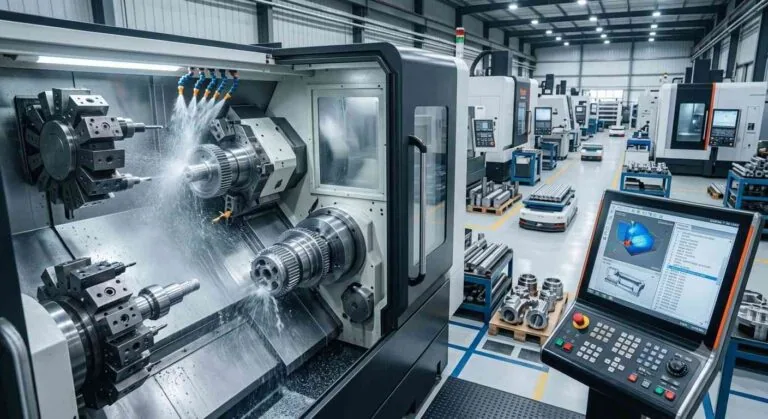
Computer Numerical Control (CNC) machining has evolved from simple automated milling into a multi-faceted discipline involving high-speed robotics and complex software integration. At its core, CNC machining is a subtractive manufacturing process where pre-programmed computer software dictates the movement of factory tools and machinery.
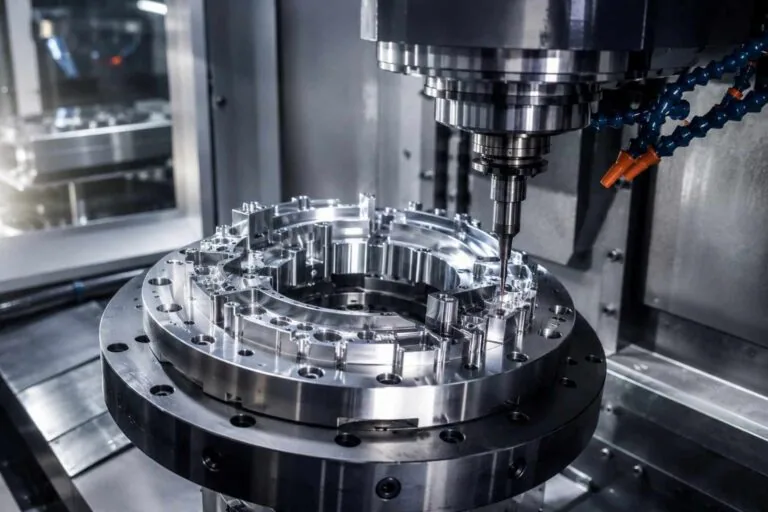
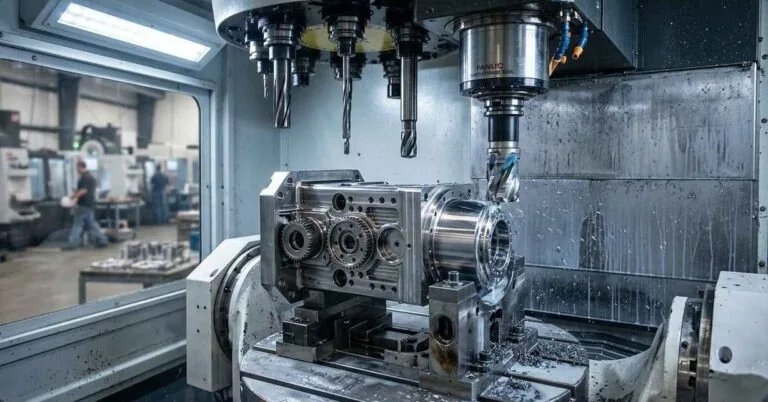
For buyers, the complexity of the part often dictates the technology required. Standard 3-axis machines are excellent for flat surfaces and simple geometries, but as designs become more organic or intricate, 4-axis and 5-axis machines become essential. These advanced setups allow the cutting tool to approach the workpiece from virtually any angle, eliminating the need for multiple setups and reducing the margin for human error.
📦 Material selection quick guide
| Material | Typical use | Machinability |
|---|---|---|
| Aluminum 6061 | Aerospace brackets, enclosures | Excellent |
| Stainless 316 | Medical/surgical, marine | Good (work hardens) |
| Inconel 718 | Turbine blades, high‑temp | Difficult, requires specialist |
| PEEK | Implants, electrical insulators | Fair (needs sharp tools) |
🔹 Tip: Always request material certifications (MTR) to avoid counterfeit stock.
🔍 Quality assurance checklist
- ✔ First article inspection per AS9102
- ✔ In‑process CMM & laser scanning
- ✔ Surface roughness (Ra) profilometer reports
- ✔ Material traceability + batch numbers
- ✔ Full dimensional documentation
Every MW+ order ships with a certificate of conformance, a CMM inspection report and material certificates. First article inspection to AS9102 and PPAP Level 3 are quoted per programme, so name them in the RFQ rather than assuming them.
⚙️ Design for Manufacturing (DfM) tips
- Avoid deep cavities with small tools (increase tool diameter if possible).
- Add radii to internal corners – standard end mills create fillets.
- Uniform wall thickness reduces distortion.
- Orient threaded holes in the same direction to minimize set‑ups.
Key Technical Factors in Part Procurement
When evaluating a machine shop, technical capability is the first filter. However, “capability” is a broad term. Buyers should categorize their needs based on the following criteria:
1. Material Versatility
The machinability of a material significantly impacts the wear on tools and the speed of production. A versatile partner should be proficient in:
- Lightweight Alloys Aluminum 6061/7075, Titanium (Grade 2, 5).
- Hardened Steels Stainless Steel 304/316, Tool Steels (A2, D2, H13).
- High-Temp Superalloys Inconel 625/718, Monel, Waspaloy.
- Engineering Plastics PEEK, Delrin (acetal), Polycarbonate, PTFE.
2. Tolerance and Precision Standards
Not all precision is created equal. A bracket may be perfectly served by the general ±0.01 mm medium class of ISO 2768-1:1989, while a fuel injector or a surgical instrument needs ±0.005 mm, and a small number of features need the ±0.001 mm floor. Ensure your provider utilizes Coordinate Measuring Machines (CMM) and laser scanning to verify these dimensions post‑production. Ask for process capability (Cpk) on the critical features: Cpk ≥1.67 is the level worth writing into the purchase order rather than hoping for. How that capability is recorded and handed over is covered under CNC machining quality control.
3. Surface Finish Requirements
The “as-machined” surface is often just the beginning. Buyers must specify Ra (Roughness Average) values. Common post-processing options include:
- Anodizing (Type II/III): For corrosion resistance and color (aluminum).
- Passivation: Essential for stainless steel in medical applications.
- Bead Blasting / Media finish: For a uniform, matte aesthetic.
- Electropolishing: Lowers Ra further, improves cleanability.
Comparing Machining Technologies
To help procurement teams decide, the table below compares the most common methods. In practice a part is rarely a pure case: prismatic work goes to CNC milling services, rotational work to CNC turning services, and anything with compound angles or undercuts to multi-axis machining. The question to settle before the RFQ goes out is which of those decides your critical dimensions.
| Feature | CNC Milling | CNC Turning (Lathe) | Multi-Axis Machining |
|---|---|---|---|
| Best For | Prismatic shapes, pockets, holes | Cylindrical / symmetric parts | Complex, organic geometries, undercuts |
| Setup Time | Moderate | Fast | High (initial programming + simulation) |
| Precision | ±0.01 mm general (ISO 2768-m) | ±0.01 mm general, tighter on diameters | ±0.005 mm, with a ±0.001 mm floor on selected features |
| Cost per Part | Mid-range | Low (for high volume) | Higher (due to complexity, but often eliminates secondary ops) |
How to Run the RFQ So the Quotation Means Something
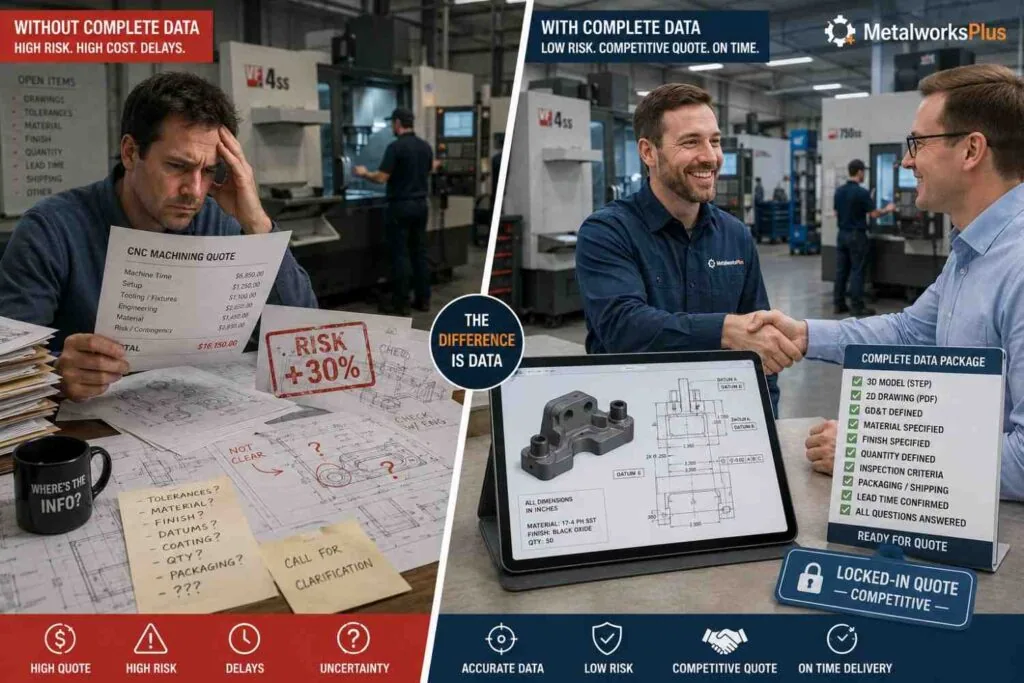
Most disagreements about a machined part begin in the RFQ. A package containing only a 3D model invites the supplier to guess at what is critical, and a quotation built on a guess is not comparable with anyone else’s. The package that removes the guesswork is short: a STEP file, a dimensioned 2D drawing stating the general tolerance class and marking the functional dimensions, the material and its condition, the surface finish including the as-machined case, the quantity you actually intend to buy, and the documentation you will require at delivery.
Two items are worth stating explicitly even when they feel obvious. The first is which dimensions will be inspected and reported, because that is what decides whether a CMM report tells you anything. The second is quantity: quoting a single prototype and then releasing five hundred against that price is the most common reason a second quotation arrives higher than the first, and asking for both figures at the outset avoids it entirely.
Expect a quotation within 24 hours on a complete package, and expect a DFM response with it. If that response is silent on a part with deep pockets, thin walls or a tight relationship across two faces, the supplier has probably not looked — which is useful to know before any money moves.
Qualifying the shop before the first release
Ask for three things and judge the answers rather than the brochure: a redacted CMM report from a comparable part, a sample first article inspection report to AS9102, and the certificate numbers for whichever quality systems your own auditor will care about — ISO 9001:2015 as the baseline, AS9100D for aerospace, ISO 13485 for medical devices and IATF 16949 for automotive. Verify them with the registrar; a logo on a website is not evidence. Then confirm that the shop making your prototype can also make your production quantity under the same quality system, because changing supplier mid-programme means repeating the whole qualification.
Evaluating the Economic Value of Precision
A common mistake in the buying process is prioritizing the lowest “per-part” price over the “total cost of quality.” A low-cost provider may save budget upfront, but if the parts require secondary rework or fail in the field, the long-term expense is catastrophic.
The True Cost of Machining Includes:
- Raw Material Sourcing: Reliable shops have established supply chains, ensuring material certifications are authentic.
- Quality Assurance (QA): Documentation such as First Article Inspection (FAI) reports and Material Test Reports (MTRs).
- Logistics and Packaging: For delicate components, specialized packaging (ESD, foam inserts) to prevent damage during transit.
- Post‑processing & coatings: Anodizing, passivation, or plating if not included in the base price.
Innovation and the Future of Sourcing
The industry is currently moving toward “Industry 4.0,” where IoT-enabled machines provide real-time data on production status. This transparency is becoming a requirement for high-stakes industries. When sourcing CNC machining services, look for partners who invest in digital infrastructure. This allows for better traceability—knowing exactly which machine, which operator, and which batch of raw material produced your specific part.
For engineers, this means fewer surprises. For manufacturers, it means a more resilient supply chain. As you move forward with your next project, remember that the best results come from a partnership based on technical transparency and a shared commitment to precision.
Frequently asked questions
How many suppliers should I put the part out to?
Three is usually enough to see the shape of the market, and more than three starts to cost you more in evaluation time than it saves. What matters more than the count is that all three receive an identical package. If one gets a drawing and two get only a model, you are not comparing prices, you are comparing assumptions.
Should I pay for a first article inspection on a prototype?
If the prototype is going into a qualification test or in front of a regulator, yes — the report is part of the deliverable. If it is a fit check on your own bench, a CMM report on the critical dimensions is usually enough and a full AS9102 package is paperwork you will not read. Decide which of the two it is before you ask for a price, because it moves the number.
How do I compare two quotations that are not like for like?
Break both down to material, machining, finishing, inspection and documentation, and ask each supplier to fill the gaps. Most of the difference between two apparently similar quotations is that one has included the inspection report and the material certificate and the other has not. A quotation that cannot be broken down is a quotation you cannot negotiate.
Can I fix the price for a year?
The machining content can usually be held; the material content is bought on the open market and generally cannot. A blanket order with scheduled releases and a stated material adjustment mechanism gives you most of the stability without asking the supplier to carry a risk they do not control. Ask for machining and material to be shown separately so that the mechanism has something to attach to.
What happens if the first article fails?
Agree the answer before it happens. The questions are who pays for the rework, whether the schedule absorbs the delay or extends, and whether a failure attributable to the drawing is treated differently from one attributable to the process. A supplier who has thought about this will have an answer ready; one who has not will negotiate it while your line is waiting.
When should I not be machining this part at all?
When the volume is high enough and the geometry simple enough for a moulded or cast part to absorb its own tooling, or when the feature you need cannot be reached by any cutter and belongs to another process entirely. Machining wins on low to medium volumes, tight tolerances and materials that cannot be moulded. It is the wrong answer for a million simple plastic housings, and honest suppliers will say so.
What should a CNC machining RFQ package include?
A STEP model, a dimensioned 2D drawing in PDF, the material grade and temper, the surface finish or coating, the quantity with any annual forecast, the documents you need with the parts, and the delivery terms. Each missing item forces the estimator to assume, and the assumption is usually the expensive one. A complete package also lets you compare suppliers on the same basis, which is the whole point of sending it to more than one.
Do I need a 2D drawing if I already have a 3D model?
Yes, for anything with a tolerance that matters. The model defines nominal geometry; the drawing defines what is acceptable: tolerances, datums, thread classes, surface finish and notes such as edge breaks or cosmetic faces. Without a drawing, a shop either quotes to its own general tolerance or asks questions that delay the quotation. Send both, and make sure the revision letters match.
Which general tolerance should the drawing default to?
Most machined parts can default to ISO 2768-m, the medium class of the general tolerance standard, with individual tolerances only on the features that carry function: bores, locating faces, sealing surfaces and mating features. Tightening the general note tightens every untoleranced dimension on the part, which is one of the most common reasons a quote comes back higher than expected. The guide to machining tolerance standards covers how to reference them.
How should I specify the material?
Give the grade, the temper or condition and the standard it is supplied to, for example 6061-T6 aluminium or 316L stainless steel, and say whether a material certificate is required. A bare “aluminium” or “stainless” leaves the supplier to choose, and the choice will be the cheapest grade that meets the letter of the drawing. If a substitute is acceptable, name it, so the supplier does not have to ask.
What is a DFM review, and should I expect one?
A design-for-manufacturability review is the supplier’s engineering read of your drawing before the price is fixed. It flags the features that drive cost or risk: internal corners smaller than a practical cutter, deep narrow pockets, thin walls, tolerances tighter than the function needs, and features that force an extra setup. MW+ returns a DFM review with every quotation, so changes can be decided before the order rather than after the first article.
How quickly should a CNC machining quote come back?
For a complete package on a typical machined part, a day or two is normal; complex assemblies or unusual materials take longer because the estimator has to check tooling and material availability. MW+ quotes within 24 hours from STEP, IGES, DXF, DWG, SolidWorks or PDF files. A quote that arrives with no questions on an ambiguous drawing deserves a second look, because someone made an assumption.
Which documents should ship with the parts?
At minimum, a certificate of conformance and the material certificates. For toleranced parts, add a dimensional inspection report with measured values, and for aerospace work a first article inspection to AS9102. State these in the RFQ so they are priced, not added later. Every MW+ order ships with a certificate of conformance, a CMM inspection report and material certificates.
Is there a minimum order quantity?
Many shops set one to cover setup, but there is no technical reason a single part cannot be machined; it simply carries the whole setup and programming cost. MW+ has no minimum order quantity. If you expect to reorder, ask for price breaks at several quantities so the setup cost is visible and you can see where the unit price flattens.
What lead time should I plan around?
Plan around the whole chain, not only the cutting: quoting, programming, material, machining, finishing and inspection. As a planning basis, MW+ runs prototypes in 3–5 business days, with a 48-hour express route, and volume production in 10–15 business days after sample approval. Anodising, plating and heat treatment are outside processes and add their own time, as the comparison of prototype vs production lead time shows.
How do I protect my design when I send it out for quotation?
Put a non-disclosure agreement in place before drawings are shared, send only what the quote needs, and mark drawings as proprietary. For sensitive products, some buyers split the assembly so no single supplier holds the complete design. Check that the supplier’s quality system controls customer documents, which ISO 9001 requires, and ask how drawings are stored and who can access them.