EV housing machining looks like ordinary aluminium milling until the second batch. The first batch proves the programme; the second and third prove the process. This case study covers complex aluminium EV housings machined for an automotive EV supplier in the Netherlands across three production batches, with CMM-certified parts every time. It explains what makes EV housings difficult, how bore and sealing-face accuracy is held, and what keeps batch three identical to batch one.
Project at a glance
- Industry
- Automotive, electric vehicles
- Client
- Sourcing lead, Netherlands
- Parts
- Complex aluminium EV housings
- Process
- Multi-axis CNC milling and boring
- Batches
- Three production batches
- Inspection
- CMM report with every batch
- Quality system
- IATF 16949
- Result
- “Flawless” across all batches (client)
- 3 batchesof production housings, all accepted
- CMMcertified parts every time
- Fastquote and clear communication throughout
- Complexaluminium EV housings, multi-face machined
“Rapid quote, great communication, and CMM-certified parts every time. They handled our complex aluminum EV housings flawlessly across three production batches.”
Sourcing Lead, Automotive EV supplier, Netherlands
What makes EV housing machining difficult?
An EV housing is the structure that holds a motor, an inverter, a gearbox or part of a battery system in place. It has to locate bearings or components precisely, seal against coolant and weather, carry heat away and do all of it at the lowest possible weight. Those demands pull against each other, and the machinist inherits the conflict.
- Thin walls next to heavy bosses. Weight targets push wall thickness down, while mounting points stay thick. Uneven sections move differently as material is removed.
- Bores that must line up across the part. Bearing and shaft bores on opposite faces must share an axis. If they are cut in separate setups, each re-clamp adds error.
- Large sealing faces. A gasket or O-ring face hundreds of millimetres long has to be flat, and a thin-walled part clamped hard will spring back out of flat when released.
- Cleanliness. In an electric drive, a loose metal chip is not just debris. It can bridge an electrical gap. Technical cleanliness is part of the specification.
- Leak tightness. Cooling jackets and sealed enclosures are often pressure or leak tested, so porosity and sealing-face damage become rejects.
What the client needed
The client was the sourcing lead at an automotive EV supplier in the Netherlands. The housings were complex aluminium parts in production quantities, and the need was straightforward to state and hard to deliver: a fast quote, clear communication, and parts that measured right on the CMM in every batch. Client names, part numbers and application details are not published.
| Requirement | Why it matters on an EV housing | How it was met |
|---|---|---|
| Bore size, form and alignment | Bearing life and shaft alignment depend on it | Opposed bores finished in one setup, sized at 20 °C |
| Sealing face flatness | Coolant and ingress sealing | Light final passes, clamping planned to avoid spring-back |
| Consistent results across batches | Assembly lines cannot absorb variation | Retained fixtures, locked programmes, first-off approval each batch |
| Technical cleanliness | Conductive particles can cause electrical faults | Deburring, washing and clean packing |
| Documented inspection | Incoming inspection and audit trail | CMM report with every batch, material certificates, CoC |
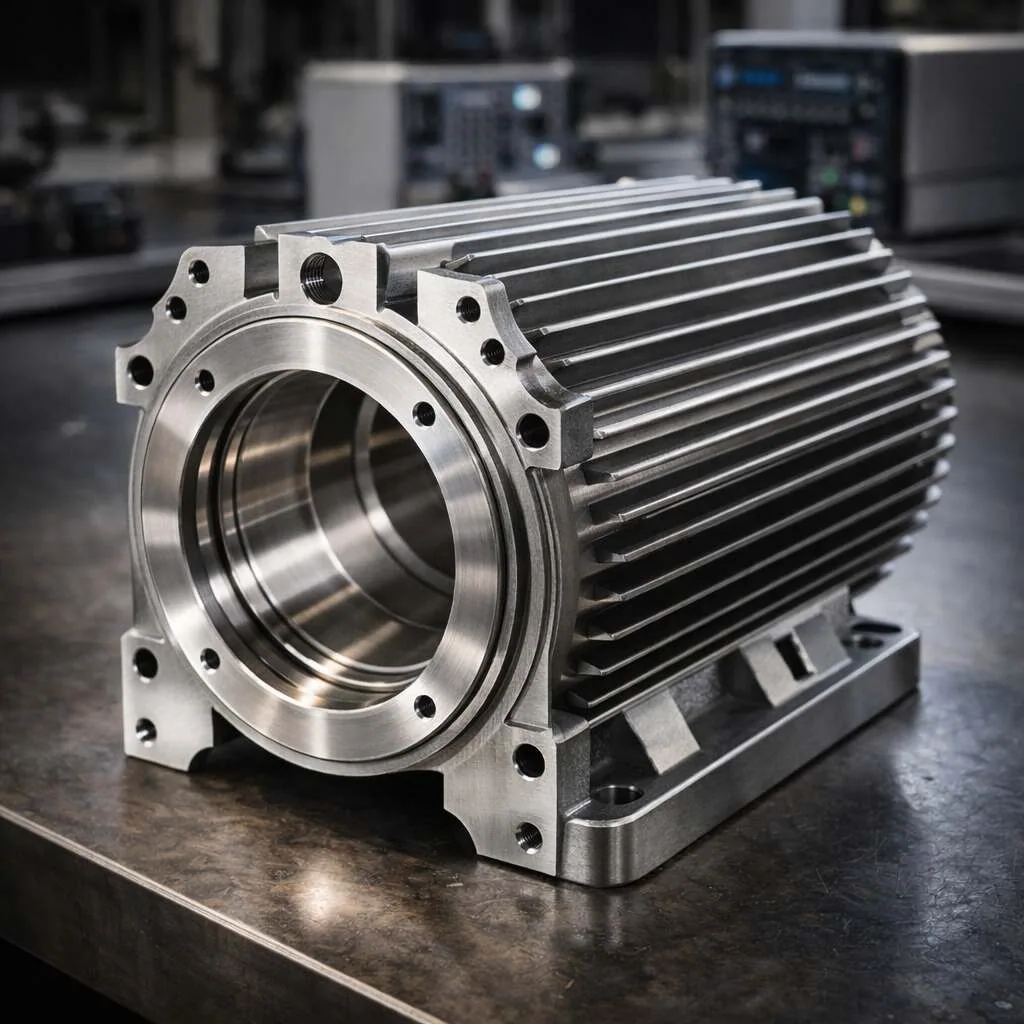
Cast or billet: two routes to aluminium EV housings
EV housings reach the machine shop in one of two forms, and the machining approach differs for each.
| Route | Typical alloys | Strengths | Machining watch-points |
|---|---|---|---|
| Die or sand casting, then machining | A356-T6, AlSi10Mg and similar cast alloys | Near-net shape, low cost at volume | Porosity exposed by machining, casting datums, variation between cast lots |
| Machined from billet or plate | 6061-T6, 6082-T6 | No tooling wait, stable material, good for low to medium volumes | High material removal, residual stress release, longer cycle time |
In EV housing machining from castings, the first job is to establish machining datums from the casting reliably, because every part in a cast lot varies slightly. For billet housings, the first job is to manage stress, because removing most of a block releases stresses locked in during rolling or extrusion. Both routes run through our CNC milling services, with complex multi-face housings moved to 5-axis machines.
How we approach EV housing machining
The route below is how MW+ runs complex aluminium housings in production. The principle is to finish every related feature in the fewest possible setups, and to hold the part so that it is not distorted while it is being cut.
| Step | Operation | What it controls |
|---|---|---|
| 1 | Datum preparation: machine locating faces and holes | A repeatable reference for every later setup |
| 2 | Rough machining with an even finishing allowance | Releases stress before final dimensions are cut |
| 3 | Unclamp and re-seat with light clamping | Lets the part settle to its free shape |
| 4 | Finish sealing faces, bores and O-ring grooves | Flatness, bore size and alignment in one setup where possible |
| 5 | Threads, inserts and small holes | Positions relative to the finished datums |
| 6 | Deburr, especially cross-holes and channel intersections | No loose burrs to break free in service |
| 7 | Wash, dry and inspect | Technical cleanliness and final dimensions |
| 8 | CMM report, clean packing, CoC | Documented acceptance of each batch |
Opposed bores in one setup
Where a housing has bearing bores on opposite faces, the best result comes from finishing both without unclamping. On a 5-axis or horizontal machine, the part is rotated rather than re-clamped, so both bores are cut about the same axis. Where the geometry does not allow that, a line-boring bar through both bores achieves the same result. Either way, the aim is the same: never let a re-clamp stand between two features that must be coaxial. The same principle drives our guide to tolerance stack-up.
Clamping thin-walled parts
A thin-walled housing clamped hard enough to resist heavy roughing will distort. Finish it in that state and it will spring out of flat when released. The fix is to rough with firm clamping, then release, re-seat with light clamping, and take the final passes with low cutting forces. It costs a few minutes per part and saves the batch.
Worked example: why bore temperature matters on aluminium EV housings
Aluminium expands about twice as much as steel. That matters twice on an EV housing: once when the bore is measured, and again when the motor or gearbox reaches operating temperature.
Take a Ø62mm bearing bore toleranced H7 under ISO 286-1, which gives a band of +0.000 to +0.030mm. Aluminium 6061 expands at about 23.6 µm/m·K; bearing steel at about 11.5 µm/m·K.
- Measuring warm. Measured at 26 °C instead of the 20 °C reference in ISO 1: 62mm × 23.6 µm/m·K × 6 K = 8.8 µm. That is almost a third of the 30 µm band, gone to temperature alone.
- Running hot. At an operating temperature of 100 °C (80 K above reference), the bore grows 62 × 23.6 × 80 = 117 µm, while the steel bearing ring grows 62 × 11.5 × 80 = 57 µm. The fit loosens by about 60 µm.
The first number is why housings are measured after they have soaked to room temperature. The second is why EV housing designers specify tighter fits, steel bearing liners or anti-creep features. A machinist who understands both can flag a fit that will not survive operating temperature before the first batch is cut.
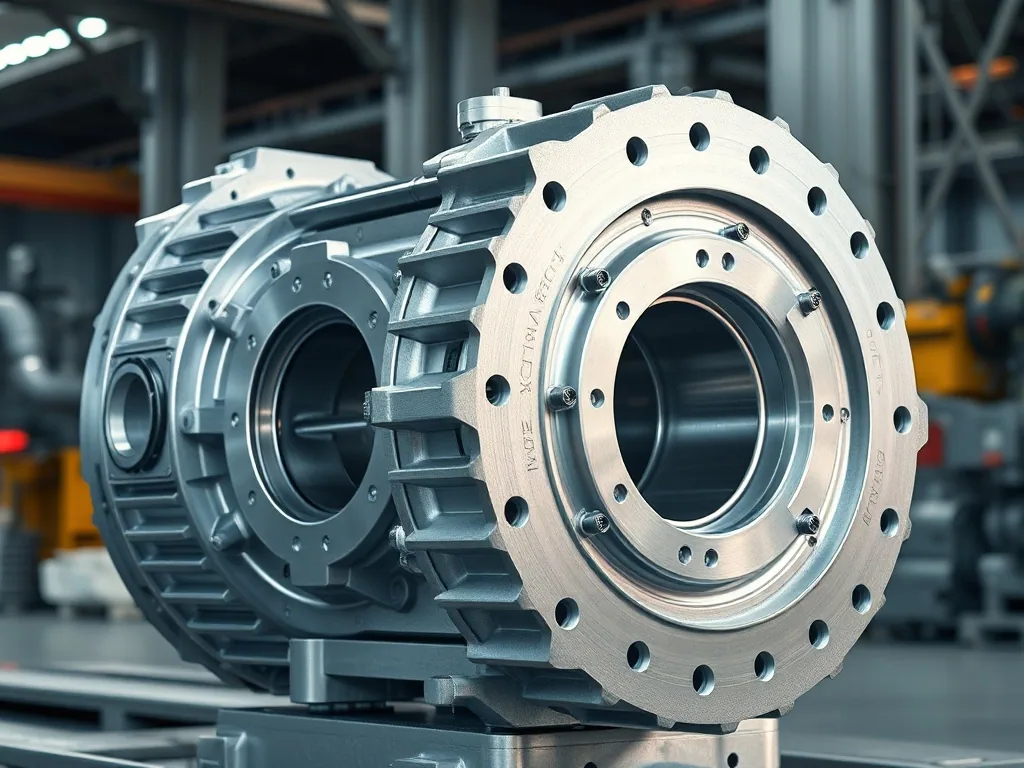
Keeping three production batches identical
The phrase in the client’s quote that matters most is “across three production batches”. Anyone can make a good first batch with enough attention. Repeating it after the fixtures have been stored, the operators have rotated and the material has come from a new lot is the real test. These are the controls that held it.
| Control | What it prevents |
|---|---|
| Fixtures retained and labelled for the part | A rebuilt fixture that locates the part slightly differently |
| Locked CNC programme revision | Unrecorded toolpath changes between batches |
| First-off inspection at the start of each batch | A whole batch run from a bad setup |
| Statistical control of critical bores and faces | Slow drift from tool wear going unnoticed |
| Material certificates checked per lot | A change in alloy or temper between batches |
| Same CMM programme and datum scheme every batch | Measurement differences being mistaken for part differences |
Our target on controlled characteristics is a Cpk of 1.67 or better, the same figure we work to across scaling CNC production from prototype to volume.
CMM-certified parts, every batch
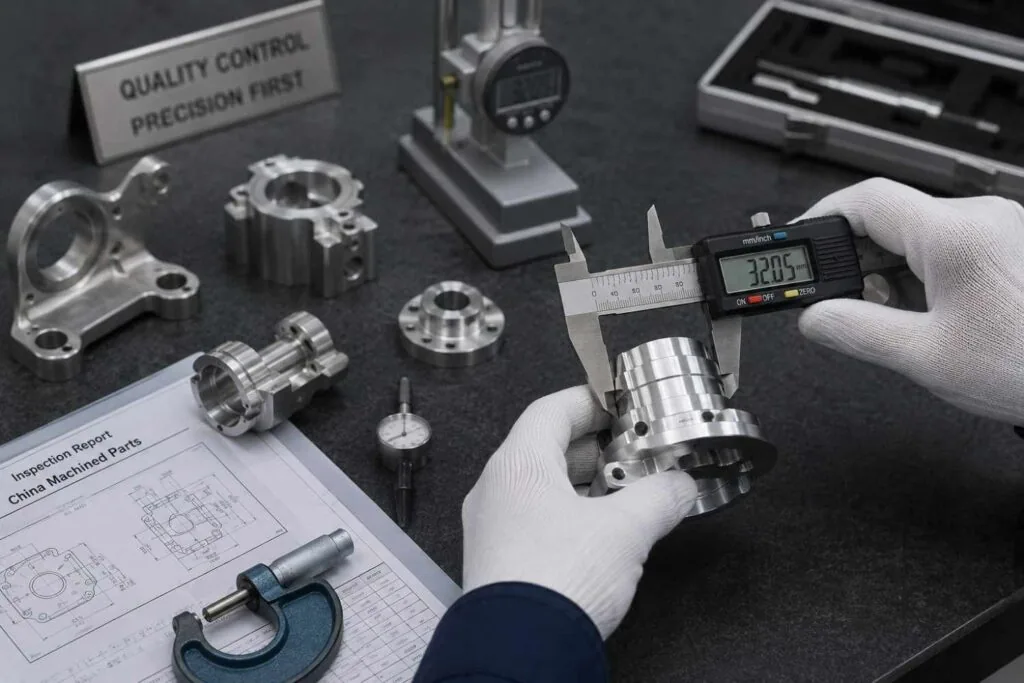
Every batch shipped with a CMM report, along with material certificates and a certificate of conformance, which is standard on every MW+ order. For automotive programmes run under IATF 16949, PPAP Level 3 submissions are available on request and quoted per programme.
A CMM report is only as useful as its datum scheme. On housings, the report should measure bores, faces and hole positions against the part’s own drawing datums, not against wherever the part happened to sit on the machine. If you are reviewing supplier reports, our guide to reading a CMM inspection report explains what to check before approval.
Technical cleanliness for electric drives
Automotive cleanliness is specified and verified under ISO 16232, which covers how particles are extracted from a component and how they are counted and sized. EV programmes often set a maximum permitted particle size, with a tighter limit for metallic particles because of the short-circuit risk. If your drawing or supplier manual sets a cleanliness class, send it with the RFQ, because it changes the deburring, washing and packing plan.
The result
The client’s sourcing lead summarised it: a rapid quote, great communication, CMM-certified parts every time, and complex aluminium EV housings handled flawlessly across three production batches. Those are the client’s words, and they are the only outcome claims this page makes.
About this case study. The client quote is published on our homepage as given. Client name, part numbers, alloy and quantities are not published. The route, controls and inspection approach describe how MW+ runs EV housing machining in production.
Common defects in EV housing machining and how to prevent them
Most rejected housings fail for one of a handful of reasons. None of them is exotic, and every one is cheaper to design out at the DFM stage than to sort out at incoming inspection.
| Defect | Usual cause | Prevention |
|---|---|---|
| Bore oversize or out of round after release | Clamping distortion or heat at the finishing pass | Light clamping for finishing, measurement after a temperature soak |
| Opposed bores misaligned | Bores finished in separate setups | One setup with part rotation, or line boring |
| Sealing face out of flat | Spring-back after unclamping, residual stress in billet | Rough, release and re-seat, then finish; stress relief where specified |
| Leak at a cooling channel or seal | Casting porosity opened by machining, damaged O-ring groove | Porosity limits agreed with the foundry, groove finish controlled, impregnation if the drawing allows it |
| Burrs at cross-holes | Intersecting drilled holes | Back-deburring tools and magnified inspection of intersections |
| Threads out of position | Datum shift between setups | Threads cut from the finished datums, not from the raw part |
| Particles found at the customer’s cleanliness test | Chips trapped in blind holes and channels | Directed flushing during washing, covered and clean packing |
The pattern is worth noticing. Almost every defect traces back to two things: how the part is held and how many times it is re-clamped. A supplier who can explain their clamping and setup plan for your aluminium EV housings before quoting is usually one who has made them before.
What to put on an EV housing RFQ
- The route and alloy. Cast or billet, and the exact alloy and temper. For castings, the casting drawing and the datum targets.
- Critical features, marked. Bearing bores, sealing faces and connector interfaces, with the functional reason if it is not obvious.
- Operating temperature. It lets the supplier sanity-check bore fits.
- Cleanliness requirement. The ISO 16232 or customer-specific class, including any metallic particle limit.
- Leak test requirement. Test pressure and method, so sealing surfaces and plugs can be planned.
- Batch plan. Batch sizes and annual volume, so fixtures and programmes are built for repeat production.
When CNC machining is the wrong approach for EV housings
- Very high volumes. At full vehicle-programme volumes, high-pressure die casting with dedicated transfer-line machining usually beats general-purpose CNC on cost per part.
- Simple sheet-formed covers. Flat covers and brackets without precision bores are often cheaper as laser cutting and forming than as machined parts.
- Uncontrolled castings. If casting variation exceeds the machining allowance, no amount of CNC skill will fix it. The casting process needs attention first.
Frequently asked questions
Can you machine cast aluminium EV housings as well as billet?
Yes. We machine castings supplied by you or your foundry, and housings from 6061-T6 or 6082-T6 billet and plate. For castings we agree the datum targets first, because every cast part varies slightly and the datums must absorb that variation.
What tolerances can you hold on EV housing bores?
Bearing bores to H7 and tighter are routine, with alignment between opposed bores held by finishing them in one setup. Our general tolerance is ±0.01mm to ISO 2768-m, ±0.005mm for precision features and ±0.001mm on selected features.
Do you provide CMM reports with every batch?
Yes. Every order ships with a CMM inspection report, material certificates and a certificate of conformance. The same CMM programme and datum scheme are used for every batch, so results are comparable batch to batch.
Can you provide PPAP for automotive housings?
Yes. We work under IATF 16949, and PPAP Level 3 submissions are available on request, quoted per programme because they involve real engineering hours.
How do you stop thin-walled housings distorting?
By separating roughing and finishing, releasing and re-seating the part between them, and finishing with light clamping and low cutting forces. For billet parts, leaving an even allowance after roughing lets stress release before final dimensions are cut.
Can you meet technical cleanliness requirements?
Send us the cleanliness class and method. Deburring, washing and packing are planned to meet it, and cross-holes and channel intersections get particular attention because that is where chips hide.
What do you need to quote EV housing machining?
A STEP model, the drawing with datums, the alloy and route, batch sizes and annual volume, and any cleanliness, leak test or PPAP requirements. An engineer returns a quote and DFM feedback within 24 hours.
Sourcing aluminium housings for an EV programme?
MW+ is a precision CNC machining company in Shenzhen, running 60+ multi-axis machines, CMM inspection and IATF 16949 quality under one roof. For wider automotive work, see our guide to complex automotive parts and our machine parts manufacturing service. For a high-volume automotive example in a different part family, read the automotive connector pins case study.
Send the model, the drawing and your batch plan. You will get a price, a lead time and written DFM feedback within 24 hours, with the features that decide batch-to-batch consistency on your EV housing flagged up front.