Some features cannot be produced with a rotating tool, however good the tool is. A hardened insert with a slot narrower than any cutter that would survive it. A die with a sharp internal corner. A profile in carbide that has already been heat treated. Those are wire EDM vs sinker EDM jobs. That is the territory where electric discharge machining earns its place — and it is a narrow territory, because EDM is slow, priced by the hour, and refuses to touch anything that does not conduct. This guide sets out where wire EDM is the right answer, where it is the wrong one, what drives the price, and what to ask before you send the drawing.
Key takeaways
- EDM cuts any electrically conductive metal regardless of hardness, because nothing touches the part. If it does not conduct, EDM cannot cut it at all — there is no workaround.
- Precision features run to ±0.005mm, with ±0.001mm available where a feature genuinely needs it. General dimensions stay at ±0.01mm to ISO 2768-m.
- EDM is priced by machine hours. It is slower than milling per cubic millimeter removed, so it belongs on the feature, not on the whole part.
- A thin recast layer forms on every cut edge. Skim passes remove most of it; fatigue-critical parts need that budgeted, not assumed.
- Wire EDM needs a through-path. Blind cavities are sinker EDM work, and no amount of programming changes that.
- Quotes come back within 24 hours; prototypes in 3–5 business days or 48-hour express; production in 10–15 business days.
On this page
- What is wire EDM, and how does it actually cut?
- Wire EDM or sinker EDM: which does your part need?
- Wire EDM against milling, laser and waterjet
- When EDM is the wrong process
- What drives the cost of an EDM job?
- Tolerances, surface finish and the recast layer
- Design rules that keep an EDM part affordable
- Choosing a wire EDM supplier
- Frequently asked questions
What is wire EDM, and how does it actually cut?
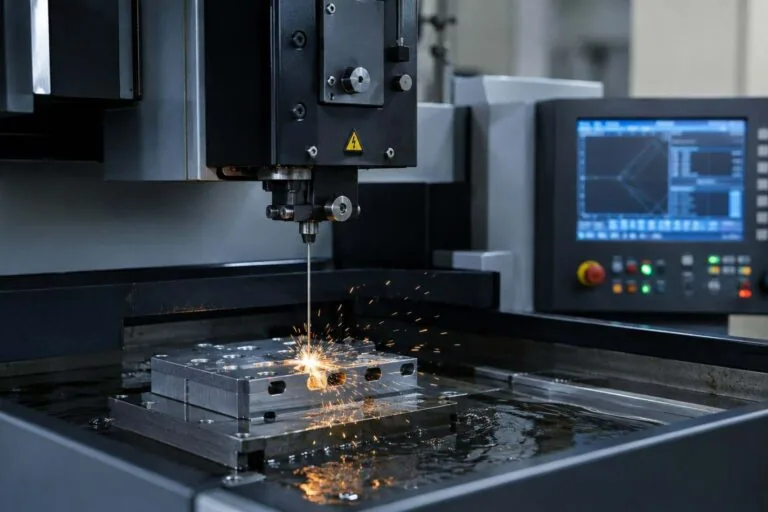
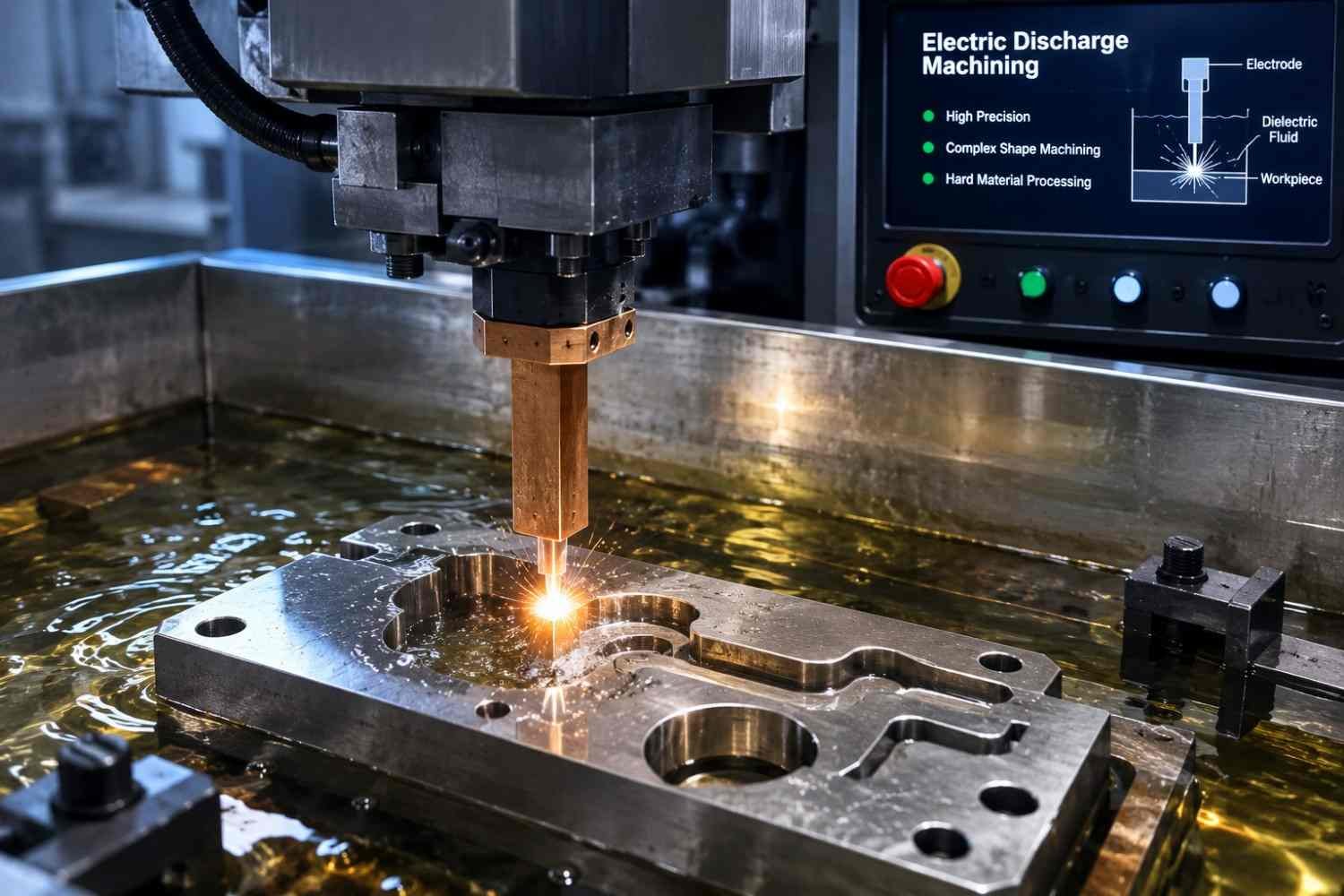
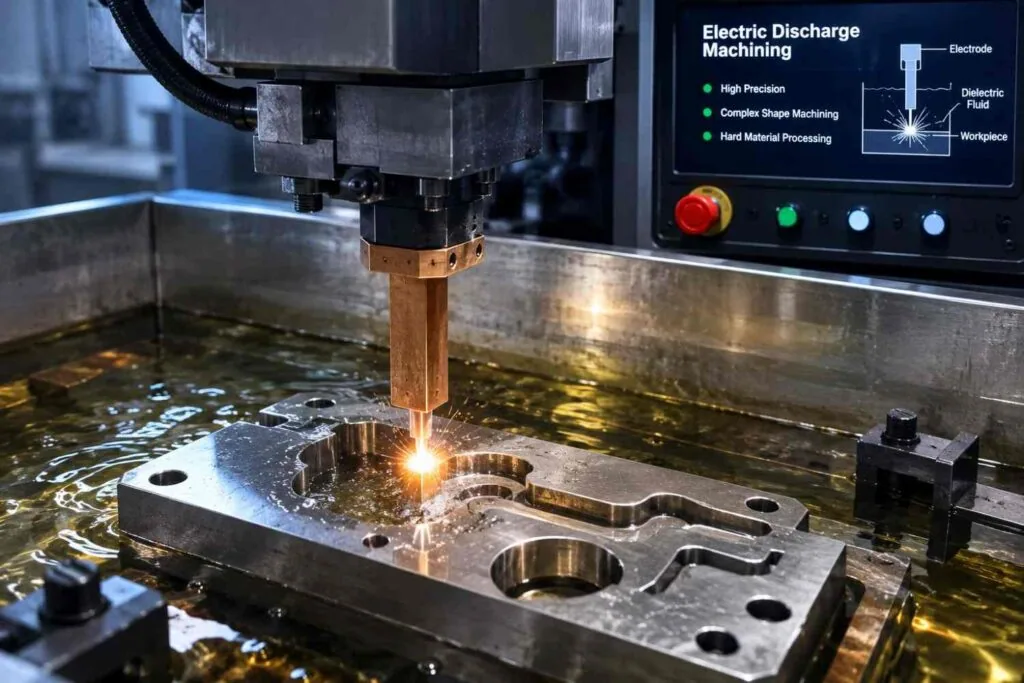
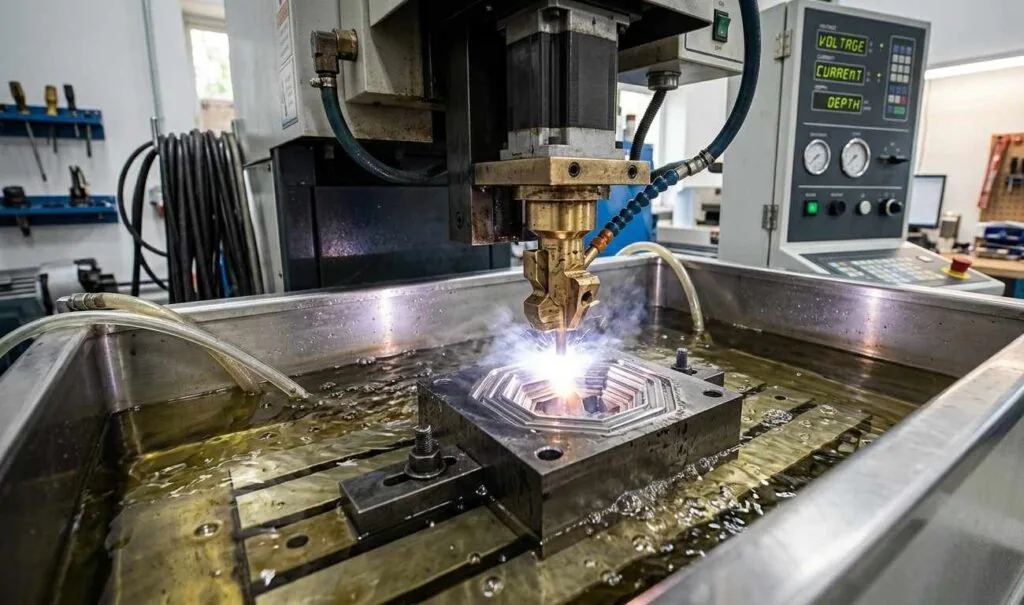
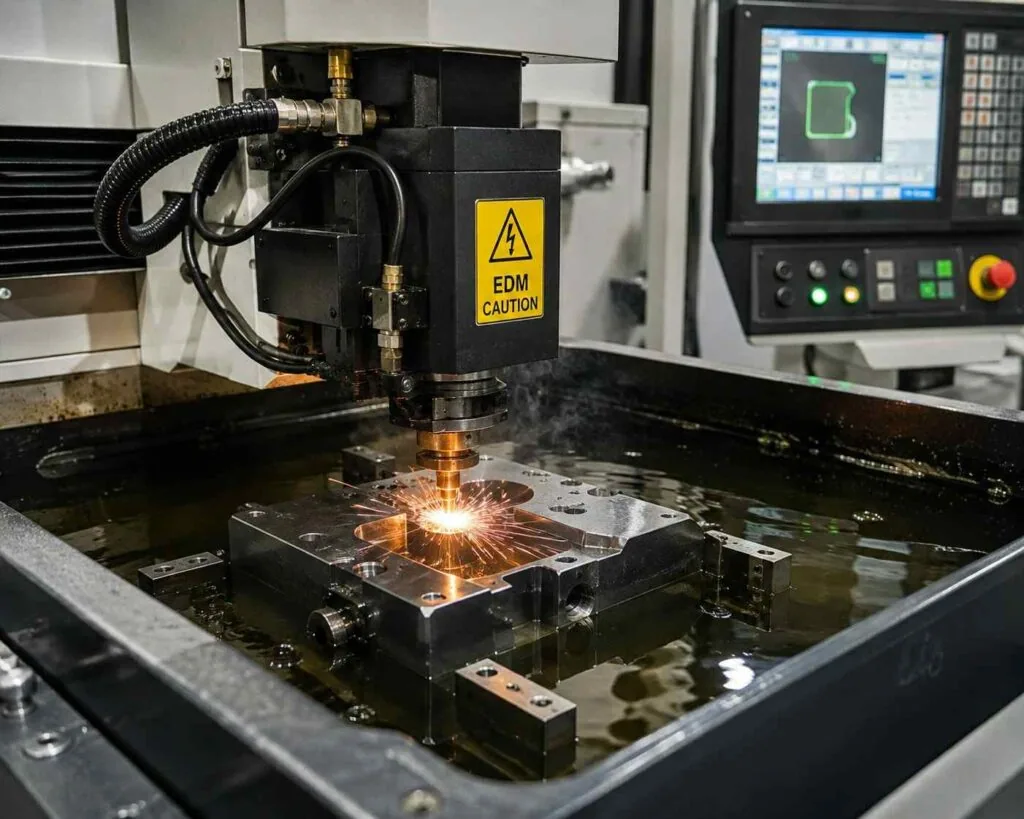
EDM is an erosion process, not a cutting process. A thin brass or coated wire acts as one electrode and the workpiece as the other, with a deionized-water dielectric flooding the gap between them. The machine pulses voltage across the gap until the fluid breaks down and releases a controlled spark. Each spark melts and vaporizes a microscopic volume of metal, and the dielectric flushes the debris away.
Thousands of those sparks fire every second, so the wire traces a programmed path through the material. Because nothing physically contacts the part, there is no tool deflection, no chatter and no clamping force pushing a thin wall out of position. That single property — zero cutting force — is the reason electric discharge machining exists alongside milling rather than being replaced by it.
It is also the reason hardness stops mattering. A spark does not care whether the steel is annealed or through-hardened. What it cares about is conductivity, and that constraint is absolute rather than a matter of degree.
Wire EDM vs sinker EDM: which does your part need?
Wire EDM feeds a continuously spooled wire through the workpiece, which means the geometry has to have a through-path. It suits 2D and tapered profiles, through-slots, extrusion dies and stamping tooling. Sinker EDM instead pushes a shaped electrode into the material to erode a blind cavity — a mold pocket, a gear-tooth form, a keyway that stops partway.
The distinction is not a preference. If your feature does not exit the material, wire EDM cannot produce it, and a supplier who quotes wire for a blind cavity either misread the drawing or intends to change it. Say which you need, or say what the feature has to do and let the shop tell you.
Wire EDM against milling, laser and waterjet
Most difficult parts have three or four plausible routes. The table below is the shortlist comparison, with the figures a buyer needs to make the call.
| Method | Best at | Typical tolerance | Material limits | Internal corners |
|---|---|---|---|---|
| Wire EDM | Hardened steel, carbide, thin deep slots | ±0.005mm | Conductive metals only | Sharp, limited by wire radius |
| CNC milling | 3D shapes, fast material removal | ±0.01mm | Most metals and plastics | Rounded to the cutter radius |
| Laser cutting | Thin sheet at speed | ±0.05–0.1mm | Metals, some plastics | Small radius, heat-affected edge |
| Waterjet | Thick stacks, no heat-affected zone | ±0.1–0.25mm | Nearly any material | Rounded, taper on thick stock |
The strongest routes usually combine methods rather than choosing one. Mill the bulk geometry, wire EDM the hardened or unreachable feature, then grind or lap the mating faces. Paying EDM rates to remove material a mill could have taken out is the single most common way to overspend on this process.
When EDM is the wrong process
This is the section a sales page leaves out. EDM has three hard limits — speed, cost per part and the conductivity requirement — and each one rules out a whole class of work. Being specific about them is more useful than another list of strengths.
Speed. EDM erodes material a spark at a time. Cut rate falls as stock gets thicker, because the wire has more area to erode and the flushing has to clear debris from a deeper kerf. Removing bulk material this way is not slightly slower than milling — it is a different order of magnitude, and you pay for every minute of it.
Cost per part. An EDM quote is machine hours plus wire plus setup. There is no volume mechanism that makes the cut itself faster on part five hundred than on part one, so the per-piece price stays stubborn where a milled part’s would fall. Volume rewards EDM only through setup amortization, which is a much weaker effect than a shorter cycle.
Conductivity. The workpiece completes an electrical circuit. Engineering plastics, technical ceramics, glass and most composites do not conduct, so the process simply does not start. This is not a tolerance limitation to be negotiated — it is the physics of the process.
| If your part | EDM is | Specify instead |
|---|---|---|
| Is a non-conductive plastic, ceramic, glass or composite | Impossible — the circuit cannot form | Waterjet, or CNC milling services |
| Needs bulk stock removed before the precision feature | The wrong tool for that step; you are paying hourly to make chips | Mill to near-net, then EDM the feature only |
| Is open geometry in soft material at ±0.01mm | Slower and dearer for no functional gain | Milling, with a finishing pass |
| Is thin sheet in volume at ±0.1mm | Uneconomic; the cut is measured in millimeters per minute | Laser cutting services |
| Has a blind cavity that does not exit the material | Outside wire EDM entirely — the wire needs a through-path | Sinker EDM with a shaped electrode |
| Is fatigue-critical and cannot carry a recast layer | Not finished when the cut ends | EDM plus skim passes and grinding or polishing, budgeted up front |
There is a fourth limit that is commercial rather than physical: EDM is often specified out of habit on parts that no longer need it. If a feature was originally EDM’d because the stock was hardened first, and the sequence has since changed so the feature could be milled before heat treatment, the process choice is worth revisiting. Ask the question at design review, not at reorder.
What drives the cost of an EDM job?
Almost all of it is machine time, and machine time is set by decisions you make on the drawing. These are the variables in the order they usually matter.
| Driver | Effect on the job | What you can do about it |
|---|---|---|
| Stock thickness | Cut rate falls as thickness rises; flushing gets harder | Mill or grind stock down before the EDM operation |
| Cut length | Price tracks the wire path, not the part outline | Remove decorative profile detail that adds path length |
| Number of skim passes | Each pass adds a full traverse of the profile | Specify the finish the function needs, per surface |
| Taper angle | Steep angles slow travel and complicate offsets | Keep tapers modest unless the die needs otherwise |
| Material | Carbide and hardened tool steel erode more slowly | Confirm the grade before quoting; substitutions change the price |
| Tolerance callout | Tighter means more skims plus more inspection | Call out precision only on the features that carry function |
| Start holes and tabs | Each closed profile needs a start hole and a tab strategy | Reduce the number of separate closed profiles where possible |
Tolerances, surface finish and the recast layer
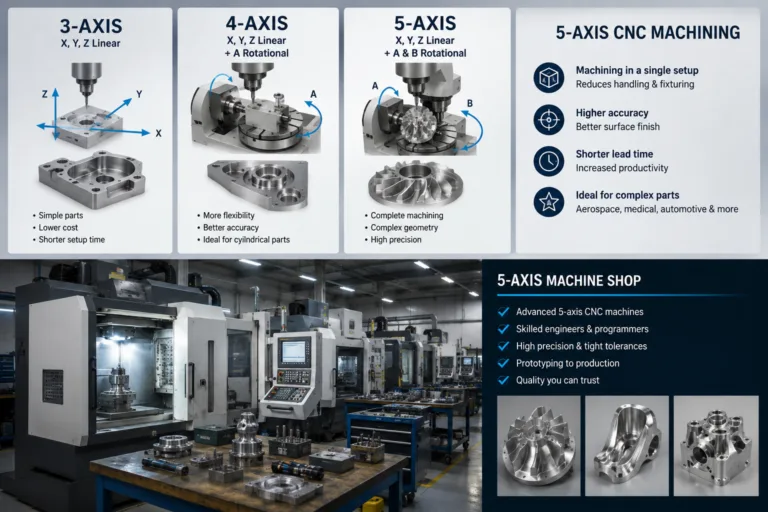
EDM is repeatable because there is no tool wear pushing the geometry off over a run. What varies instead is the number of passes, and that is a specification decision rather than a machine limitation — which is why EDM sits comfortably alongside milling and grinding in a route that produces CNC precision parts.
| Level | Reference | Typical use | What it costs |
|---|---|---|---|
| ±0.01mm | ISO 2768-m general tolerance | Non-critical profile edges | Rough cut, minimal skim |
| ±0.005mm | Called out per feature | Die clearances, locating slots, punch profiles | Skim passes plus CMM verification |
| ±0.001mm | Process floor, feature by feature | Gauge features, close-fit inserts | Multiple skims, temperature-stable conditions |
| Ra 3.2µm to Ra 0.1µm | ISO 4287 surface texture | As-cut through to polished | Each step down adds a full pass |
| H7 / h6 fits | ISO 286 | Any feature that assembles into a mating part | Specify the pair, not one half |
The recast layer, stated plainly
Every spark melts metal, and some of it resolidifies on the cut edge as a thin recast layer with a heat-affected zone beneath it. For a structural bracket or a fixture detail this is irrelevant. For a fatigue-loaded aerospace component, a medical implant surface or a die edge that will see millions of cycles, it matters, and skim passes plus a secondary finishing operation are the answer.
The mistake is treating this as a supplier problem discovered at inspection. Put the requirement on the drawing — the finish, the parameter it is measured against, and whether the recast layer must be removed — and it becomes a quoted operation instead of a dispute.
Design rules that keep an EDM part affordable
- Send it near-net. Mill or grind away everything that does not need a spark, then EDM only the feature that does.
- Accept the wire radius at internal corners. A truly sharp corner is impossible; the smallest radius is set by the wire. Specify the radius you can live with.
- Reduce closed profiles. Every enclosed shape needs its own start hole, and each one is setup time.
- Name the finish per surface. One global Ra callout forces skim passes on faces nobody will ever touch.
- Decide the heat treatment sequence early. Cutting before hardening may let a mill do the work; cutting after is what EDM is for.
For features below the size where a wire can be threaded reliably, the conversation shifts to micro-machining, and the trade-offs change again. Ask which side of that line your feature falls on before you fix the design.
Choosing a wire EDM supplier
EDM work is bought on process control rather than on price per hour, because a shop that runs an extra skim pass you did not need has quietly doubled your cost, and a shop that skips one you did need has quietly shipped a non-conforming part.
| What to ask | A good answer sounds like | Red flag |
|---|---|---|
| How many skim passes are in this quote, and why? | A number tied to the Ra you specified | “However many it takes” |
| Will you mill or grind before EDM where it is cheaper? | A routing that puts EDM only on the feature | Wire-cutting the whole blank |
| How do you handle the recast layer? | A stated pass strategy, plus finishing if required | No mention of it at all |
| How is your measurement equipment traceable? | Named CMM, calibration interval, certificates on file | No calibration records offered |
| What ships with the parts? | Certificate of conformance, CMM report, material certificates | “A report if you ask” |
Traceability deserves its own question. The NIST definition of measurement traceability requires an unbroken calibration chain back to a national standard. A dimension reported to ±0.005mm by an uncalibrated gauge is not a measurement, it is an opinion with a decimal point. Our quality assurance process sets out how that chain is maintained.
What MW+ ships and how long it takes
Every MW+ order ships with a certificate of conformance, a CMM inspection report and material certificates. FAI per AS9102 and PPAP Level 3 are available on request, quoted per program. The quality system is certified to ISO 9001:2015, AS9100D, ISO 13485, IATF 16949 and NADCAP, and process capability is held at Cpk ≥1.67. Material property figures quoted anywhere, including databases such as MatWeb, are nominal — when a property carries load, work from the mill certificate.
| Phase | Standard | Expedited | What drives the variance |
|---|---|---|---|
| Quotation | Within 24 hours | Not applicable | Missing finish or tolerance callouts stall the review |
| Prototype | 3–5 business days | 48-hour express | Stock thickness and skim pass count |
| Volume production | 10–15 business days | Quoted per release | Batch size and any post-EDM finishing |
MW+ operates a 15,000 m² facility in GuangMing District, Shenzhen, founded in 2015, with 60+ machining centers, 120+ engineers and machinists, 70+ material grades and customers in 50+ countries. There is no minimum order quantity. Send a STEP, IGES, DXF, DWG, SolidWorks or PDF file through our CNC machining services or contact us with the drawing, and if the honest answer is that your part does not need EDM, you will be told that instead.
Frequently asked questions
Why is my EDM quote so much higher than the milled version of the same part?
Because EDM is billed by machine hours and it removes material far more slowly than a cutter does. If the two quotes are for the same geometry, the milled one will usually win. The comparison only tips toward EDM when milling cannot reach the feature, cannot hold it in hardened material, or would deflect a thin section. Ask the supplier to quote a hybrid route — mill the bulk, EDM the feature — and compare that number instead.
Can wire EDM cut plastics, ceramics or carbon-fiber composites?
No. The workpiece has to complete an electrical circuit for a spark to form, and those materials do not conduct. There is no fixture, setting or wire type that changes this. For non-conductive materials the realistic routes are waterjet, milling with appropriate tooling, or in some cases laser, each with its own tolerance and edge-quality consequences.
Does EDM leave a surface I can put straight into service?
Often yes, but not always. Every cut leaves a thin recast layer over a heat-affected zone. On structural and fixture components that is normally acceptable. On fatigue-loaded, sealing or biocompatible surfaces it is not, and you should specify skim passes and any secondary finishing on the drawing so the cost is in the quote rather than in a later argument.
Can I get a genuinely sharp internal corner?
Sharper than milling, but not mathematically sharp. The corner radius is set by the wire diameter plus the spark gap, so a smaller wire gives a smaller radius at the cost of cut speed and wire breakage risk. State the maximum acceptable corner radius on the drawing and the shop will select the wire against it, rather than choosing for you.
Does ordering more parts bring the EDM unit price down much?
Less than you would expect. Setup and programming amortize across the batch, but the cut itself takes the same time on every part, so the per-piece floor stays high. Where volume genuinely helps is stacking: several thin plates clamped and cut together in one pass. Ask whether your part is a candidate, because it changes the economics far more than quantity alone.
Should the feature be cut before or after heat treatment?
That decision usually determines whether you need EDM at all. Cutting before hardening lets a mill do the work cheaply, but the part may move during heat treatment and lose the tolerance. Cutting after hardening removes the distortion risk and is exactly what EDM is for. Decide it at design review with both the machinist and the heat treater in the conversation.
How do I compare EDM quotes from different suppliers fairly?
Normalize the scope first. Confirm each quote assumes the same stock thickness, the same number of skim passes, the same surface finish parameter, the same treatment of the recast layer and the same documentation set. Two EDM quotes that differ by half are usually quoting different pass counts, and the cheaper one is not the same part.