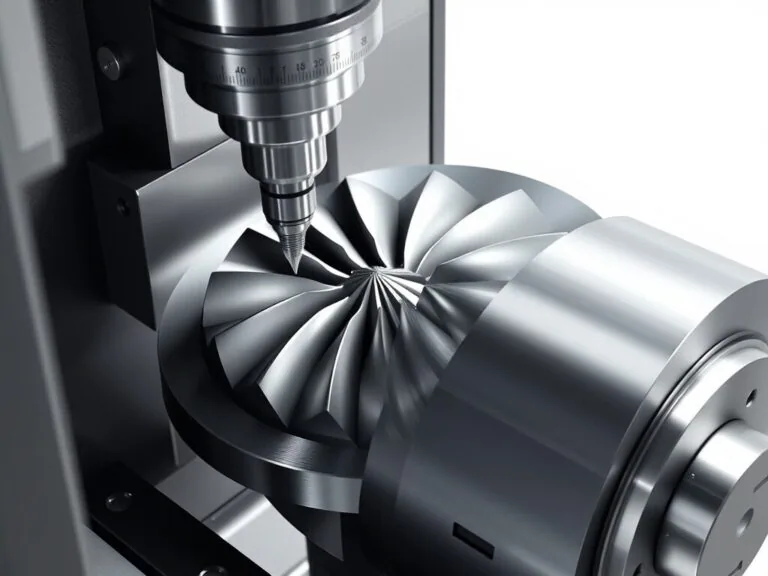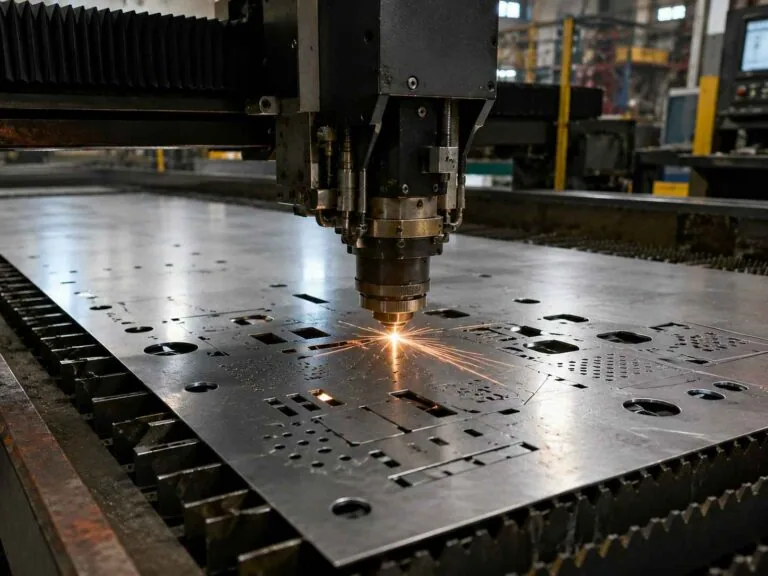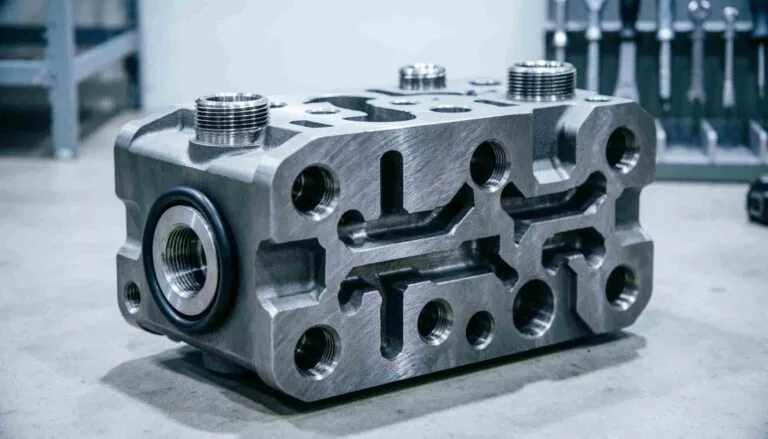
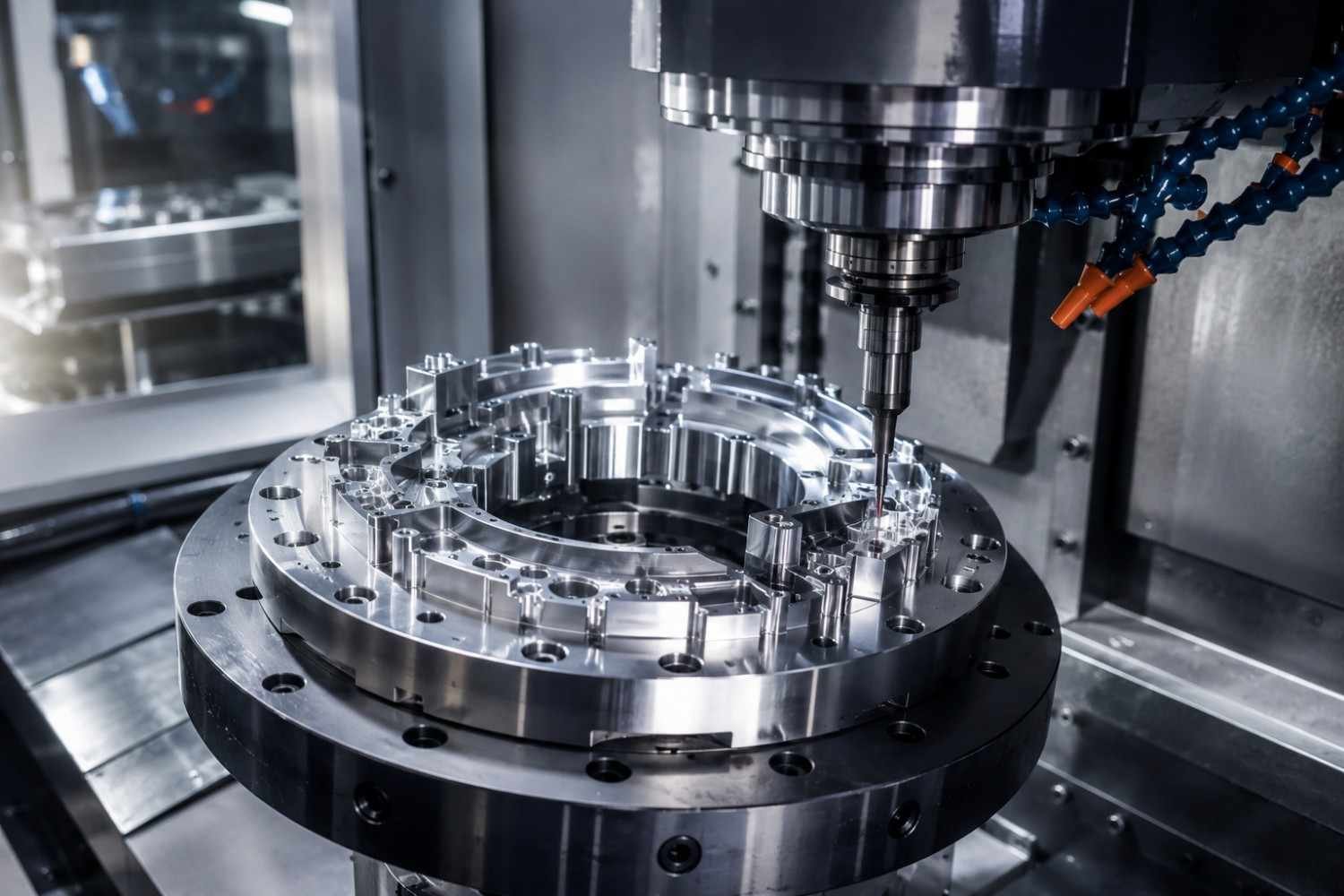
Inconel 718 machining is slow, hard on tools and entirely predictable once you respect the alloy. Run carbide at roughly 20 to 40 m/min, keep the feed high enough to cut under the work-hardened layer, flood the edge with high-pressure coolant, and plan the heat treatment so that tight features are finished after ageing. This guide explains why the alloy behaves the way it does, gives starting cutting data for turning, milling and drilling, and sets out eight rules for aerospace and energy parts made from Inconel 718.
Key takeaways
- Inconel 718 is commonly rated at about 12% of the machinability of free-machining steel. Cycle times of 10 to 15 times the aluminium equivalent are normal, not a sign of a bad shop.
- Machine in the solution-treated condition to AMS 5662 where possible, then age. Finish tight features after ageing to AMS 5663 when the tolerance demands it.
- Work hardening is the central problem. Never dwell, never rub, and always cut deeper than the hardened skin left by the previous pass.
- Carbide turning starts around 30 to 40 m/min in solution-treated material and 18 to 25 m/min when aged; ceramic inserts run several times faster for roughing.
- MW+ machines nickel alloy parts on 3, 4 and 5-axis equipment, CNC lathes and wire EDM under AS9100D, holding ±0.005mm as a precision band.
What is Inconel 718 and why is it so hard to machine?
Inconel 718 is a precipitation-hardening nickel-chromium superalloy, designated UNS N07718. It keeps high strength up to about 650 °C, resists oxidation and corrosion, and can be welded without the strain-age cracking that affects many superalloys. Those properties make it the default material for turbine discs, shafts, casings, fasteners and rings in aircraft engines and gas turbines, as well as for oil and gas tools and cryogenic hardware.
| Element | Typical range, wt % | Role |
|---|---|---|
| Nickel (plus cobalt) | 50–55 | Austenitic matrix, strength at temperature |
| Chromium | 17–21 | Oxidation and corrosion resistance |
| Iron | Balance, about 17–19 | Matrix, lowers cost |
| Niobium plus tantalum | 4.75–5.50 | Forms the gamma double-prime strengthening phase |
| Molybdenum | 2.80–3.30 | Solid-solution strengthening |
| Titanium | 0.65–1.15 | Gamma-prime strengthening |
| Aluminium | 0.20–0.80 | Gamma-prime strengthening |
The same properties that make the alloy valuable make machining Inconel difficult. Five mechanisms act at once.
- Strength at temperature. Steel softens as the cutting zone heats up. Inconel 718 barely does, so cutting forces stay high exactly where the tool is weakest.
- Work hardening. The surface hardens as it is deformed. A light or rubbing pass leaves a hardened skin that the next pass has to cut through.
- Low thermal conductivity. At about 11 W/m·K, heat stays at the tool edge instead of leaving with the chip.
- Abrasive carbides. Hard niobium and titanium carbides in the microstructure wear the cutting edge like grit.
- Adhesion. The alloy tends to weld to the tool, forming a built-up edge that tears away with bits of coating and carbide.
Which condition should Inconel 718 be machined in?
Inconel 718 is bought in the solution-treated condition, usually to AMS 5662, and precipitation-hardened by ageing, usually to AMS 5663. The standard ageing cycle holds the part at about 718 °C for 8 hours, furnace-cools to about 621 °C and holds there for a total ageing time of 18 hours. The choice of when to machine relative to that cycle is the most important planning decision on the part.
| Condition | Specification | Approximate hardness | Machining approach |
|---|---|---|---|
| Solution-treated | AMS 5662 | Well under 30 HRC | Best for roughing: higher speeds, longer tool life |
| Solution-treated and aged | AMS 5663 | Typically 36 HRC minimum, often around 40–45 HRC | Finishing tight features; lower speeds, more tool wear |
| Rough in solution-treated, age, then finish | Both, in sequence | Changes during the route | Best of both: fast roughing, stable final dimensions |
Ageing produces a small but real change in size, and it can release stresses left by heavy roughing. For loose tolerances, machining complete in the solution-treated condition and ageing afterwards is cheapest. For features held at ±0.01mm or tighter, leave a finishing allowance, age, and finish. If you are unsure which applies to your drawing, ask at the quote stage, because the answer changes the price.
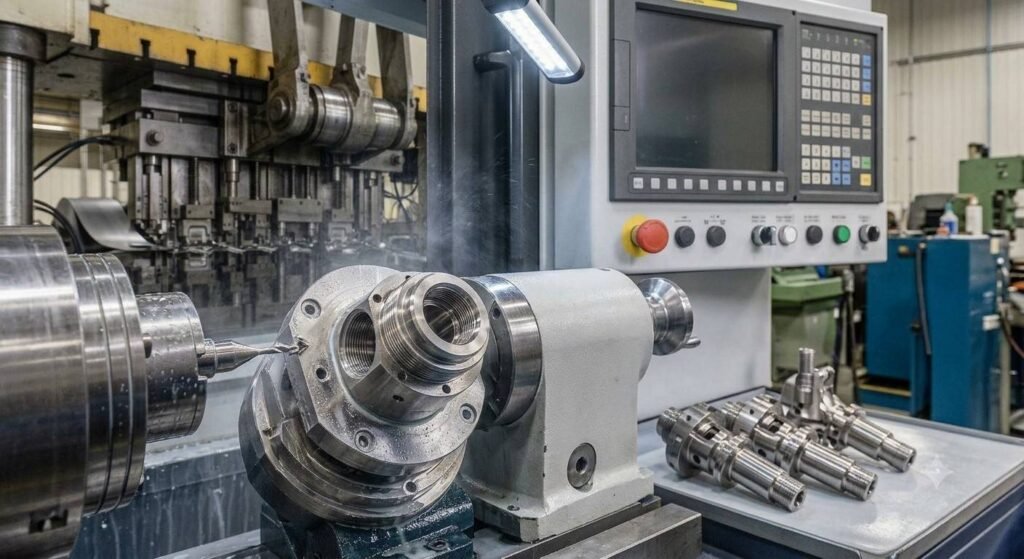
Cutting speeds and feeds for Inconel 718
The table gives starting points, not guarantees. Tool makers’ data for the exact grade and geometry governs, and every machine and setup shifts the numbers. The pattern, however, is consistent: speeds fall by roughly a third from solution-treated to aged material, and drilling runs slowest of all.
| Operation | Tool | Cutting speed, solution-treated | Cutting speed, aged | Feed |
|---|---|---|---|---|
| Turning, roughing | Coated carbide | 30–40 m/min | 18–25 m/min | 0.20–0.35 mm/rev |
| Turning, finishing | Coated carbide, sharp edge | 20–30 m/min | 20–25 m/min | 0.05–0.12 mm/rev |
| Turning, roughing | SiAlON or whisker ceramic | commonly 150–300 m/min | lower end of range | Per tool maker |
| Milling, roughing | Solid or indexable carbide | 25–35 m/min | 15–22 m/min | 0.06–0.15 mm/tooth |
| Milling, finishing | Solid carbide | 18–25 m/min | 18–22 m/min | 0.03–0.08 mm/tooth |
| Drilling, Ø6–12mm | Solid carbide, through-coolant | 10–15 m/min | 8–12 m/min | Per tool maker |
Ceramic inserts: fast, but only for roughing
Ceramic inserts work differently from carbide. At high speed they deliberately heat and soften the alloy just ahead of the edge, which lowers cutting force. They remove material several times faster than carbide, but they leave a heat-affected, stressed surface and are brittle in interrupted cuts. Use them to rough, then finish with carbide to restore surface integrity.
Tooling that survives nickel alloy
- Grade. Fine-grain carbide with a PVD coating such as TiAlN or AlTiN. These coatings form a protective aluminium oxide layer at the temperatures the alloy generates.
- Geometry. Positive rake to cut rather than push, with a small hone on the edge so it does not chip. A dull edge rubs, and rubbing causes work hardening.
- Round inserts for turning. A round insert spreads the depth-of-cut line along the edge, which delays notch wear, the characteristic failure on this alloy.
- Constant engagement in milling. Trochoidal or dynamic toolpaths keep the radial engagement low and steady, so the edge sees an even load and the heat has time to leave.
- Thread milling instead of tapping. A broken tap in an aged Inconel 718 part is often scrap. Thread milling is slower but recoverable.
Tool life is measured in minutes. A turning edge lasting 15 to 30 minutes in the cut is normal, and a tool life plan is part of any credible quote. Our guide to CNC tool wear cost shows how that feeds into part price.
Work hardening and notch wear: the two failure modes
Almost every problem in Inconel 718 machining traces back to one of two effects.
Work hardening
Every pass deforms a thin layer below the new surface and hardens it. If the next pass is shallower than that layer, the tool cuts hardened material, wears faster and hardens the surface further. The spiral ends with a broken tool or a surface that cannot be finished. The fixes are procedural: take a depth of cut and feed that stay below the hardened layer, never let the tool dwell or rub at the end of a cut, and replace edges before they are dull rather than after.
Notch wear
At the depth-of-cut line, the edge meets the hardened surface from the previous pass and the scale or burr at the edge of the chip. Wear concentrates there and cuts a notch into the insert. Varying the depth of cut from pass to pass, using round inserts or a large lead angle, and keeping edges sharp all spread that wear along the edge.
Coolant: pressure matters more than volume
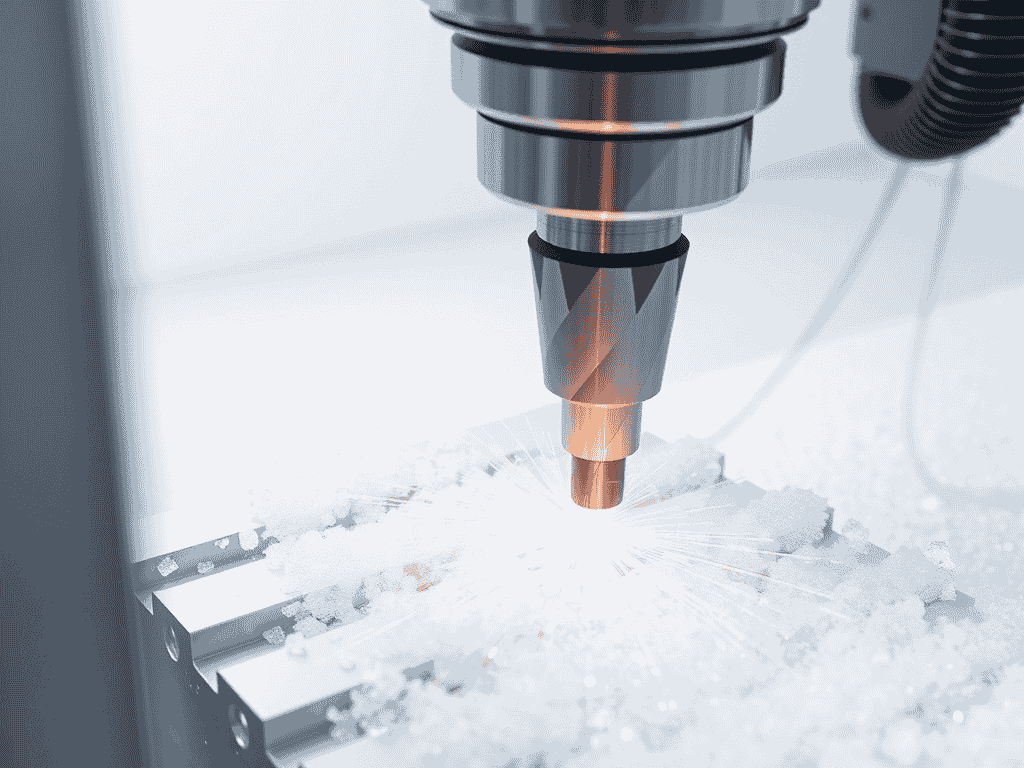
Flood coolant cools the part but struggles to reach the cutting edge, because the chip covers it. High-pressure coolant delivered through the tool, commonly 70 bar or more on production machines, does three things: it gets under the chip to the edge, it breaks the chip into short pieces, and it stops chips being re-cut. On Inconel 718, the difference in tool life between flood and high-pressure coolant is large enough that it usually decides which machine a part is routed to.
Worked example: why Inconel 718 cycle times are long
Take a roughing pass along a Ø100mm outside diameter, 60mm long, and compare nickel alloy with aluminium. Spindle speed is n = 1000 × v ÷ (π × D), with v in m/min and D in mm.
- Inconel 718, solution-treated: v = 35 m/min gives n = 35,000 ÷ (π × 100) = 111 rpm. At 0.25 mm/rev, the axial feed rate is 28 mm/min, so the 60mm pass takes about 2.2 minutes.
- Aluminium 6061: v = 400 m/min gives n = 1,273 rpm. At 0.30 mm/rev, the feed rate is 382 mm/min, so the same pass takes about 0.16 minutes.
The nickel alloy pass takes about 14 times as long. And with a turning edge lasting perhaps 15 minutes in the cut, one edge covers about seven such passes, where in aluminium the same edge would run for hours. Cycle time and tool consumption together explain most of the price difference between an aluminium part and the same geometry in Inconel 718.
When wire EDM beats cutting tools
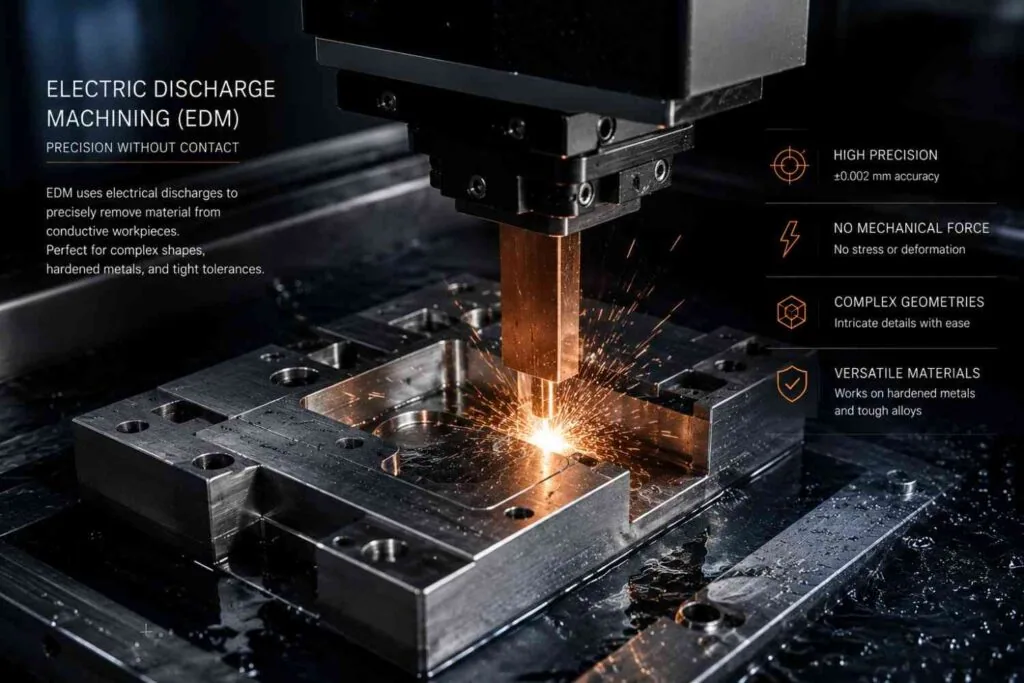
Electrical discharge machining removes material by spark erosion, so the alloy’s hardness and strength do not matter. For some Inconel features it is the better route.
| Feature | Milling or turning | EDM |
|---|---|---|
| Fir-tree and dovetail slots | Special form cutters, high wear | Wire EDM cuts the profile directly, in aged material |
| Narrow slots and sharp internal corners | Limited by tool diameter | Limited only by wire diameter |
| Blind cavities and ribs | Long, fragile tools | Sinker EDM with a shaped electrode |
| Large volumes of material removal | Faster | Slow and costly |
| Surface condition | No recast layer | Recast layer, removed with skim passes where specified |
Aerospace specifications often limit the recast layer left by EDM, so critical surfaces are finished with skim passes. Our wire EDM service handles these features on nickel alloys, and our comparison of wire EDM vs sinker EDM explains the choice between them.
8 proven rules for Inconel 718 machining
- Plan the heat treatment first. Decide what is machined before ageing and what after, and leave finishing allowance accordingly.
- Keep the tool cutting. Never dwell, never rub, never take a spring pass. Every idle contact hardens the surface.
- Cut under the hardened layer. Choose depth of cut and feed so each pass cuts below the skin left by the last one.
- Vary the depth of cut. Moving the depth-of-cut line between passes spreads notch wear along the edge.
- Use high-pressure coolant. Through the tool, aimed at the edge, with good filtration.
- Make the setup rigid. Short tools, stiff holders and solid workholding. Vibration turns into chipping.
- Change tools on a schedule. Replace edges by time or part count before they are dull, not after they fail.
- Use EDM where tools struggle. Slots, sharp corners and deep narrow features are often cheaper by wire or sinker EDM.
Inspection and documentation for nickel alloy parts
Inconel 718 parts usually go into safety-critical assemblies, so the documentation matters as much as the dimensions. Aerospace work at MW+ runs under AS9100D. Every order ships with a certificate of conformance, a CMM report and material certificates, and heat-treated parts carry the heat treatment record. First article inspection to AS9102 is available on request.
| Document | What it proves |
|---|---|
| Mill certificate to AMS 5662 or AMS 5663 | Chemistry, condition and properties of the heat supplied |
| Heat treatment record | Ageing cycle, temperatures and times as specified |
| Hardness test results | The part reached its aged condition |
| CMM inspection report | Dimensions against the drawing, after final machining |
| First article inspection report | Every characteristic verified on the first production part |
| Certificate of conformance | The shipment as a whole meets the purchase order |
When you should not machine Inconel 718 from solid
- Production volumes of large parts. Forged rings and discs with machining allowance, or castings, cut material cost and cycle time dramatically compared with hogging from bar.
- Internal passages that tools cannot reach. Laser powder bed fusion builds of 718, finished by machining at the interfaces, can make geometry that no cutter can.
- Parts that do not need a superalloy. If the service temperature is modest and the environment is not aggressive, a precipitation-hardening stainless steel can meet the load at a fraction of the machining cost. It is worth asking the question before the drawing is released.
How MW+ runs Inconel 718 machining
MW+ is a precision CNC machining company in Shenzhen with 60+ multi-axis CNC machines, lathes and wire EDM in one facility. Nickel alloy parts are routed to the machines with the rigidity and coolant pressure the alloy needs.
- Multi-axis machining for casings, blisks, brackets and impellers, where one setup protects accuracy.
- CNC turning services for shafts, rings and fasteners.
- Wire and sinker EDM for slots, corners and cavities.
- Tolerances of ±0.01mm to ISO 2768-m generally, ±0.005mm for precision features and ±0.001mm on selected features.
For an aerospace example on 5-axis equipment, read our impeller machining case study. For titanium, the other common aerospace alloy, see our guide to titanium CNC machining cost.
Frequently asked questions
Why is Inconel 718 machining so expensive?
Because cutting speeds are roughly a tenth of those used on aluminium, tool edges last minutes rather than hours, and parts often need a heat treatment step and a second finishing operation. Material cost is also high. The worked example above shows a single roughing pass taking about 14 times as long as in aluminium.
Should I machine Inconel 718 before or after ageing?
Rough before ageing, when the alloy is softer, and finish tight features after ageing, when dimensions are stable. For loose tolerances, machining complete before ageing is cheaper. Tell us the tolerance on your critical features and we will recommend the route.
What tolerance can you hold on Inconel 718 parts?
±0.005mm on precision features is our standard band, with ±0.001mm possible on selected features. On a hard, low-conductivity alloy, tool wear and temperature control matter more than machine accuracy, so we plan tool changes and measurement around the tightest features.
Can you machine Inconel 625 and other nickel alloys?
Yes. Inconel 625, Hastelloy, Waspaloy and similar nickel alloys follow the same principles, with cutting data adjusted per alloy. Each behaves slightly differently, so the alloy and condition should be on the drawing.
Do you use ceramic inserts on Inconel 718?
For roughing, where the higher speed pays off and the surface will be removed later. Finishing is done with sharp carbide to leave a clean, low-stress surface on the final part.
Can you provide heat treatment to AMS 5663?
Heat treatment is controlled as part of the route, with the ageing record and hardness results supplied in the documentation pack. Tell us the specification at quote stage so it is planned into the lead time.
How long does an Inconel 718 part take to make?
It depends heavily on size and heat treatment. Simple prototypes can run in our standard 3 to 5 business days, while aged parts with finishing after heat treatment take longer. Production lots are typically planned at 10 to 15 business days.
What to send us
A STEP model, a drawing with datums and critical features, the material specification and condition, any heat treatment and documentation requirements, and the quantity. You will get a quote and written DFM feedback within 24 hours, including a recommended heat treatment sequence and which features of your Inconel 718 machining job are better made by EDM.