Comparing Lead Times Across Different CNC Machine Parts and Tool Types
The clock starts the moment you place an order. In precision manufacturing, time is never just money — it is momentum. Whether you are sourcing custom machine parts for an automotive assembly line, ordering CNC precision parts for a medical device, or fulfilling a rapid-turn prototype run, understanding how long production actually takes — and why — is the first step toward building a supply chain that never stalls.
At MW+, we have spent years helping engineers, procurement managers, and operations leads across aerospace, defense, medical, and industrial sectors navigate exactly this challenge. This guide breaks down what actually consumes the calendar in each major CNC machining parts category so you can plan with confidence — and partner with a supplier who consistently delivers.
What Does “Lead Time” Actually Mean in CNC Manufacturing?
Before diving into comparisons, it is important to define what lead time truly covers. Many buyers assume lead time equals machine time — it does not. The full production timeline includes every stage from order receipt to delivery:
Each of these variables shifts depending on the part type, volume, material, and complexity. A simple aluminum bracket behaves entirely differently in the production queue than a titanium aerospace fitting requiring CMM verification and a First Article Inspection (FAI) report.
Each stage adds structured lead time — vertical integration reduces handoff delays.
Lead Times by CNC Part Type: What Drives Each One
Not all CNC machine parts are created equal. Below, we compare five major CNC part categories by lead time across four production volume tiers — prototype through high-volume — so you know exactly what to expect before your RFQ is even submitted.
CNC Turning Parts
Single-setup turned work is the shortest path through a shop: one work-holding, one program, and bar stock that is usually already in the rack. What stretches it is a second operation — a cross-hole, a flat, a milled feature — because that means a second setup, a second fixture and a second proving-out. Ask whether your part is genuinely single-op before assuming a turned part is fast.
CNC Milling Parts
Milled parts carry fixture work that turned parts do not. A prismatic part machined from plate in two or three setups spends more of its schedule in fixture design and CAM programming than on the spindle, and that front-loaded time is identical whether you order five pieces or fifty. It is why the effective per-piece lead time on milled parts falls so sharply with quantity.
CNC Precision Parts
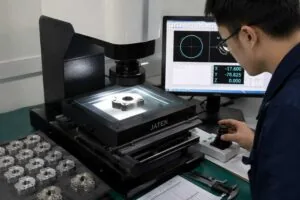
Tight-tolerance work is not slower because the cutting is slower. It is slower because of everything around the cutting: CMM programming written against your datum scheme, thermal soak time before measurement, re-chucking sensitivity that forces lighter passes, and inspection reporting that has to be produced and reviewed rather than sampled. Budget the inspection window separately from the machining window when you plan the schedule. The cost and time difference between the two most commonly requested bands is set out in tolerances of ±0.01 vs ±0.005 mm compared.
Multi-Axis Complex CNC Machining Parts
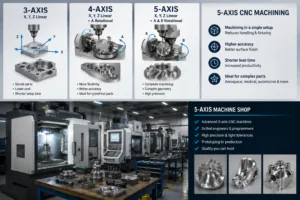
Five-axis work concentrates its lead time at the front. Toolpath generation, collision simulation and the first proving-out cycle on the machine are where the days go. Once the program is proven, the per-piece cycle is often competitive with a three-axis equivalent that needed three separate setups. On multi-axis parts the first article is the slow part, not the batch.
Master Comparison Table: All CNC Part Types at a Glance
The table below sets out the windows MW+ quotes against. It is deliberately not presented as an industry benchmark: there is no published cross-industry lead-time dataset for CNC parts, so any article offering one is estimating. Another shop numbers will differ with its backlog and its machine mix. The column worth reading is the last one, because that is where your own part will or will not lose days.
| Part type | Prototype (1–5 pcs) | Volume production, after sample approval | What extends it |
|---|---|---|---|
| Turned parts, single setup | 3–5 business days, or 48 hours on the express route | 10–15 business days | A second operation, or bar stock that has to be brought in |
| Milled parts, 2–3 setups | 3–5 business days | 10–15 business days | Fixture build and CAM programming ahead of the first cut |
| Tight-tolerance precision parts | 3–5 business days for the parts; inspection is scheduled on top | 10–15 business days plus the inspection window | CMM programming, thermal stabilisation, FAI reporting |
| Multi-axis complex parts | Programming and proving out are quoted per part; the batch then follows the standard window | 10–15 business days once the program is proven | Toolpath simulation and the first proving-out cycle |
| Any part needing post-processing | Add the finishing window | Add the finishing window | Anodising, plating and heat treatment leave and re-enter the shop |
The Top Factors That Influence CNC Machine Parts Lead Times
- Material behaviour — titanium and nickel alloys are cut at far lower surface speeds than 6061 aluminium because of poor thermal conductivity and work hardening, so the same geometry occupies the machine for considerably longer and consumes more tooling
- Tolerance band — a feature at ±0.001 mm needs slower finishing passes, a temperature-stable measurement environment and a documented CMM result, where a feature at ±0.01 mm to ISO 2768 medium class may be gauged on the machine
- Surface finish — a polished Ra 0.1 µm finish requires additional finishing and polishing operations beyond the Ra 3.2 µm as-machined surface; the finish specification, now governed by ISO 21920-2:2021 superseding ISO 4287, should state which convention the drawing uses
- Post-processing — anodising, plating, heat treatment and black oxide take the part out of the shop and put it in someone else queue, which is the single most common reason a committed date slips
- Raw material availability — common aluminium and steel grades are held in stock; nickel superalloys such as Inconel 718 and Hastelloy are ordered in, and the procurement tail is set by the mill and the distributor rather than by the machine shop
- DFM review cycles — incomplete or ambiguous drawings trigger revision loops that delay production kickoff by days, and occasionally by weeks
- Quality documentation — first article inspection to AS9102, material certificates and PPAP packages add structured, schedulable time to the QC phase and should be agreed at quoting rather than requested afterwards
How to Reduce Lead Times Without Compromising Quality
- ✅ Submit complete, GD&T-annotated drawings from the first submission — ambiguity is the #1 source of avoidable delay
- ✅ Design for Manufacturability (DFM) — eliminate unnecessary undercuts, deep blind holes, and tight-tolerance features that do not functionally require them
- ✅ Select standard materials whenever the application allows, and say in the RFQ whether a documented equivalent grade is acceptable — that single sentence often removes the procurement tail altogether
- ✅ Establish blanket purchase orders for recurring parts — a released call-off against an agreed price and an agreed control plan skips quoting, DFM review and first-article approval entirely
- ✅ Communicate rush requirements at the quoting stage — not after the order is placed, since by then the machine slot has already been allocated
- ✅ Attack the stage that is actually long — the stage-by-stage view in the CNC machining lead times playbook shows where the calendar usually goes, and it is rarely the spindle
- ✅ Partner with a vertically integrated shop — in-house turning, milling, inspection, and finishing means zero handoff delays between vendors
When a shorter lead time is the wrong thing to optimise
Pushing a supplier for the earliest possible date is not free. Compressing a schedule usually means the first article gets inspected alongside the batch rather than before it, which moves risk off the calendar and onto your incoming inspection. On a part with tight geometric tolerances that is a poor trade, and it is how a two-week saving becomes a six-week sort. If the geometry is simple and the tolerance band is wide, compress freely. If it is not, buy the time for a proper first article and protect the launch date rather than the production date.
The other case worth naming: an expedite that displaces something else. If a supplier can always take a rush order, ask what it is being moved ahead of. A shop with no queue is either very well run or very quiet, and those two look identical from a purchase order.
Where the constraint is the process rather than the schedule, the capability detail sits on the CNC milling services page, and a drawing sent through request a CNC machining quote comes back with a lead-time estimate within 24 hours.
Frequently asked questions
What is a realistic lead time for CNC machine parts?
There is no single average worth quoting, because the spread across part types and shops is wider than any average is useful. As a planning basis, MW+ quotes prototypes at 3–5 business days with a 48-hour express route, and volume production at 10–15 business days from sample approval. Post-processing and formal inspection are scheduled on top of those windows rather than inside them.
Why do tight-tolerance precision parts take longer?
Because the time goes into the work around the cutting. CMM programming has to be written against your datum scheme, parts need to reach a stable temperature before measurement, re-chucking sensitivity forces lighter finishing passes, and the inspection report has to be produced and reviewed rather than sampled. None of that is spindle time, and all of it is schedule.
How do I actually shorten a milling lead time?
Reduce the number of setups, since fixture design and CAM programming are front-loaded and identical at any quantity. Send a complete, dimensioned drawing with the datum scheme defined so the DFM review does not turn into a revision loop. Say at quoting stage that you need it expedited, not after the order is placed, because by then the slot has been allocated.
What adds the most time to an order?
Three things, in this order: post-processing that takes the part out of the shop and into somebody else queue, procurement of a grade that is not held in stock, and an ambiguous drawing that triggers a revision cycle. The machining itself is rarely the bottleneck, which is why quoting only the machining time produces dates that get missed.
Does MW+ offer expedited production?
Yes. A 48-hour express route is available on prototypes and expedited slots exist on production work, both subject to current loading. Raise it during quoting so the slot is reserved and the effect on the rest of your schedule is visible before you commit.
Does a quoted lead time run from the purchase order or from drawing approval?
Ask, and get it in writing, because shops differ and this is where most schedule disputes start. MW+ counts from approval of the final drawing revision and, on parts requiring a sample, from sample approval. Any change to the drawing after that point restarts the clock on the affected operations.
Lead-time windows on this page are the ones MW+ quotes against and are subject to current loading; they are not an industry benchmark.