A machined prototype that arrives in three to five business days is not the product of a faster spindle. The cutting itself usually takes minutes. A rapid CNC prototyping lead time is won or lost in the hours around the cutting — quoting, design review, stock availability, programming, fixture preparation, inspection and the courier cut-off — and every one of those is a scheduling problem rather than a machining problem.
This page takes the schedule apart phase by phase, shows the arithmetic of where the hours actually go, and sets out which decisions on your drawing move the delivery date. It is about the calendar. The separate question of what the part costs at different quantities is handled in our guide to the prototype-to-production cost curve.
Key takeaways
- Spindle time is the smallest block in a prototype schedule. A worked example below finishes a 200 mm slotting pass in 6.3 seconds of cutting; the same part still needs days of calendar.
- MW+ returns a quotation within 24 hours and ships standard prototypes in 3–5 business days, with a 48-hour express route for parts that qualify.
- Stock availability is the most common single-day delay. A grade held in the rack in a usable section keeps the 3-day slot; a mill-order section does not.
- Tolerance drives the schedule through verification, not through cutting. General work runs to ±0.01 mm against ISO 2768-m; ±0.005 mm and ±0.001 mm features add measurement and thermal settling time.
- Speed does not reduce the record. Every order ships with a certificate of conformance, a CMM inspection report and material certificates; AS9102 first article is quoted separately because it takes engineering hours the express route does not contain.
- An incomplete RFQ is the largest self-inflicted delay. A STEP file with no dimensioned drawing, no datum scheme and no finish call-out costs a full round trip before the job is even scheduled.
- What does a 3–5 day lead time actually cover?
- Where the hours really go: two worked calculations
- What actually drives the schedule?
- Which materials hold the three-day slot?
- How tolerance and finish move the date
- Does a fast part get less inspection?
- How to compress the lead time legitimately
- When a 3–5 day prototype is the wrong thing to buy
- How MW+ schedules rapid prototype work
- Frequently asked questions
What does a 3–5 day lead time actually cover?
It covers everything between an accepted order and a package handed to a carrier. It does not usually include the quotation round, and it never includes transit. Both are frequently the reason a buyer’s own “five days” turns into two weeks, so it is worth agreeing at the start which clock each party is reading.
| Phase | Typical elapsed | What stalls it |
|---|---|---|
| Quotation and technical review | Within 24 hours of a complete file set | Missing drawing, no datums, no finish call-out |
| Order confirmation and DFM feedback | Same working day | Features that cannot be reached with a standard tool |
| Stock allocation | Same day if the section is racked | A grade or section that must be ordered in |
| CAM programming and simulation | Hours, run in parallel with stock allocation | Complex 5-axis geometry, undefined tolerances |
| Fixture preparation and setup | Hours; longer if soft jaws must be cut | Thin walls, awkward datum surfaces |
| Machining | Minutes to a few hours of spindle time | Multiple setups, hard alloys, deep cavities |
| Deburring and secondary operations | Hours | Manual finishing, tapping, marking |
| Inspection and documentation | Hours | Thermal settling before measurement, full reporting |
| External finishing, if specified | Adds working days | Anodising, plating and heat treatment are batch processes |
| Packing and carrier collection | Same day if before cut-off | Missing the collection by an hour costs a full day |
Read down that column of stalls. Seven of the ten are decided before any metal moves, which is why the fastest way to lose a day is to send an incomplete package, and the fastest way to gain one is to answer a DFM question within the hour.
Where the hours really go: two worked calculations
Calculation 1: how long the cutting takes
Take a 200 mm slotting pass in aluminium 6061 with a three-flute carbide end mill of 12 mm diameter. Assume a cutting speed of 300 m/min and a feed per tooth of 0.08 mm, both routine values for this combination. Spindle speed comes from the standard relationship:
n = (1000 × Vc) ÷ (π × D) = (1000 × 300) ÷ (π × 12) = 7,958 rev/min
Table feed follows from spindle speed, feed per tooth and flute count:
Vf = n × fz × z = 7,958 × 0.08 × 3 = 1,910 mm/min
So the pass takes 200 ÷ 1,910 = 0.105 min, or 6.3 seconds. Even a part needing two hundred such passes, plus tool changes and rapid moves, finishes inside a shift. The cutting is never what makes a prototype take a week.
Calculation 2: assembling the calendar
Now add the blocks that surround it for a single milled aluminium housing with one secondary setup. Suppose review and quotation consume 6 working hours, stock allocation 1, programming and simulation 4, fixture preparation and setup 3, machining 2, deburring and tapping 2, inspection and reporting 3, and packing 1. The total is 22 working hours.
Against an 8-hour working day that is 2.75 days of work — but it does not compress into 2.75 days of calendar, because phases hand off between people and shifts and because a courier collects once a day. Spread across handoffs it lands in the three-to-five day band. Spindle time is 2 of the 22 hours, or 9%. Add an anodising operation, which is an external batch process, and the same part moves to seven or eight days without a single extra minute of cutting.
What actually drives the schedule?
Five variables account for almost every prototype that slips. None of them is machine capacity.
| Driver | Effect on the schedule | What you can do about it |
|---|---|---|
| Completeness of the RFQ | Each clarification round adds a working day | Send model, drawing, material spec, finish and quantity together |
| Stock section and grade | A mill order adds days before cutting starts | Ask which grades are racked; accept a near equivalent if function allows |
| Number of setups | Each re-fixture adds preparation and re-indication | Design features onto fewer faces where the function permits |
| Tolerance and datum clarity | Undefined datums stop programming outright | Apply ISO 1101 or ASME Y14.5 datums to critical features |
| Secondary and external processes | Anodising, plating and heat treatment run in batches | Ask for as-machined parts first, finish a second set later |
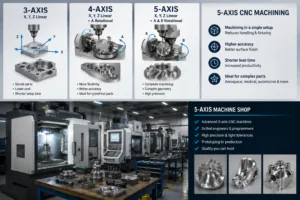
Setup count deserves emphasis. A part with features on five faces machined on a 3-axis centre needs several fixtures and several re-indications; the same part on a multi-axis machining centre can often be completed in one or two. On a prototype that difference is measured in days, not pennies.
Which materials hold the three-day slot?
The grades that hold the fastest slot are the ones that are both easy to cut and routinely racked. Availability matters at least as much as machinability: a highly machinable alloy that has to be ordered in a 60 mm section is slower than a tougher alloy already sitting in the store.
| Material | Typical specification | Density (g/cm³) | Effect on a rapid schedule |
|---|---|---|---|
| Aluminium 6061-T6 | ASTM B209 / ASTM B211 | 2.70 | Fastest route; high removal rates, widely stocked |
| Aluminium 7075-T6 | ASTM B209 / ASTM B211 | 2.81 | Similar cutting behaviour; fewer sections held |
| Brass C36000 | ASTM B16 | 8.50 | Free-cutting; excellent for turned prototypes |
| Stainless 303 | ASTM A582 | 7.90 | Free-machining grade; the quick stainless option |
| Stainless 304 / 316L | ASTM A276 | 8.00 | Work hardens; slower feeds and more tool wear |
| Titanium Grade 5 (Ti-6Al-4V) | ASTM B348 | 4.43 | Low cutting speeds and heat management; plan extra days |
| Acetal / POM | Stock shape to supplier spec | 1.41 | Very fast to cut; dimensionally sensitive to temperature |
| PEEK | ASTM D6262 | 1.30 | Machines well but stock lead time usually governs |
If the prototype is only for form and fit, substituting a faster-cutting grade is a legitimate way to protect the date, provided the substitution is recorded and the functional test is repeated in the production alloy. If the prototype is for functional or regulatory testing, do not substitute. The grade selection logic in full is covered in our guide to CNC material selection.
How tolerance and finish move the date
Tightening a tolerance rarely slows the cut. It slows everything around the cut: more careful setup, a spring pass, thermal settling before measurement, and a longer inspection routine. Surface finish behaves the same way, because the finer grades are reached with additional passes or a separate operation rather than by cutting harder.
| Requirement | Reference | Effect on a rapid schedule |
|---|---|---|
| General dimensions, ±0.01 mm band | ISO 2768-m | No schedule impact; this is the default |
| Fits such as H7 on a bore | ISO 286-1 | Adds a finishing pass and a gauge check |
| Precision features at ±0.005 mm | ISO 1101 datums required | Adds setup care and CMM time |
| Selected features at ±0.001 mm | ISO 1101 / ASME Y14.5 | Adds thermal settling and dedicated fixturing |
| As-machined finish, Ra 3.2 µm | ISO 21920-2 (superseding ISO 4287) | No schedule impact; standard condition |
| Fine-machined finish, Ra 0.4 µm | ISO 21920-2 / ASME B46.1 | Adds finishing passes and roughness verification |
| Polished finish, Ra 0.1 µm | ISO 21920-2 / ASME B46.1 | Manual operation; plan additional days |
| Anodising, plating or passivation | Process specification on the drawing | External batch process; adds working days |
The practical rule is to tolerance only what function requires. A drawing that applies a precision band to every dimension forces the whole part through the slow route, when in most designs three or four features carry the fit and the rest are governed by the general note.
Does a fast part get less inspection?
It should not, and the documentation set is the way to check. Every MW+ order, prototype or production, ships with a certificate of conformance, a CMM inspection report covering the critical dimensions, and material certificates traceable to the mill. That is the baseline, not an extra.
What a rapid order does not automatically include is formal first article documentation. A first article inspection report to AS9102, or a PPAP Level 3 submission under IATF 16949, is a programme deliverable that consumes engineering hours; it is quoted separately for exactly that reason. Ask for it explicitly if your approval gate needs it, and expect it to extend the schedule.
One detail worth knowing if you intend to re-measure the part on arrival: measuring instruments carry a stated permissible error. A CMM verified to ISO 10360-2 declares it in the form E0,MPE = A + L/K. With A = 2.0 µm and K = 300, a 250 mm measurement carries a permissible error of 2.0 + 250/300 = 2.83 µm. If your own gauge is less capable than that, a disagreement on a ±0.005 mm feature may be the measurement rather than the part. The full method sits under CNC machining quality control and in our walkthrough of the CMM inspection process.
How to compress the lead time legitimately
Everything below removes real hours rather than pressuring a supplier to skip steps.
- Send a complete package at the first attempt: 3D model in STEP or IGES, a dimensioned 2D drawing with datums, material and temper specified to a standard, surface finish call-out, quantity and the date you actually need.
- Name a technical contact who can answer a DFM question the same hour. This single item saves more calendar than any other.
- Mark which dimensions are critical. Reviewers stop and ask when everything looks equally important.
- Accept an as-machined finish for the first article and order the finished set afterwards; external coating is usually the longest single block.
- Ask which grades and sections are in stock before fixing the material, and allow a documented equivalent where function permits.
- Order the spare you will inevitably need in the same batch. A second piece added to an existing setup costs a fraction of a day; a repeat order costs the whole cycle again.
- Confirm the incoterm and the carrier cut-off. Parts finished at 17:30 for a 17:00 collection ship the next morning.
When a 3–5 day prototype is the wrong thing to buy
The design is not ready to be tested
If the model still has open questions, a fast part answers none of them and consumes a review cycle. A day spent closing the datum scheme and the fit list is worth more than a day saved in the shop.
The part needs a finish or heat treatment to be meaningful
Hardness, corrosion behaviour and wear cannot be tested on an as-machined blank. If the answer you need depends on the treated condition, buy the realistic schedule rather than the fast one and plan the gate around it.
You need a process signal, not a part
A handful of prototypes cannot tell you whether a process will hold a characteristic over thousands of pieces. That question needs a capability study on a production setup, and no express route substitutes for it.
Volume is the real requirement
If you already know the quantity is in the hundreds, the express route is the expensive way to buy it. The trade-offs are set out in our comparison of low-volume CNC machining, and scale-up runs through machine parts manufacturing.
How MW+ schedules rapid prototype work
MW+ has machined precision components in Shenzhen since 2015, from a 15,000 m² facility running 60+ CNC machining centres staffed by 120+ engineering and quality professionals, with 70+ materials in regular use. Over a million parts have shipped to 50+ countries at a 99% on-time delivery record.
Quotations are returned within 24 hours from STEP, IGES, DXF, DWG, SolidWorks or PDF, with the DFM observations attached rather than sent separately. Standard prototypes ship in 3–5 business days and a 48-hour express route is available for parts that qualify on geometry, material availability and finish. There is no minimum order quantity, so a single piece is a normal order rather than an exception, and the same tolerance system applies as in production: ±0.01 mm general to ISO 2768-m, ±0.005 mm precision, ±0.001 mm on selected features, with Cpk ≥1.67 on controlled characteristics once a process runs at volume.
Work is carried out under ISO 9001:2015, AS9100D, ISO 13485, IATF 16949 and NADCAP accreditation, with ITAR, RoHS and REACH registration. The prototype service is described at CNC prototyping, and the full process list at CNC machining services.
Frequently asked questions
Does the 3–5 days include shipping to me?
No. The quoted lead time runs from order confirmation to parts packed and handed to the carrier. International transit is separate and depends on the service and the customs route. Ask for the ship date rather than the delivery date, then add your own transit estimate; a supplier who quotes a door-to-door figure is making assumptions about a carrier they do not control.
Why did my quote come back with questions instead of a price?
Almost always because something on the drawing cannot be interpreted a single way: a missing datum, a tolerance that conflicts with a fit, a finish named by trade name, or a feature no standard tool can reach. Answering within the hour usually keeps the original date. Treating the questions as an argument about who should have caught it costs a day.
Can I get a 48-hour part instead?
For parts that qualify, yes. Qualification is practical rather than commercial: the material has to be in stock in a usable section, the geometry has to be machinable in one or two setups, and no external finishing can be required. Send the model early and ask whether it qualifies before committing to a date with your own stakeholders.
Will a rushed part be less accurate?
The specification does not change with the schedule, and the inspection record is how you confirm it. What a compressed schedule does remove is slack — there is less room to re-run a piece if something is marginal. The honest answer is that speed raises the chance of a remake, not the chance of an out-of-tolerance part being shipped.
Is there a minimum order quantity for prototypes?
No. A single piece is a normal order. It is still worth asking for the price of two or three at the same time, because the preparation is already paid for and a spare removes the schedule risk of a damaged or destructively tested part.
How do I stop finishing from wrecking the date?
Split the order. Take the as-machined parts on the fast schedule for fit and assembly checks, and send a second set through anodising or plating on the normal schedule for the tests that need the treated surface. This is the single most effective way to keep an approval gate and a coating requirement from colliding.
What documentation comes with a rapid prototype?
A certificate of conformance, a CMM inspection report on the critical dimensions, and material certificates traceable to the mill heat number. A formal AS9102 first article report or a PPAP Level 3 submission is available on request and quoted per programme, because both are engineering deliverables in their own right rather than paperwork attached to a box.