Scaling CNC production is not the same job repeated more times. Between the first proving part and a released annual volume, what governs the work changes three times over: first setup amortisation, then cycle time and automation, then statistical capability and documented control. The failure mode is treating all three phases as one.
This guide sets out what changes at each tier, the qualification gate that sits between them, the capability arithmetic that decides whether a process can hold tolerance at volume, and the honest case for not scaling with machining at all.
Key takeaways
- Three regimes, not one: setup-dominated below roughly 50 pieces, cycle-time-dominated through the mid volumes, and capability-dominated once annual quantities reach tens of thousands.
- Process capability is the number that decides whether a tolerance survives volume. At Cpk 1.67 the nearer specification limit sits 5σ away, predicting about 0.03 nonconforming parts per 100,000; at Cpk 1.33 it predicts about 3.
- To hold ±0.01 mm at Cpk 1.67, the process standard deviation must be 0.01 ÷ 5.01 ≈ 0.002 mm. That is a machine, fixture and thermal requirement, not a wish.
- A dedicated fixture pays for itself at a calculable quantity. If it costs the machining equivalent of 120 parts and removes 25% of cycle time, breakeven is 120 ÷ 0.25 = 480 parts.
- Watch the standards: ISO 2859-1:1999 was withdrawn on 22 January 2026 and replaced by ISO 2859-1:2026; ISO/TS 16949 was replaced by IATF 16949 in 2016. Purchase orders still citing either are out of date.
- MW+ runs from single pieces with no MOQ up to 1,000,000+ units, in one 15,000 m² facility with 60+ CNC machining centres, 99% on-time delivery and more than 1 million parts delivered to 500+ companies across 50+ countries.
- What actually changes as volume increases?
- What does each volume tier actually demand?
- What qualification gate sits between the tiers?
- Worked example: what does Cpk actually promise at volume?
- How does inspection change as quantities grow?
- What changes in material supply and paperwork?
- Where does automation actually pay?
- When should you not scale with machining at all?
- How MW+ handles the transition
- Frequently asked questions
What actually changes as volume increases?
The part does not change. Four other things do, and each has a different owner.
| What changes | Below ~50 pieces | Mid volume | High volume |
|---|---|---|---|
| Dominant cost | One-time setup, programming, fixturing | Cycle time and material | Cycle time, yield and material contract |
| Workholding | Standard vice or soft jaws | Purpose-built fixture, possibly multi-part | Dedicated fixture, sometimes dedicated machine |
| Inspection | First article plus full dimensional report | First and last article plus sampling | Sampling plus in-process control and capability tracking |
| Material supply | Bought per order from stock | Scheduled against a forecast | Contracted by lot, with traceability to heat number |
| Documentation | Certificate of conformity and report | Add first article to AS9102 where required | Add capability evidence, control plan, change control |
| Change control | Informal; revisions expected | Revision requires re-quote | Any change can require partial requalification |
The transition that catches people is the last row. Early on, a design change is a CAD edit. At volume it is a requalification event, and the cost of a change no longer sits with engineering — it sits with the schedule.
What does each volume tier actually demand?
| Tier | Indicative quantity | Engineering focus | The thing that usually goes wrong |
|---|---|---|---|
| Proving | 1–10 | Does the geometry work, and can it be made at all | Freezing the design before the first part has been measured |
| Pilot | 10–500 | Fixture concept, cycle time measurement, first article | Treating the pilot as a small production run rather than a test |
| Ramp | 500–10,000 | Automation, tool life, repeatability between setups | Discovering the fixture needs a redesign after the order is placed |
| Volume | 10,000–100,000 | Statistical control, yield, material scheduling | Capability never measured, so drift is found by the customer |
| Series | 100,000–1,000,000+ | Dedicated capacity, contracted material, change control | Change control absent, so a minor revision halts the line |
Two practical notes. The pilot tier is the cheapest place to find a problem and the tier most often skipped when a schedule slips — which is precisely when it is most needed. And the ramp tier is where fixture lead time bites: a purpose-built multi-part fixture has to be designed, made and proved, and that work does not compress just because the order did.
What qualification gate sits between the tiers?
Scaling is a sequence of gates, each with evidence attached. Skipping one does not save time; it moves the discovery of the problem to a tier where it costs more.
| Gate | Evidence required | What it proves | Consequence of skipping it |
|---|---|---|---|
| Design freeze | Reviewed drawing with tolerances, datums and critical characteristics | The thing being scaled is defined | Every later change becomes a requalification |
| Manufacturability review | Named features, proposed changes, agreed disposition | The design can be made economically | Cycle time locked in at the wrong level |
| First article | Full dimensional report, or AS9102 forms where required | The process as configured produces a conforming part | Systematic error replicated across the lot |
| Fixture proving | Repeatability across positions and across setups | The fixture does not add its own variation | Part-to-part variation blamed on the machine |
| Capability study | Cpk from a measured run, not a claim | The tolerance can be held repeatedly, not once | Drift found only when a customer measures it |
| Control plan | Characteristics, frequency, method, reaction rule | Deviation is detected and acted on | Nonconformance discovered at final inspection |
| Change control | Revision record and requalification scope | Changes are managed, not absorbed | A small revision stops a released line |
Where the customer is aerospace, the first-article gate is contractual under AS9102 and a change of process, tooling or location re-triggers it. Our guide to first article inspection in CNC machining covers what that package contains and when a partial FAI is enough.
Worked example: what does Cpk actually promise at volume?
Process capability is the arithmetic that separates “we made a good part” from “we can keep making good parts”. Cpk measures how many standard deviations of process spread fit between the process mean and the nearer specification limit, divided by three. So Z, the distance to the nearer limit in standard deviations, is simply 3 × Cpk.
| Cpk | Distance to nearer limit, Z = 3 × Cpk | One-sided nonconforming rate | Expected nonconforming parts in 100,000 |
|---|---|---|---|
| 1.00 | 3.00σ | ≈ 1,350 per million | ≈ 135 |
| 1.33 | 4.00σ | ≈ 31.7 per million | ≈ 3.2 |
| 1.67 | 5.01σ | ≈ 0.27 per million | ≈ 0.03 |
| 2.00 | 6.00σ | ≈ 0.001 per million | ≈ 0.0001 |
Read the third row against the fourth column. The difference between Cpk 1.33 and Cpk 1.67 looks small on a certificate and is the difference between roughly three nonconforming parts in a hundred thousand and roughly none. That is why 1.67 is the threshold on regulated work, and it is the level MW+ tracks to.
Turning Cpk into a machine requirement
The arithmetic runs backwards too, which is how you tell whether a tolerance is realistic before committing to it. Take the general band MW+ holds against ISO 2768-m: ±0.01 mm.
- Half the tolerance band = 0.01 mm
- Required Z at Cpk 1.67 = 3 × 1.67 = 5.01σ
- Maximum process standard deviation = 0.01 ÷ 5.01 = 0.00200 mm
- For a precision feature at ±0.005 mm: 0.005 ÷ 5.01 = 0.00100 mm
- For a critical feature at ±0.001 mm: 0.001 ÷ 5.01 = 0.00020 mm
A process standard deviation of 0.2 µm is not something a shop achieves by trying harder. It requires thermal control, a stiff and repeatable fixture, tool-wear compensation and a measurement system whose own uncertainty is small compared with 0.2 µm. This is the arithmetic behind the advice to mark only the features that genuinely need the tight band.
When does a dedicated fixture pay for itself?
Fixtures are the other scaling decision with a clean breakeven. Express the fixture cost in part-equivalents of machining, then divide by the fraction of cycle time it removes.
- Fixture cost, expressed as machining equivalent = 120 parts
- Cycle time removed per part = 25%, so each part saves 0.25 part-equivalents
- Breakeven quantity = 120 ÷ 0.25 = 480 parts
Below 480 the fixture loses money; above it, every part is 25% cheaper to cut. Run the same arithmetic with your supplier’s actual numbers and the fixture conversation stops being a matter of opinion. Note that the saving is recurring while the cost is once, so if a second release is likely the calculation improves further.
How does inspection change as quantities grow?
Inspecting every feature on every part is affordable at ten pieces and impossible at a hundred thousand. What replaces it is not less rigour but a different instrument.
| Volume | Primary inspection method | What it is for | Evidence produced |
|---|---|---|---|
| 1–10 | Full dimensional report on every part | Confirming the process produces the drawing | CMM inspection report |
| 10–500 | First and last article plus sampled features | Confirming the process did not drift during the run | Report plus sampling record |
| 500–10,000 | Sampling plan plus in-process checks | Detecting drift before it produces scrap | Sampling record, control charts |
| 10,000+ | Statistical process control on key characteristics | Acting on trend rather than on failure | Capability indices, control plan, reaction records |
| Any volume, regulated | First article to AS9102, PPAP where automotive | Contractual release of the process | Form set, capability study, control plan |
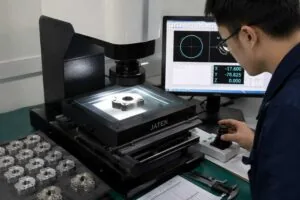
If a purchase order or quality agreement specifies AQL sampling, check which edition it cites. ISO 2859-1:1999 was withdrawn on 22 January 2026 and replaced by ISO 2859-1:2026. Similarly, ISO/TS 16949 has not existed since 2016; the automotive standard is IATF 16949. Documents citing the withdrawn versions are common and worth correcting at the point the volume agreement is written, since that is the document an auditor will read. Every MW+ order ships with a certificate of conformity, a CMM inspection report and material certificates, with FAI to AS9102 and PPAP Level 3 quoted per programme — the wider approach is set out under CNC machining quality control.
What changes in material supply and paperwork?
At low volume material is bought from stock. At series volume it becomes a scheduled commodity with its own qualification, and the documentation around it becomes part of the product.
| Concern | Low volume | Series volume |
|---|---|---|
| Material sourcing | From stocked bar, plate or tube | Scheduled against forecast, sometimes a dedicated buy |
| Traceability | Certificate for the grade | Certificate to heat or lot number, tracked per shipment |
| Grade substitution | Possible with agreement | Requires requalification if properties differ |
| Specification | ASTM B221, ASTM A276 and similar named on the drawing | Same, plus lot acceptance evidence retained |
| Surface texture | Callout per ISO 21920-2, superseding ISO 4287 | Same, plus method and sampling agreed |
| Packaging | Protective packing per shipment | Specified packaging, often part of the agreement |
The most common late surprise at volume is not machining at all: it is a material lot whose properties sit at a different point within the specification band than the qualification lot did. Specifying the standard is not the same as specifying a lot, and where a property genuinely matters, the agreement should say what is retested and how often.
Where does automation actually pay?
Automation is often presented as the answer to volume. It is an answer to a specific question: what is the operator doing that the machine could do, and how often?
- Pallet changers pay where setup time is a meaningful share of the cycle and the same part runs repeatedly. They convert setup from an interruption into a parallel activity.
- Bar feeding pays on turned parts made from standard bar, where loading is otherwise the largest non-cutting element. Slender parts usually belong in Swiss machining rather than conventional turning.
- Multi-part fixtures pay by the arithmetic above, and pay twice when they also remove a setup.
- In-process probing pays where tool wear is the dominant drift, because it corrects rather than detects.
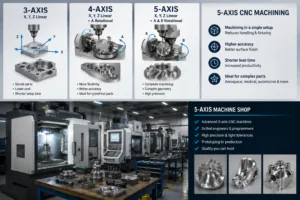
- Multi-axis machining pays where it removes setups, not where it merely adds axes; multi-axis machining is a setup-reduction strategy first and a geometry capability second.
What automation does not fix is a process that is not capable. Automating an unstable process produces nonconforming parts faster. The capability study belongs before the automation investment, not after it.
When should you not scale with machining at all?
Machining scales well because it needs no hard tooling, which is exactly why it is sometimes kept too long. The honest counter-case:
- When another process becomes cheaper per part. A polymer part in the tens of thousands usually belongs in an injection mould; a simple flat part belongs in laser cutting and forming; a complex thick-walled shape may belong in a casting with finish machining. Machining does not stop being possible, it stops being the right answer.
- When the design is still moving. Committing dedicated fixtures and capacity to a geometry that will change is how tooling investment becomes scrap. Stay in the bridge tier until the design is genuinely frozen.
- When the forecast is not real. Scaling commits fixtures, material schedules and capacity. A forecast built on optimism converts into inventory rather than savings; see our guide to low-volume cost and speed trade-offs for where the curve actually flattens.
- When the tolerance is not capable. If the capability arithmetic above says the process standard deviation must be 0.2 µm and nothing in the plan delivers that, volume will expose it. Fix the tolerance or the process first.
- When single-sourcing the whole volume is the real risk. The cheapest per-part arrangement is not always the right one for a part that stops a line. Dual sourcing costs more per piece and buys continuity, and that trade belongs to the buyer, not the supplier.
There is a symmetrical error: staying in bridge production for years because nobody ran the numbers. If a part has a stable design and a credible annual volume, continuing to buy it in small releases pays the setup repeatedly for no reason.
How MW+ handles the transition
MW+ has machined precision parts in Shenzhen since 2015, from a single 15,000 m² facility with 60+ CNC machining centres and 120+ engineering and quality professionals, and has delivered more than 1 million parts to 500+ companies across 50+ countries at 99% on-time delivery.
The practical consequence of keeping proving, pilot and series work in one plant is that the programme, the fixture and the inspection routine move with the part rather than being rebuilt at each tier. There is no minimum order quantity, so a part can start as a single piece and finish at 1,000,000+ units without a supplier change and without re-proving what has already been proved. Quotes return within 24 hours from STEP, IGES, DXF, DWG, SolidWorks or PDF files; standard prototypes run 3–5 business days, volume production 10–15 business days, with 48-hour express available for urgent proving parts.
General machining is held to ±0.01 mm against ISO 2768-m, precision features to ±0.005 mm and critical features to ±0.001 mm, with capability tracked to Cpk ≥1.67 and certification to ISO 9001:2015, AS9100D, ISO 13485, IATF 16949 and NADCAP. Series work is quoted under machine parts manufacturing; early proving batches under CNC prototyping; and the equipment list sits under CNC machining capabilities.
Frequently asked questions
At what quantity does CNC production stop being economical?
There is no fixed number, because it depends on geometry, material and what the alternative process would cost to tool. The useful test is comparative: price the part as machined at your forecast volume, price the tooling and per-part cost of the alternative process, and compare total cost over the programme life rather than per piece. Machining wins whenever tooling amortisation would not complete inside the programme.
Do I need a new first article when volume increases?
Volume alone does not trigger one. Change does. Moving to a dedicated fixture, a different machine, a re-posted NC program or a different plant are all changes that trigger a first article under AS9102, and the practical answer is to agree in advance which changes will trigger one, so the schedule includes the gate rather than discovering it.
What Cpk should I ask for?
Ask for the number the consequence justifies. Cpk 1.33 is a common general requirement and predicts roughly three nonconforming parts per hundred thousand from the nearer limit; Cpk 1.67, the level MW+ tracks to, predicts roughly none. Requiring 1.67 on every characteristic of every part is expensive and rarely justified — require it on the characteristics whose failure matters.
Should I dual-source once volume is significant?
It depends on what a stoppage costs you, not on what the second source costs per part. Dual sourcing adds a second qualification, a second first article and a second set of fixtures, and it removes single-point risk. Parts that stop a line generally justify it; parts with shelf-stable alternatives generally do not. Decide it as a continuity question and price it accordingly.
How long does scaling from prototype to series actually take?
The machining is rarely the constraint. The gates are: design freeze, manufacturability review, first article, fixture design and proving, capability study, and — where regulated — customer approval of the documentation package. Fixture design and customer approval are usually the longest calendar items, and both can be started earlier than most programmes start them.
Does cost per part keep falling indefinitely?
No. Setup amortisation flattens quickly, after which cost is dominated by cycle time, material and yield, none of which fall with quantity in the same way. Beyond that point, further reduction comes from design change, process change or material contract rather than from volume — the shape of that curve is covered in our guide to prototype versus mass production.
Can tolerances be held at high volume as well as on a prototype?
Holding a tolerance once and holding it a hundred thousand times are different claims, and the second is what Cpk measures. A prototype proves the tolerance is achievable; a capability study proves it is repeatable. Ask for both, and note that capability is a property of the process including its fixture and thermal environment, so it must be measured on the production configuration rather than inferred from the proving batch.
What should I send to get a scaling plan quoted?
A 3D model, a drawing with tolerances and critical characteristics marked, the material and condition, the current quantity, the forecast annual quantity, and any documentation the end customer requires. That is enough to quote the tiers and the gates rather than just the parts. Send it and request a CNC machining quote; an engineer responds within 24 hours.