Most parts on a production line start on a lathe. CNC turned parts such as shafts, pins, bushings, fittings, threaded bodies and connector shells are all round, and round parts are made by spinning the work against a tool rather than spinning the tool against the work. That single mechanical fact decides which process quotes your drawing, what it costs, and how tightly it holds.
This guide covers what CNC turning actually produces, where the boundary against milling sits, which materials and tolerances are realistic, what separates a shop that can run 500 parts from one that can run 500,000 — and the cases where turning is the wrong answer for your part.
Key takeaways
- Turn it when the part is dominated by a rotational form. Mill it when the part is prismatic. Most real parts need both, which is why one supplier for turning and milling avoids split responsibility.
- Realistic tolerance ladder: ±0.01 mm general to ISO 2768-m, ±0.005 mm precision, and a floor of ±0.001 mm on selected features, with Cpk ≥1.67 on controlled characteristics.
- Surface finish runs Ra 3.2 µm as-machined, Ra 0.4 µm fine-machined and Ra 0.1 µm polished. Specify the parameter from ISO 4287, not the word “smooth”.
- At volume, the metric is not cycle time but drift. Ask about tool-change intervals, in-process gaging frequency and what happens between the first part and the hundred-thousandth.
- Every order ships with a certificate of conformance, a CMM inspection report and material certificates. FAI to AS9102 and PPAP Level 3 are on request, quoted per program.
- Quotes within 24 hours, prototypes in 3–5 business days or 48-hour express, production in 10–15 business days, no minimum order quantity, capacity to 1,000,000+ units.
On this page
- What are CNC turning services, and what do they produce?
- CNC turning or CNC milling: which does your part need?
- The turning operations behind your drawing
- Which materials suit CNC turning?
- What tolerances and finishes can turning hold?
- What makes a shop good at high-volume turning?
- When CNC turning is the wrong process
- How do you choose a CNC lathe services provider?
- Frequently asked questions
What are CNC turning services, and what do they produce?
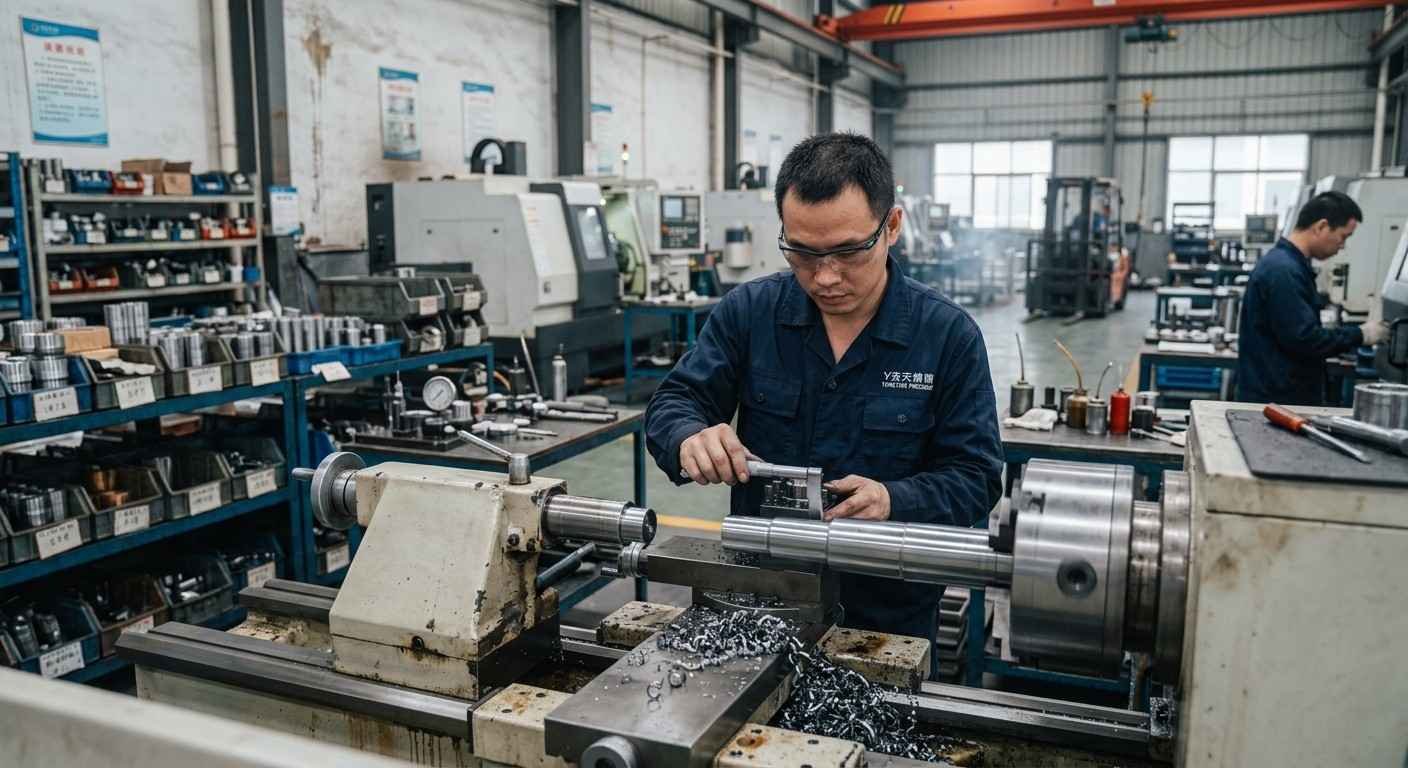
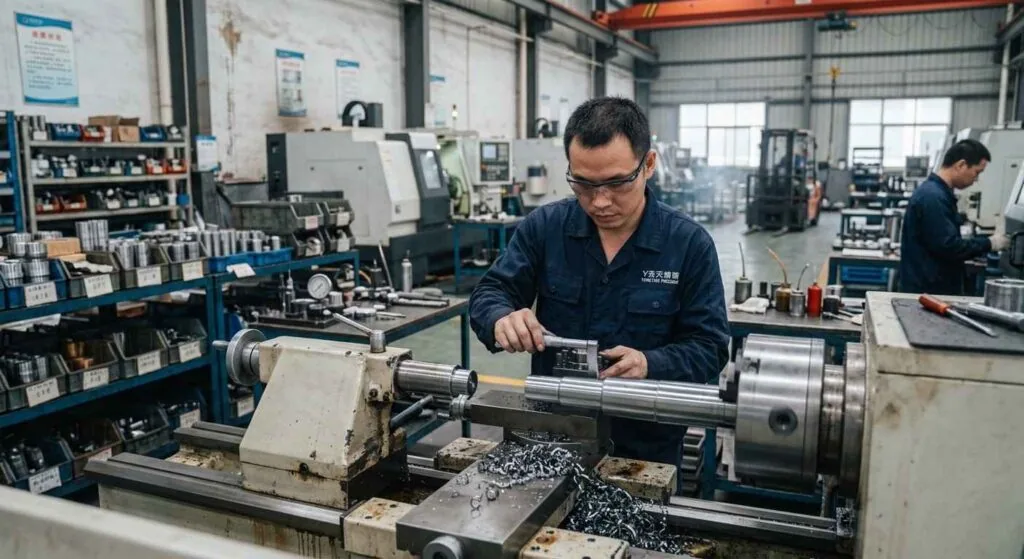
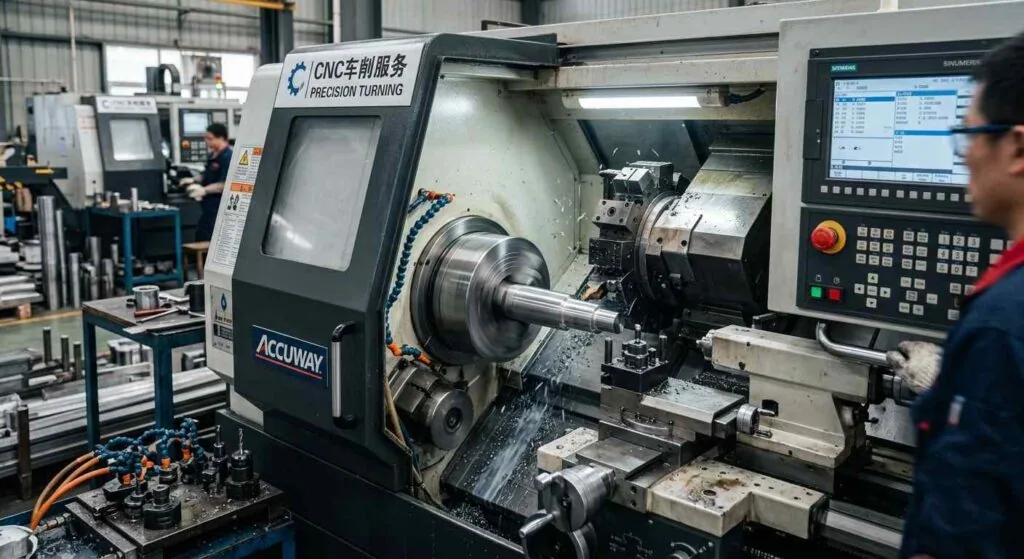
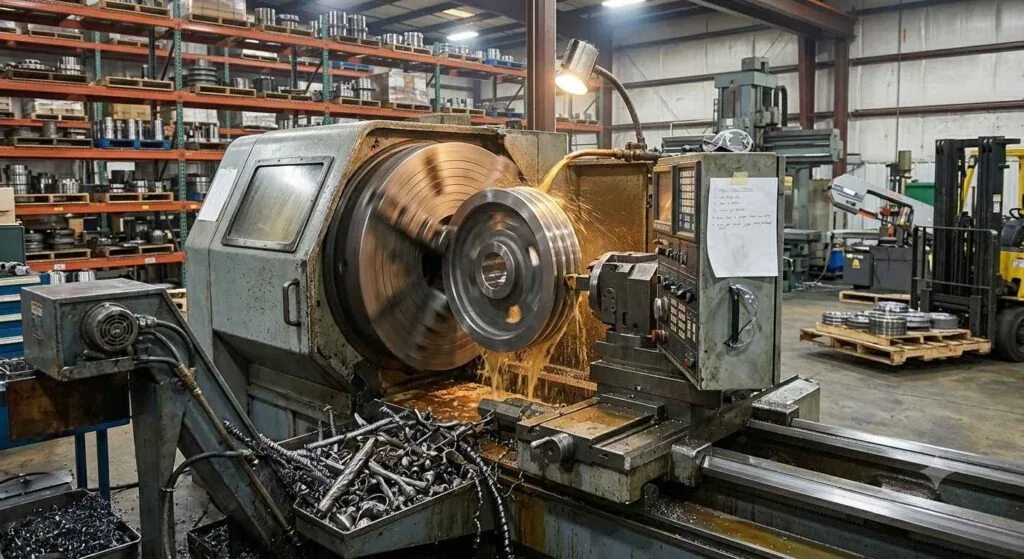
CNC turning spins a metal or plastic workpiece while a computer-controlled cutting tool removes material to shape it. Because the geometry is generated by rotation, the process naturally produces cylindrical and conical forms: outside diameters, bores, tapers, grooves, threads and faces.
“Custom” means the part is made to your drawing rather than pulled from a catalog, and in practice that changes what you need from the supplier. A catalog part arrives already qualified; a custom turned part needs the shop to interpret your datums, hold your tolerances and prove it did. CNC turning services at MW+ cover prototype quantities through production runs on the same machines, which is the difference that matters when a design moves from validation to release.
CNC turning or CNC milling: which does your part need?
The distinction is what moves. In turning the workpiece rotates against a tool that traverses; in milling a rotating tool cuts into a stationary workpiece. Everything else follows from that.
| Criterion | CNC turning | CNC milling |
|---|---|---|
| What moves | The workpiece rotates | The tool rotates |
| Natural geometry | Cylindrical, conical, threaded, grooved | Flat, boxed, pocketed, contoured |
| Typical parts | Shafts, pins, bushings, fittings, valve bodies | Housings, brackets, plates, manifolds |
| General tolerance | ±0.01 mm to ISO 2768-m | ±0.01 mm to ISO 2768-m |
| Precision tolerance | ±0.005 mm, to ±0.001 mm on selected features | ±0.005 mm, to ±0.001 mm on selected features |
| Where it struggles | Long non-round sections, sharp internal corners | Long slender round parts, high-volume round work |
| Economics at volume | Strong — bar feeding runs unattended | Weaker per piece; fixturing dominates |
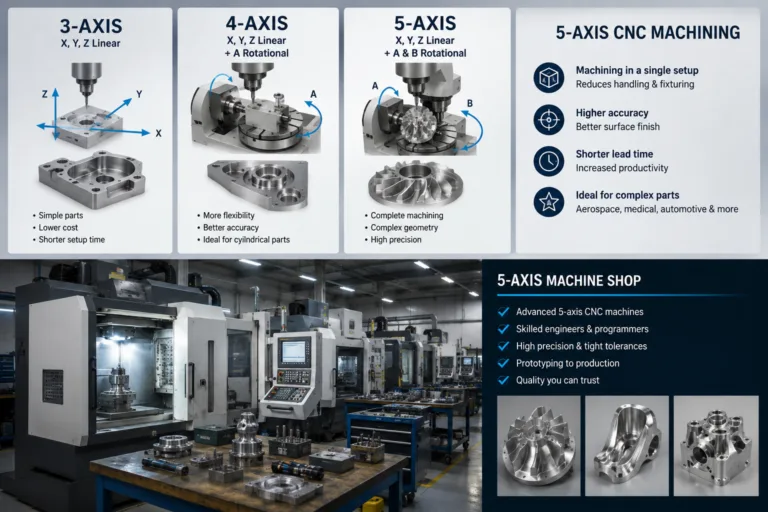
Many parts need both — a turned shaft with milled flats and a cross-hole, for instance. Modern turn-mill lathes with live tooling do this in one setup, which is cheaper and holds better than transferring the part. Where the prismatic content dominates, the work belongs on CNC milling or on 3, 4 and 5-axis machining instead.
The turning operations behind your drawing
Reading a turning quote is easier once you can name what the machine is doing. These are the operations that appear on almost every turned part, and what each one costs you if it is specified carelessly.
- Facing squares and finishes the end face. It establishes your length datum, so say which face is the datum rather than dimensioning from both ends.
- Turning reduces the outside diameter along a length. This is where your tightest tolerance usually lives, and where cycle time is spent.
- Boring enlarges an existing hole with a single-point tool. It holds far better concentricity to the outside diameter than drilling does, and costs more.
- Threading cuts or rolls internal and external threads. Standard forms run on standard tooling; a non-standard pitch means a special tool on every part.
- Grooving and parting cut recesses and separate the finished part from the bar. Specify a root radius on retaining grooves — leaving it open invites a stress riser.
- Knurling adds a grip pattern. It deforms material rather than cutting it, so allow for the diameter growth it produces.
A shop that runs the full range finishes more of the part in one setup. Every transfer between machines costs a re-grip, and a re-grip is where concentricity and true position quietly disappear. If your drawing carries runout or coaxiality callouts to ISO 1101 or ASME Y14.5, ask how many setups the quote assumes.
Which materials suit CNC turning?
Anything available as round bar can be turned, across 70+ grades. What varies between them is chip behavior, tool life and cycle time — which is to say, cost. Where a mechanical or electrical property is load-bearing in your design, work from the mill certificate for the delivered lot rather than a handbook, and cross-check unfamiliar grades against published material property data and the relevant ASTM bar specification.
| Material | Typical turned parts | Why it is chosen | Watch out for |
|---|---|---|---|
| Aluminum 6061, 6063, 7075 | Fittings, connectors, pulleys, spacers | Light, fast metal removal, low cost per part | Thread strength in 6061; 7075 is not weldable |
| Stainless 303, 304, 316 | Medical, food and marine components | Corrosion resistance and availability | 303 machines freely; 304 and 316 cost cycle time |
| Carbon steel 12L14, 1215, 4140 | Shafts, pins, general hardware | Strength and low material cost | Needs plating or coating for corrosion service |
| Brass C36000 and copper | Terminals, valve parts, fittings | Free machining and conductivity | Dezincification of brass in wet or ammonia service |
| Engineering plastics (POM, PTFE, PEEK) | Bushings, insulators, low-friction parts | Chemical resistance, self-lubrication | Dimensions move with temperature and moisture |
What tolerances and finishes can turning hold?
Any lathe can hit a number on one part. The question worth asking is what it holds on every part, at rate, across the life of the program — which is why process capability is a more meaningful commitment than a headline figure.
| Level | Achievable on | Typical use | Cost impact |
|---|---|---|---|
| ±0.01 mm general, to ISO 2768-m | Standard CNC turning | Overall length, clearance diameters, non-critical shoulders | Baseline |
| ±0.005 mm | Precision turning with in-process gaging | Bearing journals, sealing lands, mating diameters | Moderate; raises inspection frequency |
| ±0.001 mm | Selected features, controlled-temperature inspection | Interference fits, gage datums | Significant; drives high-frequency inspection |
| Concentricity and runout | Single-setup turning or turn-mill | Bore to outside diameter, journal to journal | Low in one setup, high once split across operations |
| Ra 3.2 → 0.4 → 0.1 µm | As-machined → fine-machined → polished | Body → running or sealing surface → optical face | Rises steeply at Ra 0.1 µm |
Two things belong on the drawing rather than in a phone call. If a shaft presses or slides into a bore, specify it through the ISO 286 limits-and-fits system instead of inventing a plus-minus band — the fit is what you actually care about. And a tolerance is only real if the measurement is traceable, so ask how gages and CMMs are calibrated and to what; NIST explains measurement traceability clearly. The MW+ quality assurance process sets out what is measured and how often.
What makes a shop good at high-volume turning?
At 200 parts, almost any competent shop will hold your print. At 200,000, the variable is drift — tool wear, thermal growth, bar-stock variation — and the shops that handle volume well are the ones that manage drift as a process rather than reacting to it.
The four levers that actually control drift
Rigid machines, because a lathe that flexes puts its deflection straight into the diameter. Scheduled tool changes, because inserts should be replaced on an interval derived from data, not when parts start failing gauge. Automation — bar feeders and part handling — because unattended running removes operator-to-operator variation. And in-process gaging at a defined frequency, because catching drift at part 400 is cheap and catching it at part 4,000 is not.
The commercial version of this question is simpler: ask what the supplier’s Cpk target is on a controlled characteristic and how it is evidenced. MW+ works to Cpk ≥1.67, running 60+ machining centers in a 15,000 m² facility in GuangMing District, Shenzhen, with capacity to 1,000,000+ units. Ask any supplier for the same two numbers and compare those rather than unit price alone.
When CNC turning is the wrong process
Turning is not a universal answer, and specifying it for the wrong part costs money and lead time. These are the cases where we would route your work elsewhere.
| Your situation | Do this instead | Why |
|---|---|---|
| Long, slender part with a high length-to-diameter ratio | Swiss-type turning | A guide bushing supports the cut; a chucker lets the bar deflect and taper |
| Part is mostly prismatic with one turned feature | Mill it, and turn as a secondary operation | Turning a block down to a prism throws away stock and cycle time |
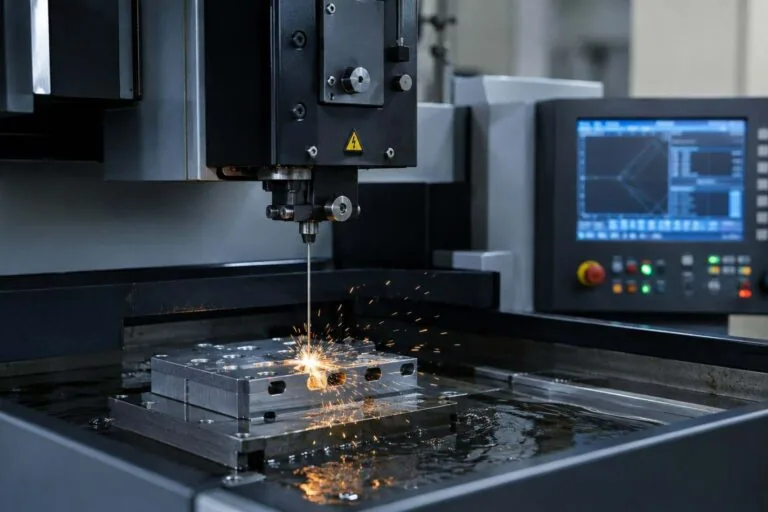
| Sharp internal corner in hardened material | Wire or sinker EDM | No rotating tool produces a true sharp internal corner |
| Very high volume of a simple formed shape | Cold heading or stamping | Forming beats cutting per piece once the geometry is simple and frozen |
| Near-net casting or forging already exists | Buy the blank, machine only the critical features | Cutting the whole form from bar pays twice for the same material |
| Design will change again before release | CNC prototyping, then re-cost | Choosing a production process against a moving print locks in the wrong one |
Turning wins on rotational geometry, volume economics and unattended running. It loses on slenderness without a guide bushing, on prismatic content, and on shapes a forming process can make outright.
How do you choose a supplier for CNC turned parts?
Unit price is the least informative number in a quote. These six questions separate suppliers faster, and they apply to any shop, including this one.
| What to ask | A good answer | Red flag |
|---|---|---|
| What certifications do you hold, and what is the scope? | Certificate number and scope covering machining — for MW+, ISO 9001:2015, AS9100D, ISO 13485, IATF 16949 and NADCAP | Logos with no certificate number, or a scope that excludes turning |
| How many setups does this quote assume? | A stated number, with the datum scheme it holds | No answer — the concentricity risk is then yours, not theirs |
| What ships with the parts? | Certificate of conformance, CMM inspection report and material certificates as standard | Inspection data only on request |
| What is your in-process gaging frequency at this volume? | A defined interval tied to a capability target | “We inspect first and last piece” on a 100,000-piece run |
| Do prototypes and production run on the same machines? | Yes — the ramp is a scale-up, not a requalification | Prototypes subcontracted elsewhere |
| What happens when a lot fails? | Containment, root cause, corrective action, named signatory | Replacement parts with no cause analysis |
On timing, MW+ quotes within 24 hours of a complete RFQ, runs prototypes in 3–5 business days or 48-hour express, and production in 10–15 business days, with no minimum order quantity. What moves those dates is rarely the cutting: it is special bar stock, outside finishing queues and unanswered drawing questions. Send a 3D model with a dimensioned drawing, the material and condition, the finish or plating scope, and both first-release and annual quantities.
If your program spans more than turned parts, the same package covers precision machined components and machine parts manufacturing under one quality system. The full capability list covers equipment and materials, or you can send a drawing for review.
Frequently asked questions
Why is my turned part quoted higher than a similar one I bought before?
Usually one of three things: a tighter tolerance than the previous part, a feature that forces a second setup, or a material that costs cycle time rather than money. Ask the supplier which feature drives the price. It is often a single callout, and where the function does not require it, relaxing that one dimension can move the quote more than negotiating ever will.
How tight a tolerance can CNC turning actually hold?
General work runs at ±0.01 mm to ISO 2768-m, precision features at ±0.005 mm, and the floor is ±0.001 mm on selected controlled characteristics rather than on every dimension. The tighter bands require temperature-controlled inspection and high-frequency in-process gaging, both of which appear in the price. Most parts perform identically with one tight diameter and everything else at general tolerance.
Is there a minimum order quantity for turned parts?
No. A 25-piece validation lot and a 250,000-piece release run through the same quoting process and the same machines. Quantity changes unit price, because setup is amortized across the lot, and scheduling, because larger releases may be split into batches. If you expect to ramp, say so at RFQ stage — it changes how the job is programmed and tooled from the first run.
Do I need a first article inspection report, and is it included?
Every order ships with a certificate of conformance, a CMM inspection report and material certificates as standard. A full first article inspection to AS9102, and PPAP Level 3, are separate deliverables available on request and quoted per program. Ask for whichever your customer requires at RFQ stage rather than after the first shipment, because retrospective FAI usually means re-running parts.
How do I know a shop can really hold quality across a large run?
Ask for two things: the capability target on a controlled characteristic, stated as a Cpk with data behind it, and the in-process gaging interval at your volume. A supplier that inspects only the first and last pieces of a six-figure run is not controlling drift, whatever its certificate says. Those two answers tell you more than a facility tour will.
Can you turn a material I specify or supply myself?
Yes, across 70+ grades, and customer-specified or customer-supplied bar is normal on regulated programs. Send the grade, condition and the specification you work to, and state whether you need the mill certificate traced through to the finished lot. Also state the bar condition — drawn, centerless-ground or hot-rolled — because it affects both achievable tolerance and setup.
How should I compare turning quotes from different suppliers?
Normalize four things before price. The documentation package, since a quote without an inspection report is a different product. The tolerance interpretation, because a shop reading your print as general tolerance always looks cheaper. The number of setups assumed. And the landed cost including freight and duty where relevant. Once those match, the remaining spread is real and usually narrower than it first appeared.