

A turning quote is a stack of decisions, and most of them were made on your drawing rather than on the shop floor. This guide covers how CNC lathe services are actually priced, which specification choices move the number, where turning is the wrong process entirely, and what to ask a supplier before you put two quotes side by side. Every standard named here links to the source document.
Key takeaways
- General turned dimensions run at ±0.01mm to ISO 2768-m; called-out features to ±0.005mm. ±0.001mm is the floor of the process, not a routine setting.
- Turning leaves about Ra 3.2µm as-machined, Ra 0.4µm fine-machined, Ra 0.1µm polished. Specify the roughness your function needs in ISO 4287 terms.
- Diameters that assemble into a mating part belong in ISO 286 fit language — h6, g6, H7 — not a bare plus-or-minus number.
- Setup is charged per batch, not per piece, so unit price falls with quantity. MW+ has no minimum order quantity and runs programs to 1,000,000+ units.
- Standard prototypes ship in 3–5 business days, express in 48 hours, and volume production in 10–15 business days. Quotes come back within 24 hours.
- Turning is the wrong answer for prismatic parts, for features cut after hardening, and for flat profiles from sheet. The decision table says what to use instead.
On this page
- What do CNC lathe services actually cover?
- Where the money goes in a turning quote
- How much does a tighter tolerance really cost?
- Which material should you specify for turned parts?
- Design rules that lower turning cost
- Lead time, batch size and repeat orders
- When turning is the wrong process
- What should you ask a CNC turning supplier?
- How MW+ runs turning work
- Frequently asked questions
What do CNC lathe services actually cover?
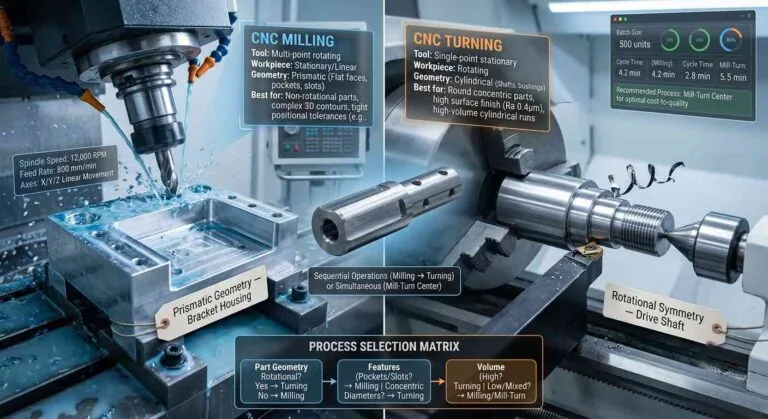
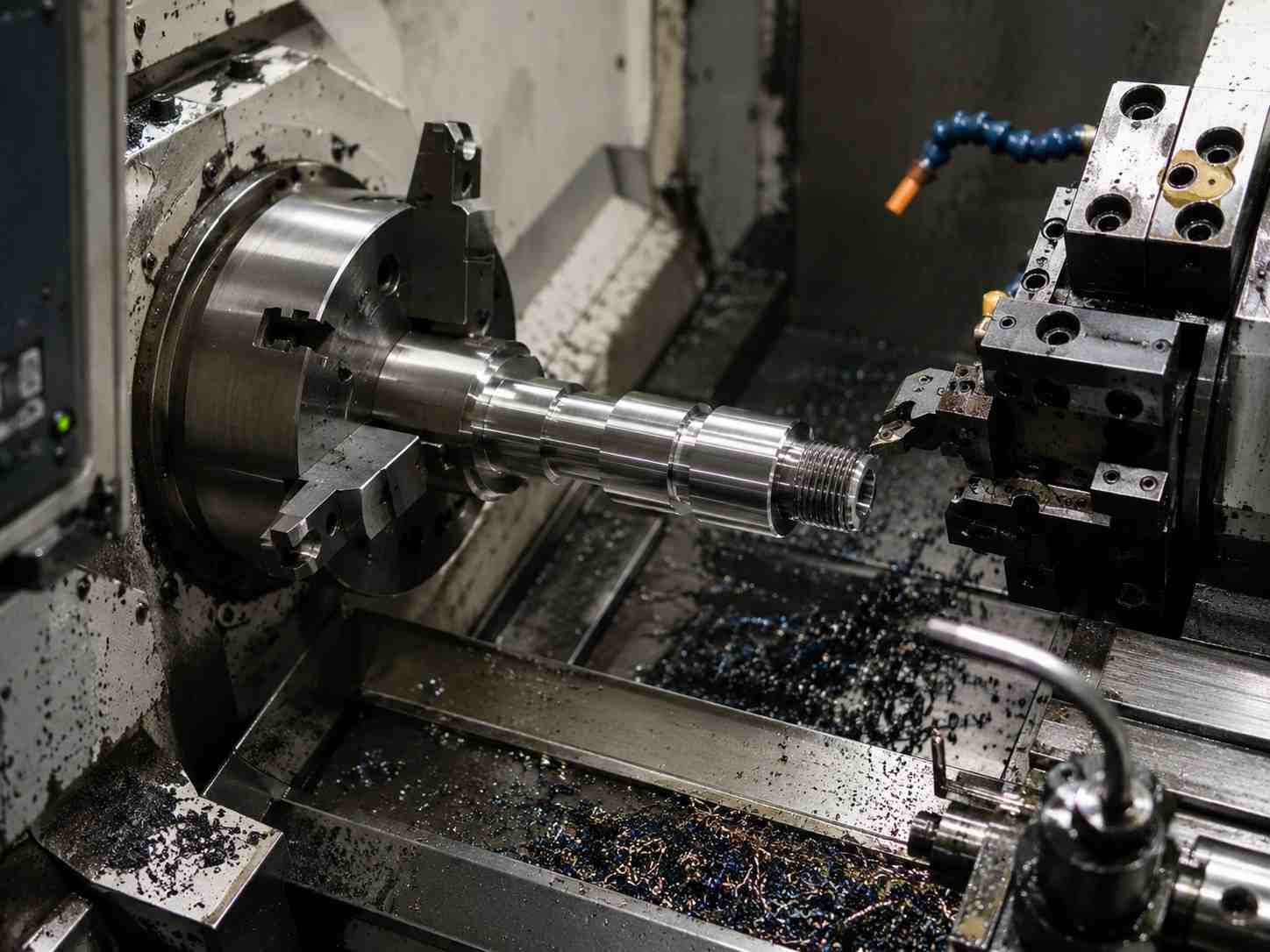
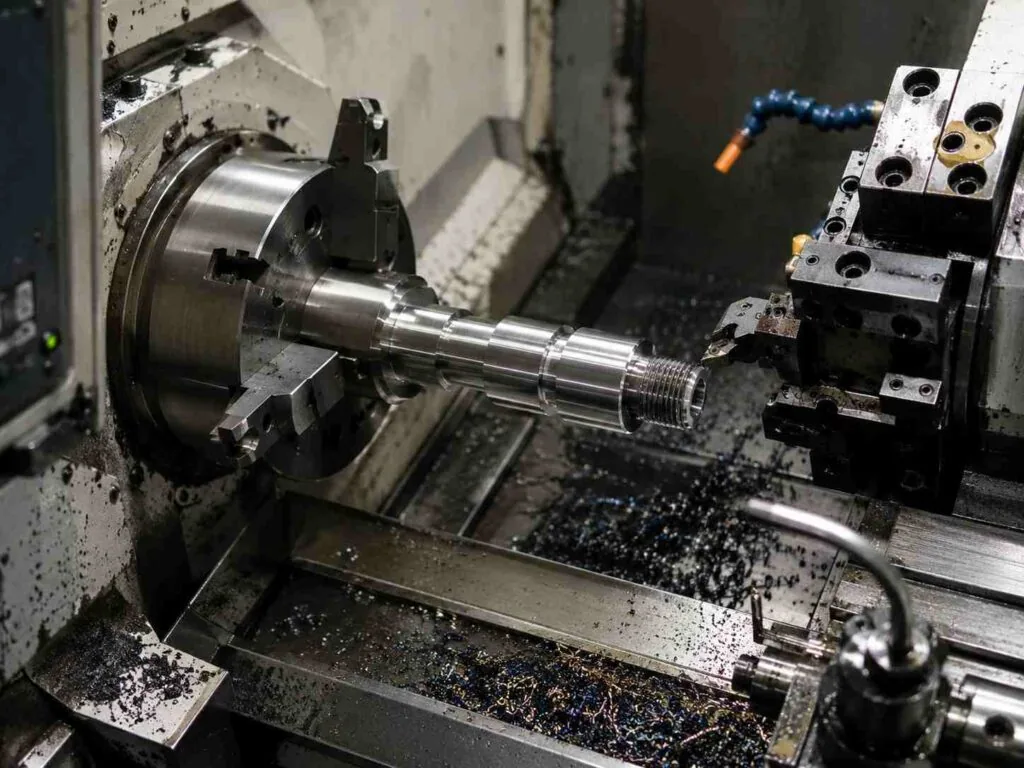
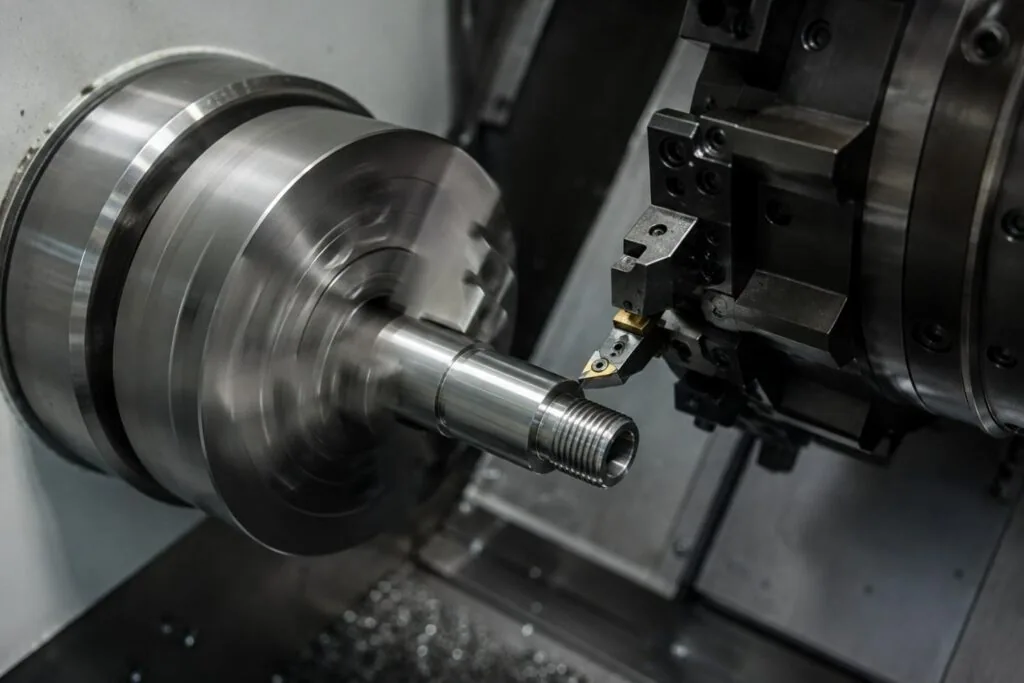
A CNC lathe rotates the workpiece and holds the tool still. That single fact defines the process. Anything that is a body of revolution — shafts, pins, bushings, valve bodies, connector shells, threaded fittings — is cheapest and most accurate when turned, because the machine produces a round feature by its own geometry rather than by interpolating one.
In practice, a shop selling CNC turning services offers more than plain outside-diameter work. Modern turning centers add driven tooling, a sub-spindle and a Y axis, so cross-holes, flats and light milling happen in the same clamping. Every operation folded into that clamping removes a setup, and setups are one of the few costs you can attack directly.
Standard turning, live tooling and Swiss-type lathes
A standard chucker grips the part at one end. That suits stubby components, but a long, slender part pushes away from the tool and leaves you chasing diameter down the length. A Swiss-type machine feeds bar stock through a guide bushing so the material is supported millimeters from the cutting edge. If your part is long relative to its diameter, ask specifically about Swiss machining.
Where the money goes in a turning quote
Most shops build a turning price the same way: material, plus spindle time at an hourly rate, plus setup spread across the batch, plus finishing, inspection and margin. You cannot change the shop rate, but you can change almost everything it multiplies.
| Cost driver | What it really covers | Lever you control | Leverage |
|---|---|---|---|
| Material | Bar stock plus the swarf that never becomes part | Near-net bar diameter; standard grade | High |
| Cycle time | Spindle hours at the machine rate | Remove features that force slow passes or small tools | High |
| Setup | Programming, tooling, fixturing, first-off proving | Batch orders; scheduled releases | Medium |
| Tolerance | Extra finishing passes plus the gauging to prove them | Tighten only functional features | High |
| Surface finish | Slower feeds, extra passes, sometimes a second process | State an Ra figure per surface, not globally | Medium |
| Finishing and plating | Anodizing, passivation, plating, and the vendor queue | Match treatment to the service environment | Medium |
| Inspection | CMM time, reports, certificates, FAI documentation | Request FAI or PPAP by need, not by habit | Low |
The three high-leverage rows — material, cycle time and tolerance — are all set by the drawing. By the time a quote lands in your inbox, the expensive decisions have already been made. The productive conversation with a machinist happens before release, not after.
How much does a tighter tolerance really cost?
There is no single multiplier, and anyone who gives you one is guessing. What is predictable is the mechanism: every step tighter adds a finishing pass, narrows the thermal window, and moves inspection from a hand gauge to a CMM.
| Tolerance level | Standard reference | Typical turned feature | What it demands |
|---|---|---|---|
| ±0.1mm | ISO 2768-c, coarse | Non-functional diameters, cosmetic steps, saw-cut lengths | Single pass, hand gauge |
| ±0.01mm | ISO 2768-m, medium — MW+ general default | Locating diameters, shoulder positions, thread majors | Separate finishing pass, in-process gauging |
| ±0.005mm | Called out per feature on the drawing | Bearing seats, sealing diameters, press fits | Temperature-stable finishing, CMM verification, tighter insert changes |
| ±0.001mm | Process floor, feature-by-feature only | Gauge diameters, honed or ground bores | Dedicated setup, slow cycle, near-100% inspection |
| h6 / g6 / H7 | ISO 286 fits | Any diameter that assembles into a mating part | Cost sits in the pair, not the single part — specify both halves |
The most expensive drawing habit is a global tight tolerance in the title block. If every dimension is called at ±0.005mm, the shop treats every dimension as critical, whether it does anything or not. Two or three called-out features on an otherwise standard drawing get you the same functioning part at a very different price — the difference between ordering a part and ordering CNC precision parts where precision is aimed where it is needed.
Surface finish is a separate specification from tolerance
A diameter can be dimensionally perfect and still leak, gall or fail a seal because the roughness is wrong. Turning leaves roughly Ra 3.2µm as-machined, reaches Ra 0.4µm with fine machining, and Ra 0.1µm with polishing. State the parameter as well as the number — Ra, Rz and Rmax are defined differently in ISO 4287, and a supplier quoting against the wrong one will produce a surface you did not order.
Which material should you specify for turned parts?
Material choice hits the quote twice: as the price of the bar, and as the cycle time it takes to cut. A free-machining grade can be cheaper per kilo and faster to cut than the alloy beside it, so the material and machine-time columns move together. MW+ works in 70+ grades; these carry most turning work.
| Material | Nominal property that matters | Behavior in turning | Relative material cost | Typical turned part |
|---|---|---|---|---|
| 12L14 free-cutting steel | Leaded, high-sulfur, breaks chips cleanly | Excellent | Low | Fittings, bushings, fasteners |
| 1018 / 1045 carbon steel | Nominal 440–585 MPa tensile by grade and condition | Good | Low | Shafts, pins, spindles |
| 303 stainless | Sulphur added for machinability, at some cost to corrosion resistance | Good | Medium | Valve bodies, sensor housings |
| 316L stainless | Nominal 2.0–3.0% molybdenum for chloride resistance | Moderate — work hardens | Medium–high | Medical, food contact, marine |
| 6061-T6 aluminum | Nominal density 2.70 g/cm³ | Excellent | Medium | Housings, spacers, adapters |
| C360 brass | The machinability benchmark for bar stock | Excellent | Medium | Connector bodies, plumbing fittings |
| Ti-6Al-4V | Nominal 4.43 g/cm³, nominal 950 MPa tensile | Poor — heat stays in the tool | Very high | Implants, aerospace fittings |
Every figure above is a published nominal value for the grade, not a measurement of your bar. Cross-check on a materials database such as MatWeb, and when a property is load-bearing, work from the mill certificate rather than any table, including this one.

Design rules that lower turning cost
These come up most often in design-for-manufacture review, in rough order of how much they matter. None change what the part does.
- Start from a standard bar diameter. A finished OD just under a stocked size means one light pass; just over it means the next size up and a lot of material turned into chips.
- Let internal corners take a tool radius. A sharp internal corner in a bore or groove has to be produced by a separate process. A specified corner radius is free.
- Keep bores shallow relative to their diameter. Deep small bores need long, thin boring bars that chatter, so feeds drop.
- Say what each surface is for. A note that a diameter is a seal seat tells the machinist to protect the finish there and relax elsewhere.
- Consolidate where the geometry allows. One turned component replacing a two-piece assembly removes a joint, an assembly step and a tolerance stack.
Lead time, batch size and repeat orders
Setup is why a five-piece order always looks expensive per unit. Once the machine is proven and the tools are set, additional parts are comparatively cheap, so your ordering pattern matters as much as the quantity.
| Phase | Standard | Expedited | What drives the variance |
|---|---|---|---|
| Quotation | Within 24 hours | Not applicable | Drawing completeness; missing GD&T or finish callouts |
| Prototype turning | 3–5 business days | 48-hour express | Grade availability; secondary operations |
| First article documentation | On request, added to the prototype phase | Not applicable | FAI per AS9102 paperwork and CMM queue |
| Volume production | 10–15 business days | Quoted per release | Batch size, plating vendor queue, packaging spec |
| Dispatch | Additional to the above | Air freight | Incoterm, customs, consolidation |
Two moves follow. Ask where the quantity breaks sit rather than guessing — the step between price bands is often smaller than people assume. And if the product will repeat, say so at quotation: a supplier who knows a release schedule can hold material and keep tooling set, and that shows up in the price. If you are still proving the design, run it through CNC prototyping first.
When turning is the wrong process
Turning is not the default answer to a metal part, and a supplier who says it is will sell you an expensive one. Here is where a lathe is the wrong tool.
| If your part | Turning is | Specify instead |
|---|---|---|
| Is prismatic — a block with pockets, faces and off-axis holes | Wrong process; there is no axis of revolution to exploit | CNC milling services |
| Needs features produced after heat treatment in hardened steel | Possible as hard turning, but insert cost and cycle time climb | Wire EDM or grinding |
| Requires an internal square, keyway or sharp internal corner | Not capable in one operation, whatever the tooling | EDM or broaching as a secondary operation |
| Is a flat profile cut from sheet or plate | Uneconomic — nearly all the bar becomes swarf | Laser cutting services |
| Is long and slender relative to its diameter | Prone to deflection and taper on a standard chucker | Swiss-type turning with a guide bushing |
| Is a one-off with no repeat and no functional tolerances | Correct, but setup will always dominate the unit price | Turning, with realistic per-piece expectations |
There is a quieter case too: the part is round, but the quantity is so low and the tolerance so loose that a stock component would do. If a catalog bushing fits, buy the bushing. Custom turning earns its cost when it removes an assembly step, hits a fit a stock part cannot, or lets you control material certification.
What should you ask a CNC turning supplier?
Price alone does not tell you whether two quotes are for the same thing. These five questions separate shops that have thought about your part from shops that ran it through a calculator.
| What to ask | A good answer sounds like | Red flag |
|---|---|---|
| What tolerance do you hold as standard, and against which standard? | “±0.01mm general to ISO 2768-m, ±0.005mm on called-out features” | “As tight as you need” |
| How is your measurement equipment traceable? | Named CMM, a stated calibration interval, certificates traceable to a national metrology institute | No calibration records offered |
| What ships with the parts as standard? | COC, CMM inspection report and material certificates on every order | “We can send a report if you ask for one” |
| Can you run first article inspection or PPAP? | “FAI per AS9102 and PPAP Level 3 on request, quoted per program” | Claiming full FAI on every order at no cost |
| Which quality systems are certified, and can I see the certificates? | ISO 9001:2015, AS9100D, ISO 13485, IATF 16949, NADCAP, with certificate numbers | Logos with nothing behind them |
Documentation that should ship with the parts
Every MW+ order ships with a certificate of conformance, a CMM inspection report and material certificates. FAI per AS9102 and PPAP Level 3 are available on request, quoted per program, because both consume real engineering hours. Ask any supplier how their gauges tie back to national standards — the NIST definition of measurement traceability is the reference point, and a shop that cannot describe its calibration chain cannot defend its numbers. See how MW+ structures this in our quality assurance process.
How MW+ runs turning work
MW+ is a precision machining supplier founded in 2015, operating a 15,000 m² facility in GuangMing District, Shenzhen with 60+ machining centers and 120+ engineers and machinists, serving customers in 50+ countries across 70+ material grades.
Turning runs to a general tolerance of ±0.01mm to ISO 2768-m, ±0.005mm on called-out features, and ±0.001mm where a feature requires it. Process capability is held at Cpk ≥1.67. The quality system is certified to ISO 9001:2015 alongside AS9100D, ISO 13485, IATF 16949 and NADCAP. There is no minimum order quantity, and volume programs run to 1,000,000+ units.
Send a STEP, IGES, DXF, DWG, SolidWorks or PDF file and a quote comes back within 24 hours. To talk through trade-offs on a drawing before you release it — including whether turning is the right process — contact us with the print and the annual quantity.
Frequently asked questions
Why is my turned part quoted so much higher than the material weight suggests?
Because the bar is only one input. The quote also carries spindle hours at the machine rate, the setup proven before the first good part, secondary operations, the finishing vendor’s charge, and the inspection needed to demonstrate the drawing was met. On a tightly toleranced part with a plated finish, machining and verification outweigh the raw material several times over. Ask for the quote split by phase.
Can you just hold ±0.005mm on every dimension if I ask for it?
Technically yes, and you should not ask. A blanket precision tolerance forces every feature onto a finishing pass and into CMM verification, including the ones that do nothing. The result is a slower cycle, higher scrap risk and a price reflecting both. Call out ±0.005mm on features that carry a fit, a seal or a bearing, and let the rest sit at the ISO 2768-m general tolerance of ±0.01mm.
Why did my repeat order cost more per piece than the first one?
Usually one of three things. The batch was smaller, so setup was spread over fewer parts. The material moved, because bar stock is a traded commodity. Or the first order was quoted against a projected annual volume the release did not reach. A framework agreement with scheduled releases removes the first and third causes.
Do I get an inspection report with the parts, or is that an extra?
With MW+ a certificate of conformance, a CMM inspection report and material certificates ship with every order at no extra charge. First article inspection to AS9102 and PPAP Level 3 are separate deliverables, quoted per program, because they document every drawing characteristic rather than a sampled set. If a supplier offers full FAI free on every order, ask what is actually in the document.
What if the material certificate does not match what I specified?
Stop the lot and raise it before anything is machined further. The mill certificate is the only document tying the physical bar to a chemistry and a heat number, and a substitution — even to a nominally equivalent grade — changes machining behavior, corrosion performance and sometimes regulatory acceptability. Nominal tables are for design; the certificate is what you keep on file.
Is a Swiss lathe worth paying for, or will a standard CNC lathe do?
It depends on the length-to-diameter ratio and the tolerance you need down that length. A short part with generous tolerances is cheaper on a standard chucker. A long, slender part with a controlled diameter along its full length either needs Swiss turning or comes back with taper, chatter and a scrap rate you pay for anyway. Ask which machine the shop intends to run it on.
How do I compare an overseas turning quote against a domestic one fairly?
Normalize the scope before you compare the number. Confirm both quotes assume the same general tolerance standard, the same surface finish parameter, the same documentation set, packaging and incoterm. Then add freight, duty and the working capital tied up in a longer transit. A quote that looks cheaper and drops the CMM report is not the same product.
Turned families such as main shafts, splined shafts, couplings and bronze bushings are listed with their usual materials on the machine parts catalogue page.