The way a sheet metal part gets cut decides most of what happens to it afterwards: the edge condition your finisher inherits, the hole positions your assembly line lives with, and the scrap you quietly pay for on every sheet. Choose badly between fiber vs CO2 laser cutting and you inherit deburring labor, fit-up problems and a cost per part that drifts upward unnoticed.
This guide covers what a heavy-duty fiber laser shop genuinely delivers: the material and thickness envelope, the tolerances worth writing on a drawing, where the laser edge stops being good enough, what drives price, and where laser cutting is the wrong process entirely.
Key takeaways
- Plan around a profile tolerance of ±0.05 mm on thin sheet. Anything tighter is a secondary machining operation, not a laser operation, and should be priced as one.
- A heavy-duty fiber machine covers roughly 0.5–40 mm carbon steel, 0.5–30 mm stainless, 0.5–20 mm aluminum and 0.5–10 mm copper or brass. Thickness, not material, is usually the binding constraint.
- Put a general tolerance class on the drawing. ISO 2768-m is the sensible default for cut-and-formed sheet metal, and it stops every unmarked dimension from being argued about later.
- Laser cutting is the wrong answer for very high volume simple blanks (stamping wins), for zero heat-affected zone requirements (waterjet or wire EDM wins), and for features under ±0.05 mm (milling wins).
- Ask for the documentation package before the price. A certificate of conformance, a dimensional inspection report and material certificates should arrive with the parts, not on request.
- Nesting density moves the per-part price more than the hourly rate does. Batch same-material, same-thickness parts into one order and yield improves for free.
- What a laser cutting service actually includes
- Fiber or CO2: which laser fits your material?
- Which materials and thicknesses can a fiber laser hold?
- What tolerance can laser cutting actually hold?
- Edge quality, heat input and second operations
- What actually drives the price of a laser-cut part?
- When laser cutting is the wrong choice
- How do you evaluate a laser cutting supplier?
- Frequently asked questions
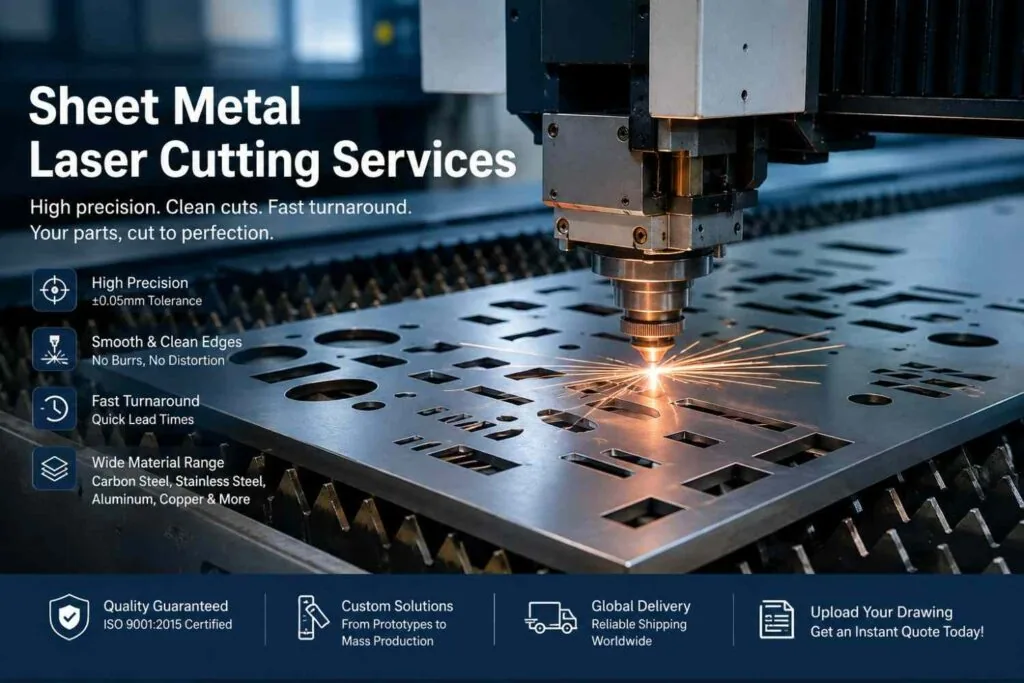
What a laser cutting service actually includes
Cutting is one step in a chain of five or six. If you buy only the cut, you become the integrator for everything that follows, and the handoffs between vendors are where schedules go to die.
From CAD file to nested sheet
A flat-pattern job needs a 2D profile, but the shop also wants the 3D model to check bend reliefs, hole-to-bend distances and hardware clearances. Usable formats are STEP, IGES, DXF, DWG, SolidWorks and PDF. Send the drawing too: it carries the tolerances, material callout and finish, none of which is inferable from geometry.
A design-for-manufacturing review comes before nesting. It is where a competent shop tells you the 0.6 mm slot in your 3 mm plate is below the practical kerf-to-thickness ratio, or that a hole 1.5 mm from a bend line will distort.
What happens after the cut
Most parts need at least one more operation: deburring, forming on a press brake, tapping, hardware insertion, welding, then powder coating, anodizing or plating. A shop that runs laser cutting services alongside forming and finishing keeps the part under one traveler and one inspection plan, which is worth more than a small unit-price difference.
It matters most when a flat part has one or two features the laser cannot hold; those get finished on a mill in the same building rather than shipped elsewhere. MW+ runs its laser floor beside 60+ machining centers in a 15,000 m² facility in GuangMing District, Shenzhen. The process list is on the capabilities overview.
Fiber vs CO2 laser cutting: which laser fits your material?
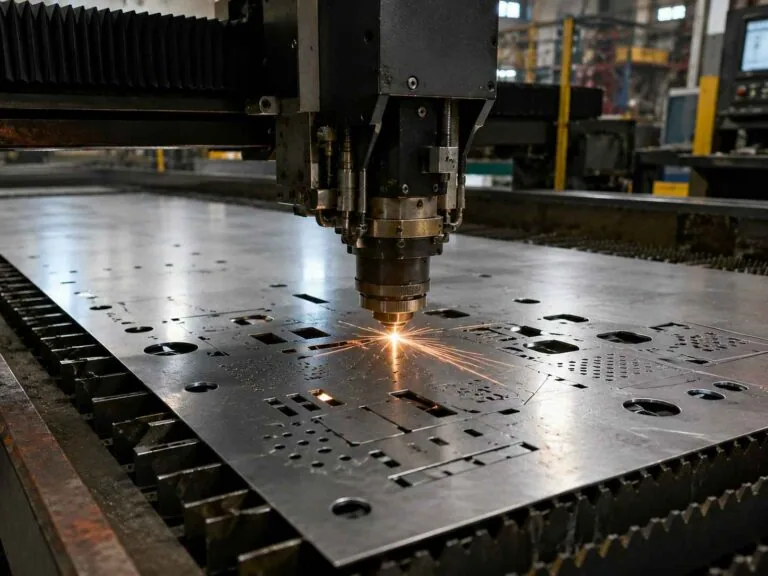
Fiber has displaced CO2 on most production floors for reasons that show up on your invoice: higher electrical efficiency, no laser gas, no mirror alignment, and a 1.06 µm wavelength that copper and brass absorb rather than reflect. CO2 keeps a place on thick non-metals, but for sheet metal, fiber is the default.
The more useful comparison is not fiber against CO2, but laser against the other ways of getting a flat blank out of a sheet.
| Process | Sweet spot | Handles well | Edge condition | Where it loses |
|---|---|---|---|---|
| Fiber laser | 0.5–25 mm | Steel, stainless, aluminum, copper, brass | Narrow kerf, small heat-affected zone | Thick reflective metals; zero heat input |
| CO2 laser | 1–20 mm | Steel, stainless, acrylic | Similar to fiber on steel | Copper and brass; running cost |
| Plasma | 3–50 mm | Carbon steel, stainless | Wide kerf, visible bevel, dross | Tolerance; thin gauge |
| Waterjet | 1–150 mm | Anything, including hardened stock | Cold cut, matte edge, slight taper | Speed and cost per part |
| Turret punch | 0.5–6 mm | Steel, stainless, aluminum | Roll-over and burr | Tool library limits geometry |
Which materials and thicknesses can a fiber laser hold?
The table below is a working envelope, not a guarantee. A 30 mm stainless plate with 4 mm slots is a different job from a 30 mm plate with 25 mm holes.
| Material | Thickness range | Usual assist gas | What to watch |
|---|---|---|---|
| Stainless 304 / 316 | 0.5–30 mm | Nitrogen | Nitrogen leaves an oxide-free, weld-ready edge; oxygen is cheaper but leaves an oxide layer to remove first |
| Aluminum 5052 / 6061 | 0.5–20 mm | Nitrogen | Reflective and conductive; more dross above 12 mm |
| Carbon steel (mild, SPHC) | 0.5–40 mm | Oxygen | Oxygen adds exothermic energy for the thickest cuts, at the cost of an oxidized edge |
| Copper and brass | 0.5–10 mm | Nitrogen | Absorbs the fiber wavelength, but conducts heat away fast; the thickness limit is real |
| Galvanised / pre-plated steel | 0.5–4 mm | Nitrogen | Zinc vaporises at the kerf; plan for touch-up |
Grade substitution is the quiet risk. 304 and 316 cut almost identically and cost very differently, and a substitution will not be caught by dimensional inspection. Specify the sheet to a published ASTM standard — A240 for stainless sheet and plate, B209 for aluminum — and require the mill certificate with the shipment.
Published nominal values are fine for early design work, and MatWeb is the easiest place to look them up. Where a property is load-bearing — yield strength on a structural bracket, conductivity on a heatsink — work from the mill certificate for the heat you were actually shipped.
What tolerance can laser cutting actually hold?
Most disappointed buyers are not victims of a bad shop. They wrote a machining tolerance on a sheet metal drawing, nobody queried it, and the parts came back exactly as capable as the process allows.
| Feature | Realistic on a fiber laser | How it is held | Cost impact |
|---|---|---|---|
| Profile and hole position, sheet under 3 mm | ±0.05 mm | Positioning accuracy, stable focus and gas pressure | Baseline |
| Profile and hole position, plate 6–20 mm | ±0.1 to ±0.2 mm | Kerf taper grows with thickness | Baseline |
| Hole diameter, laser cut | ±0.05 to ±0.15 mm by thickness | Piercing strategy and lead-in placement | Baseline |
| Bend angle on a press brake | ±0.5° typical, ±0.25° with per-part setup | Tooling and springback compensation | Small adder for the tighter class |
| Overall flatness after forming | Specify it; not inherent | Stress-relieving or flattening | Adds a step |
| Any feature tighter than ±0.05 mm | Not a laser operation | Secondary milling, reaming or wire EDM | Adds a setup; price separately |
Two things belong on every sheet metal drawing. First, a general tolerance class, so that unmarked dimensions have a defined meaning: ISO 2768 medium class is the workable default for cut-and-formed parts. Second, geometric callouts where function depends on them, expressed in the language of ASME Y14.5 or ISO 1101 rather than as a pile of ± dimensions.
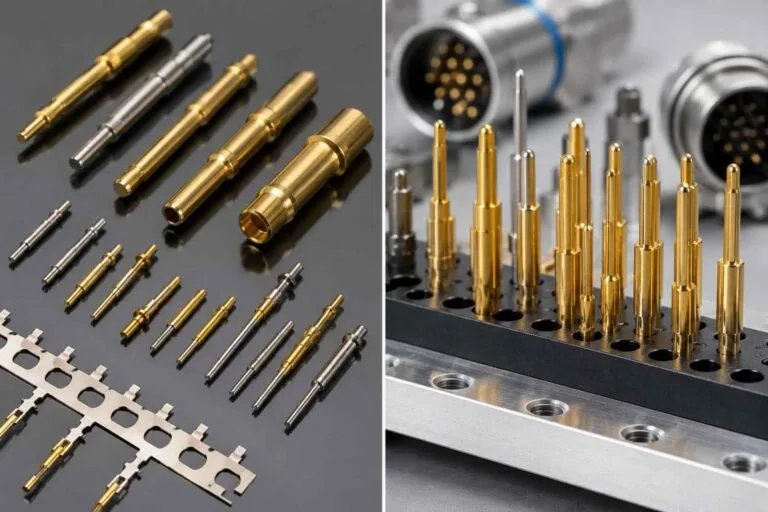
If a hole must accept a press-fit bushing or a dowel, do not laser it to size. Call it out as a fit class under ISO 286, cut it undersize and finish it on a mill. Parts where most features need that treatment belong in CNC machining from the start, with the laser only preparing the blank.
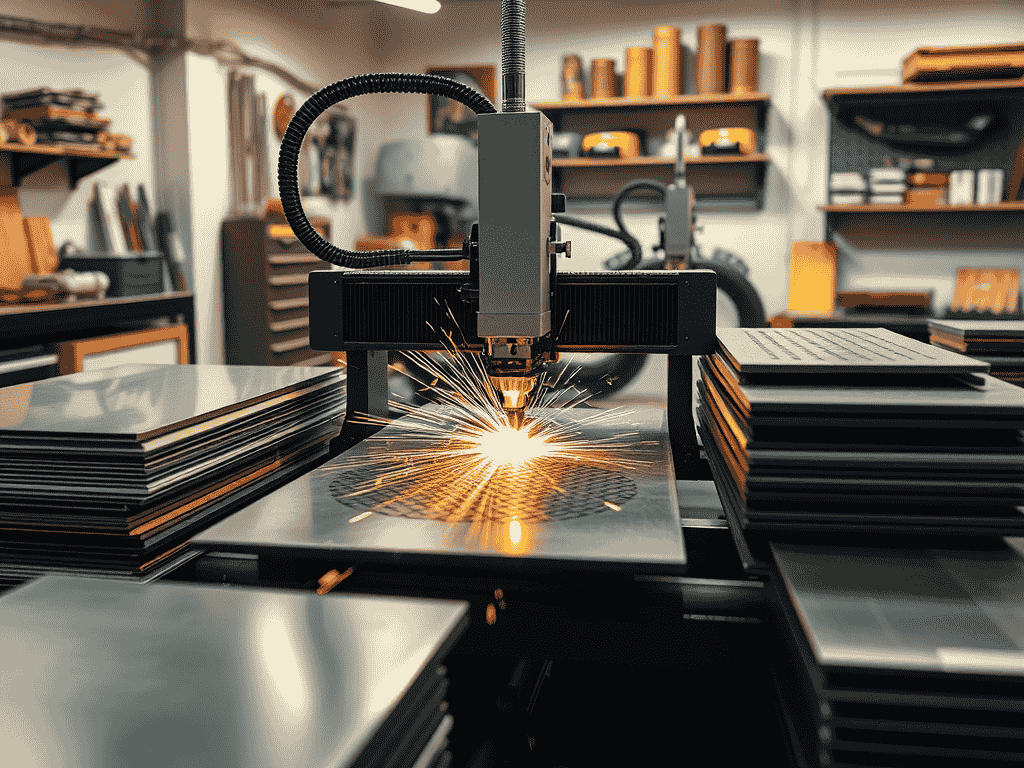
Edge quality, heat input and second operations
Taper, striation and dross
A laser kerf is not a perfect rectangle. The beam has a focal waist, so the cut is wider at the top than the bottom, and that taper grows with thickness. On 1 mm stainless it is invisible; on 20 mm carbon steel it is a real dimension on mating parts.
Striation, the fine vertical lines down the cut face, is normal and comes from the melt front moving in pulses. Dross clinging to the underside is not normal on a well-tuned machine at the correct feed and gas pressure. Persistent dross on thin material is a process control problem worth raising.
When the laser edge is not good enough
Three cases recur. Sealing surfaces need a defined roughness, which means specifying Ra to ISO 4287 and machining the face. Fatigue-critical parts need the recast layer removed, because a thermally altered edge initiates cracks. Electrical contact surfaces need burr-free, plating-ready geometry, usually a machining or wire EDM operation.
The heat-affected zone on a fiber laser is narrow, but not zero. If your specification says zero, you are specifying waterjet or EDM and should say so on the drawing.
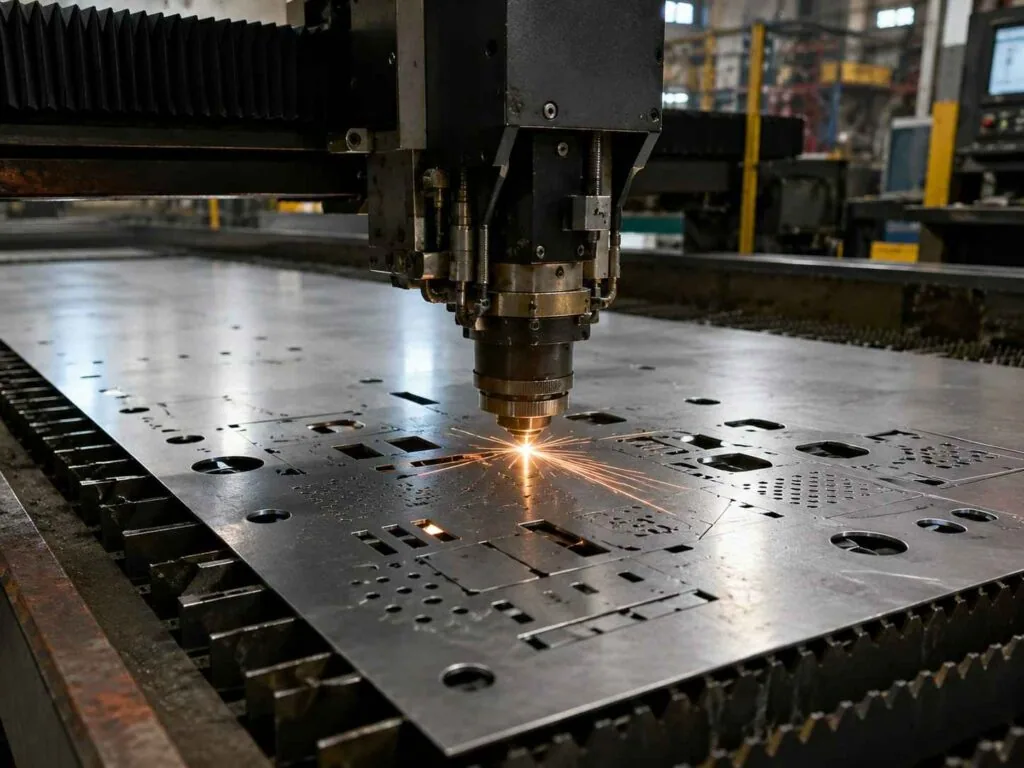
What actually drives the price of a laser-cut part?
Laser time is charged by the metre of cut path and the number of pierces, not by the area of your part. That single fact explains most quote surprises.
| Cost driver | Why it moves the price | What you can do about it |
|---|---|---|
| Nest density | You pay for the sheet, not the part; a sparse nest bills you for scrap | Batch same-material, same-thickness parts into one release |
| Number of pierces | Each pierce costs time and consumable life in thick plate | Delete decorative perforations; allow common-line cutting |
| Cut path length | Intricate contours cost more than a simple blank of equal weight | Simplify non-functional outlines; open up small radii |
| Assist gas choice | Nitrogen costs more than oxygen and cuts thick plate slower | Ask for nitrogen only where welding, plating or appearance needs it |
| Tolerance and finish callouts | Each tighter-than-standard feature can add a setup elsewhere | Tolerance only what function needs |
| Secondary operations | Forming, welding and coating usually dominate a finished enclosure | Quote the finished part, not the blank |
Volume behaves differently from stamping. There is no die to amortize, so the unit price curve is flatter; what improves is nesting and setup count. MW+ operates with no minimum order quantity, scales to 1,000,000+ units, and quotes within 24 hours of receiving a drawing.
When laser cutting is the wrong choice
A supplier who never tells you the process is wrong is a supplier who will happily sell you the wrong process. Here is where the laser loses.
| Your situation | Better answer | Why |
|---|---|---|
| Simple flat blank, hundreds of thousands per year, stable design | Progressive die stamping | Cycle time per part is a fraction of laser time and the die amortizes fast |
| Specification forbids any heat-affected zone or recast layer | Waterjet or wire EDM | Both are cold processes; a fiber laser HAZ is narrow, not absent |
| Multiple features tighter than ±0.05 mm | CNC milling | You pay for milling anyway; starting there removes a handoff |
| Copper or brass above roughly 10 mm | Waterjet | Conductivity carries heat out of the kerf faster than the beam adds it |
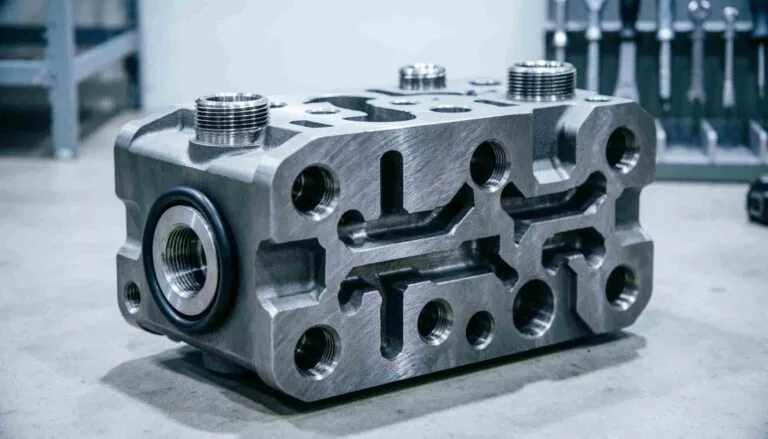
| Part is not flat — it is a machined 3D body | Milling or turning | A laser cuts profiles through sheet, not depth-varying geometry |
| Very small parts with slots narrower than the material is thick | Wire EDM or micro-machining | Kerf and taper set a floor on slot width versus thickness |
| One-off part needed tomorrow from stock you already hold | Manual sawing and milling | Programming and setup overhead exceed the cut time on one piece |
How do you evaluate a laser cutting supplier?
Capability claims are cheap. These questions separate shops that run a controlled process from shops that merely own a machine.
| What to ask | A good answer sounds like | Red flag |
|---|---|---|
| What arrives with the parts? | Certificate of conformance, inspection report, material certificates, as standard | “We can provide documentation if you need it” |
| How is your measuring equipment calibrated? | Scheduled calibration against traceable standards | No interval, or no records |
| Which certifications do you hold, and to what scope? | Named standards, certificate numbers, registered scope | Logos with no certificate offered |
| Will you review my drawing before quoting? | Written DFM feedback naming specific features and risks | A price by return, no questions asked |
| What is your lead time, and what makes it slip? | A cutting date and a finished-part date, with the named risk | A single number with no phases |
| Can you machine the features the laser cannot hold? | In-house milling and turning, one inspection plan | “We subcontract that”, no named partner |
Read the scope statement, not the logo. ISO 9001:2015 is the baseline quality management system; AS9100D adds aerospace configuration management and counterfeit-part control; ISO 13485 governs medical device quality systems; IATF 16949 covers automotive supply. MW+ holds all four.
Measurement matters as much as the certificate. Ask what the CMM and gauges are calibrated against; the chain should end at a national metrology institute, which is what NIST traceability means. Every MW+ order ships with a certificate of conformance, a CMM inspection report and material certificates; first article inspection to AS9102 and PPAP Level 3 are on request, quoted per program. See the quality assurance page.
Ready to price a job? Send the STEP file and drawing via contact us for a quote and DFM notes within 24 hours.
Frequently asked questions
Why did my quote go up when I only added a few small holes?
Laser time is driven by pierces and cut path length, not part area. Each hole is a pierce plus a contour, and in thick plate a pierce takes far longer than an equivalent length of cutting. Twenty small holes in a 12 mm bracket can add more machine time than the entire outside profile.
Can you hold ±0.01 mm on a laser-cut part?
Not with the laser alone. A fiber laser holds roughly ±0.05 mm on thin sheet, and kerf taper widens that with thickness. Features at ±0.01 mm or tighter come from a secondary operation — milling, reaming or wire EDM — on a machine holding ±0.005 mm, and down to ±0.001 mm for the most demanding work. The tolerance is achievable on the part, just not by the laser, and it belongs on the quote as a separate line.
Should I specify nitrogen or oxygen cutting?
Specify the outcome and let the shop choose the gas. If the edge will be welded, plated or left visible, you need an oxide-free edge, which means nitrogen. If the part is powder coated or purely structural, oxygen cutting is faster and cheaper on carbon steel and the oxide layer is irrelevant.
How do I stop holes distorting near a bend?
Keep the hole edge at least two and a half times the material thickness plus the bend radius away from the bend line. Inside that distance the material stretches into the hole and it goes oval. If the layout cannot allow the clearance, either machine the hole after forming or add a relief slot at the bend. Flag it at DFM, not after the first article.
What lead time should I plan for?
Ask for two dates: when parts come off the laser and when the finished part ships. Cutting is rarely the bottleneck. At MW+ a standard prototype runs 3–5 business days, 48-hour express exists for urgent work, and volume production runs 10–15 business days. Coating and plating drive most variance, so confirm the finishing step specifically.
Is a cheaper per-part price from an overseas shop actually cheaper?
Only if you compare the same scope. Build the comparison on landed cost for a finished, inspected, documented part: unit price, finishing, inspection paperwork, freight, duty and the expected cost of a rework loop. A quote for a bare blank always beats a quote for a coated assembly with a CMM report, and the two are not the same purchase.
Do I need to send a 3D model if the part is flat?
Send both. The flat DXF drives the cut, but the 3D model shows bend directions, hardware locations and how the part sits in the assembly, which is what makes a DFM review worth anything. Where the two disagree, and they often do, the shop should ask which governs. That question is cheaper before cutting than after.
Can one supplier cut, form, finish and machine the same part?
Yes, and it is usually the right structure for mixed-process parts. One supplier owning cut, form, weld, machine and finish means one inspection plan, one certificate of conformance, and one party responsible when a dimension is out. MW+ combines laser cutting with milling, turning and finishing across a site staffed by 120+ engineers and machinists, shipping to 50+ countries. See laser cutting and precision machined parts.
Cutting sheet metal at MW+
Fibre suits thin and reflective stock and runs faster; CO² still earns its place on thicker mild steel and non-metals. Both, plus bending, welding and finishing, are on our laser cutting and sheet metal fabrication page. Cut-and-machined assemblies combine that with CNC machining; finished families sit under machined products.