Most “top CNC machining companies” lists have a structural problem: they mix machine tool builders with contract machine shops. Those are different businesses. One sells you a machine; the other sells you parts. If you are sourcing components, half of a typical list is not a supplier you can send a drawing to.
This page keeps the ten well-known names, says plainly which category each one belongs to, and strips out the cost and lead-time figures that circulate on these lists without a source behind them. Then it covers the part that actually decides your outcome: how to evaluate a machining supplier for your specific part.
Key takeaways
- Check the category first. Machine tool builders such as DMG MORI, Mazak and Hermle sell equipment; contract shops sell finished parts. Only the second group can quote your drawing.
- Require the certification that matches your program: ISO 9001:2015 as a baseline, AS9100D for aerospace, ISO 13485 for medical devices, IATF 16949 for automotive — and verify the certificate number and scope, not the logo.
- Compare landed cost with an identical documentation package, not unit price. A quote without an inspection report is not the same product as one with it.
- Ask whether prototypes and production run on the same machines. If they do not, your ramp is a requalification.
- MW+ figures used here are its own: ±0.005 mm precision tolerance, ±0.01 mm general to ISO 2768-m, Cpk ≥1.67, 10–15 business days production, no minimum order quantity, up to 1,000,000+ units.
- Cost multipliers, hourly labor rates and country-wide lead times have been removed from this page. They were not sourced, and you should distrust them wherever you see them.
On this page
- How this list was built, and what it does not measure
- Machine tool builders vs. contract machine shops
- The ten companies
- How do sourcing regions actually compare?
- Which certifications should you require?
- How do you evaluate a supplier beyond a list?
- When a list like this is the wrong way to choose
- Where MW+ fits, in its own numbers
- Frequently asked questions
How this list was built, and what it does not measure
The ten names below are companies that engineering and sourcing teams encounter repeatedly when researching CNC machining and milling. They are presented alphabetically within category rather than ranked one to ten, because there is no defensible way to rank a machine tool builder against a contract shop, or a micro-machining specialist against a high-volume turning house.
Descriptions are limited to what each company publishes about itself, and each entry links to that source where the company’s own site is the reference. Anything that could not be attributed — revenue figures, country counts, cost multipliers, hourly labor rates, shipping-speed claims — has been removed rather than repeated.
What this page cannot tell you is whether any of these companies is right for your part. That depends on your tolerance stack, your volume, your documentation requirements and your qualification process. The sections after the list are where that decision actually gets made. MW+ publishes this page and appears on the list; treat its inclusion accordingly and verify its claims the same way you would verify anyone else’s.
Machine tool builders vs. contract machine shops
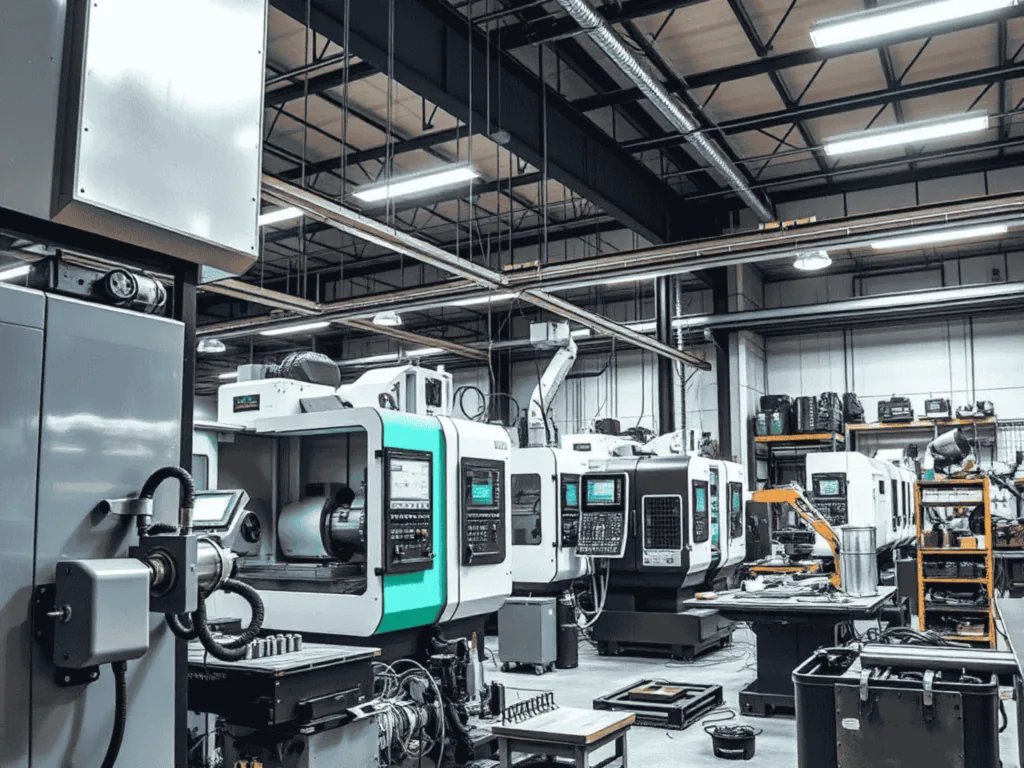
This is the distinction most lists blur, and it changes what you can do with the name. A machine tool builder designs and sells machining centers, lathes and automation to manufacturers. A contract machine shop buys those machines and sells you finished parts to your drawing.
Both are legitimately “CNC machining companies”, and the builders matter to you indirectly — the equipment in your supplier’s shop is often one of these brands. But if you have a print and a quantity, only the contract shops are addressable. Sending an RFQ to a machine tool builder gets you a machine quote.
The ten companies
| Company | Country | Category | Can it quote your drawing? |
|---|---|---|---|
| Protolabs | United States | Digital manufacturing service | Yes |
| MetalworksPlus (MW+) | China | Contract precision machining | Yes |
| Owens Industries | United States | Ultra-precision contract shop | Yes |
| DMG MORI | Germany / Japan | Machine tool builder | No — sells machines |
| Yamazaki Mazak | Japan | Machine tool builder | No — sells machines |
| Hermle | Germany | Machine tool builder | No — sells machines |
| GF Machining Solutions | Switzerland | Machine tool builder (milling, EDM) | No — sells machines |
| DN Solutions | South Korea | Machine tool builder | No — sells machines |
| Fair Friend Group | Taiwan | Machine tool group | No — sells machines |
| SMTCL | China | Machine tool builder | No — sells machines |
Protolabs — United States
A digital manufacturing service offering CNC machining alongside injection molding and 3D printing, with automated quoting that returns manufacturability feedback at upload. Best known for prototype and low-volume work ordered online. See the company’s own service description for current capabilities and locations.
MetalworksPlus (MW+) — China
A contract precision machining manufacturer in Shenzhen covering milling, turning, Swiss and micro work under one quality system, from prototype through production. Its published figures appear in the MW+ section below rather than here, so they sit next to the caveats that belong with them.
Owens Industries — United States
A Wisconsin-based ultra-precision contract machine shop focused on mission-critical aerospace, defense and medical components, running simultaneous 3-, 4- and 5-axis work. The relevant question for a buyer is not the shop’s age but whether its scope of accreditation covers your part class.
DMG MORI — Germany and Japan
A machine tool group formed from Germany’s DMG and Japan’s Mori Seiki, building 5-axis machining centers and turn-mill systems used across aerospace, mold-making, medical and automotive production. Details of its current machine range are on the company’s site.
Yamazaki Mazak — Japan
One of the long-established Japanese machine tool builders, known for multi-tasking turn-mill machines and for pairing equipment with service and automation programs. Its current product and support offering is documented on the Mazak site.
Hermle — Germany
A German builder of 5-axis vertical machining centers with a strong presence in medical, aerospace and tool-and-die work, and integrated robotic handling for unattended running. Machine specifications and automation options are published on Hermle’s site.
GF Machining Solutions — Switzerland
A Swiss-rooted builder covering high-accuracy milling, electrical discharge machining and laser texturing, widely used in mold-making, aerospace and electronics. If your parts need EDM, the process comparison in electric discharge machining explains where it beats cutting. Its current brand and division structure are set out on the company’s own site, and have changed — confirm before you specify equipment.
DN Solutions — South Korea
The Korean machine tool business formerly known as Doosan Machine Tools, producing turning centers, machining centers and automation used broadly in automotive and general manufacturing. Treat any specific capability claim as something to confirm directly with the manufacturer.
Fair Friend Group — Taiwan
A Taiwanese machine tool group holding a portfolio of lathe, machining center and grinding brands with manufacturing across Asia and Europe. It appears on lists like this because its equipment underpins a large share of the contract shops you will actually buy parts from.
SMTCL — China
Shenyang Machine Tool Co., one of China’s long-standing domestic machine tool builders, producing CNC lathes and machining centers for the Chinese industrial base and for export. Revenue and export figures that circulate for this company are not independently verifiable and are omitted here.
How do sourcing regions actually compare?
The honest version of this comparison contains no numbers, because credible country-level figures for machining cost and lead time do not exist in a form you can apply to your part. What does exist is a set of questions that resolve the comparison for your specific case.
| Factor | Regional or domestic supplier | Established overseas exporter | How to settle it for your part |
|---|---|---|---|
| Unit cost at volume | Higher labor and overhead in most Western markets | Typically lower, but supplier-specific | Quote the same drawing to both with an identical documentation package |
| Total landed cost | Little or no freight and duty | Freight, duty and broker fees are material | Model landed cost per piece, never unit price alone |
| Lead time | No international transit | In-shop time plus transit | Ask for in-shop days and transit days as separate numbers |
| Certification | Mature registrar ecosystem | Broad among export-focused manufacturers | Ask for certificate number and scope; verify with the registrar |
| Engineering response | Usually same time zone | Depends entirely on the supplier’s engineering team | Send a real technical question during the RFQ and time the answer |
| IP and regulatory exposure | Often preferred for controlled programs | Case by case | A legal and compliance decision, not a cost decision |
| Ramp risk | Depends on the shop | Depends on the shop | Ask whether prototype and production run on the same machines |
Most established programs end up blended: regional partners for controlled or ultra-low-volume work, certified overseas partners for cost-driven volume. That is a portfolio decision, not a verdict on a country. If you want the China-specific version of this comparison, see ten CNC machining companies in China compared.
Which certifications should you require?
Certification does not make a supplier good, but the absence of the right one makes them unusable for a regulated program. Match the scheme to the program, then verify the certificate rather than the logo.
| Program type | Require | What it actually governs |
|---|---|---|
| Any commercial part | ISO 9001:2015 | The quality management system: document control, nonconformance, corrective action |
| Aerospace and defense | AS9100D | ISO 9001 plus aerospace additions: configuration management, counterfeit parts, risk |
| Medical devices | ISO 13485 | Device-specific QMS: design controls, traceability, sterile and validation requirements |
| Automotive | IATF 16949 | Automotive QMS and core tools, including PPAP submission levels |
| Drawing interpretation | ISO 1101 or ASME Y14.5 | Which GD&T convention the shop reads your print in — agree this before quoting |
| Measurement confidence | Traceable calibration | Gage and CMM calibration traced to national standards; see NIST on traceability |
How do you evaluate a supplier beyond a list?
Six questions separate suppliers faster than any ranking. Ask them of everyone you shortlist, including the company publishing this page.
| What to ask | A good answer | Red flag |
|---|---|---|
| What is your certificate number and scope? | A number you can verify with the registrar, with machining in scope | Logos only, or a scope that covers a different process |
| What ships with the parts? | Certificate of conformance, CMM inspection report and material certificates as standard | Inspection data only on request for a regulated part |
| Do prototypes and production run on the same machines? | Yes — the ramp is a scale-up, not a requalification | Prototypes subcontracted to a different process or shop |
| What capability do you hold on a controlled characteristic? | A stated Cpk with data behind it | A tolerance quoted with no capability evidence |
| How are gages and CMMs calibrated? | Documented interval, traceable to national standards | No interval or no reference chain |
| What happens when a lot fails? | Containment, root cause, corrective action, named signatory | Replacement parts with no cause analysis |
When a list like this is the wrong way to choose
A global top-ten is a starting point for orientation and a poor tool for selection. These are the situations where following one costs you money or time.
| Your situation | Do this instead | Why |
|---|---|---|
| You need one or two parts this week | A local shop or a digital manufacturing service | Freight and onboarding dominate the cost at that quantity |
| Your part is dominated by one specialist process | Shortlist by process, not by brand — Swiss turning, EDM, grinding | A generalist with wide capability rarely beats a specialist on its own process |
| The program is export-controlled or IP-sensitive | Let legal and compliance set the supplier region first | Cost comparison is irrelevant if the supplier is not eligible |
| You are replacing an incumbent mid-program | Dual-source on the same drawing before switching | Requalification risk usually exceeds the unit-price saving |
| Your drawing is not stable yet | Run CNC prototyping and defer supplier selection | Choosing a production supplier against a moving print rewards the wrong bidder |
| You only need equipment, not parts | Contact a machine tool builder from the table above | Contract shops do not sell machines, and builders do not sell parts |
Where MW+ fits, in its own numbers
MW+ is a contract precision machining manufacturer founded in 2015, operating a 15,000 m² facility with 60+ machining centers and 120+ engineers and machinists in GuangMing District, Shenzhen, serving customers in 50+ countries across 70+ material grades. It is certified to ISO 9001:2015, AS9100D, ISO 13485, IATF 16949 and NADCAP.
On capability: ±0.01 mm general tolerance to ISO 2768-m, ±0.005 mm precision, a floor of ±0.001 mm on selected features, and Cpk ≥1.67 on controlled characteristics. Surface finish runs Ra 3.2 µm as-machined, Ra 0.4 µm fine-machined and Ra 0.1 µm polished. Capabilities span CNC machining, CNC milling, 3, 4 and 5-axis work and micro-machining.
On commercial terms: quotes within 24 hours of a complete RFQ, prototypes in 3–5 business days or 48-hour express, production in 10–15 business days, no minimum order quantity, and capacity to 1,000,000+ units. Every order ships with a certificate of conformance, a CMM inspection report and material certificates; FAI per AS9102 and PPAP Level 3 are available on request and quoted per program. The quality assurance process sets out what is measured and how often, and the full capability list covers equipment and materials. To test any of it, send a drawing and apply the six questions above.
Frequently asked questions
Why are machine tool builders on a list of machining companies?
Because the phrase “CNC machining company” covers both businesses, and most published lists never separate them. The distinction matters commercially: a builder sells you a machining center, a contract shop sells you parts to your drawing. If you are sourcing components, filter the list to the contract shops before you do anything else, or you will spend a week emailing sales teams who cannot help you.
Does appearing on a top-ten list mean a supplier suits my part?
No. Lists measure visibility and scale; your part is decided by tolerance stack, material, volume, documentation and qualification route. A supplier that is excellent at low-volume aerospace work may be a poor fit for a high-volume turned component, and neither fact shows up in a ranking. Use a list to build a shortlist, then evaluate each name against your actual drawing.
How do I verify a supplier’s certifications are genuine and in scope?
Ask for the certificate itself, not the logo — it carries a certificate number, a named registrar, an expiry date and a scope statement. Check the scope actually covers machining of your part type, because a certificate scoped to assembly or trading is common and useless to you. Then confirm the number with the registrar directly; every accredited body publishes a way to do this.
Should I source domestically or overseas for a regulated part?
Start with eligibility, not cost. If the program carries export control, data residency or regulatory constraints, your legal and compliance teams narrow the supplier region before any quote is meaningful. Where both regions are eligible, the decision comes down to landed cost, documentation depth and engineering responsiveness — all of which vary far more between individual suppliers than between countries.
What does a fair quote comparison across countries look like?
Normalize four things first. The documentation package, since a quote without an inspection report is a different product. The tolerance interpretation, because a shop quoting your print as general tolerance always looks cheaper. Secondary operations and finishing scope. And landed cost including freight and duty. Once those match, the remaining spread is real, and it is usually narrower than the raw unit prices suggested.
Can one supplier take a part from prototype through production?
Some can, and it is worth confirming rather than assuming. The question to ask is whether prototypes and production parts run on the same machines under the same quality system. If they do, your ramp is a scale-up. If prototypes are subcontracted or run on a different process, moving to production is effectively a new qualification, with the cost and schedule risk that implies.
How long should CNC production actually take?
There is no credible industry-wide answer, which is why country-level lead-time figures on comparison pages should be ignored. Ask each supplier for its own committed date and what drives variance on your part — usually material availability, outside finishing queues and unanswered drawing questions rather than machining time. For reference, MW+ quotes production at 10–15 business days and prototypes at 3–5 business days.
Company descriptions on this page are drawn from each company’s own published material and are limited to what those sources state. Figures that could not be attributed to a named source have been removed. This is an industry overview, not a third-party audit — verify certifications and audit facilities before awarding a machining program.
Where MW+ fits
MW+ machines to ±0.01 mm general (ISO 2768-m), ±0.005 mm precision and ±0.001 mm on selected features, with Cpk ≥1.67 on controlled characteristics. The process range is on our CNC machining services page; the parts we build to drawing are grouped under machined products, including CNC precision parts.