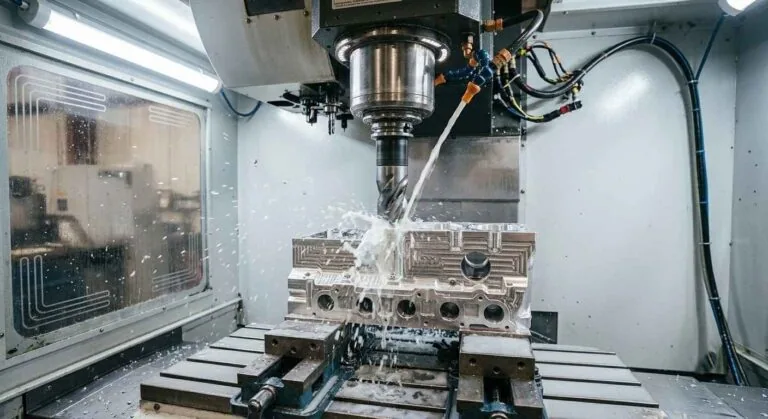








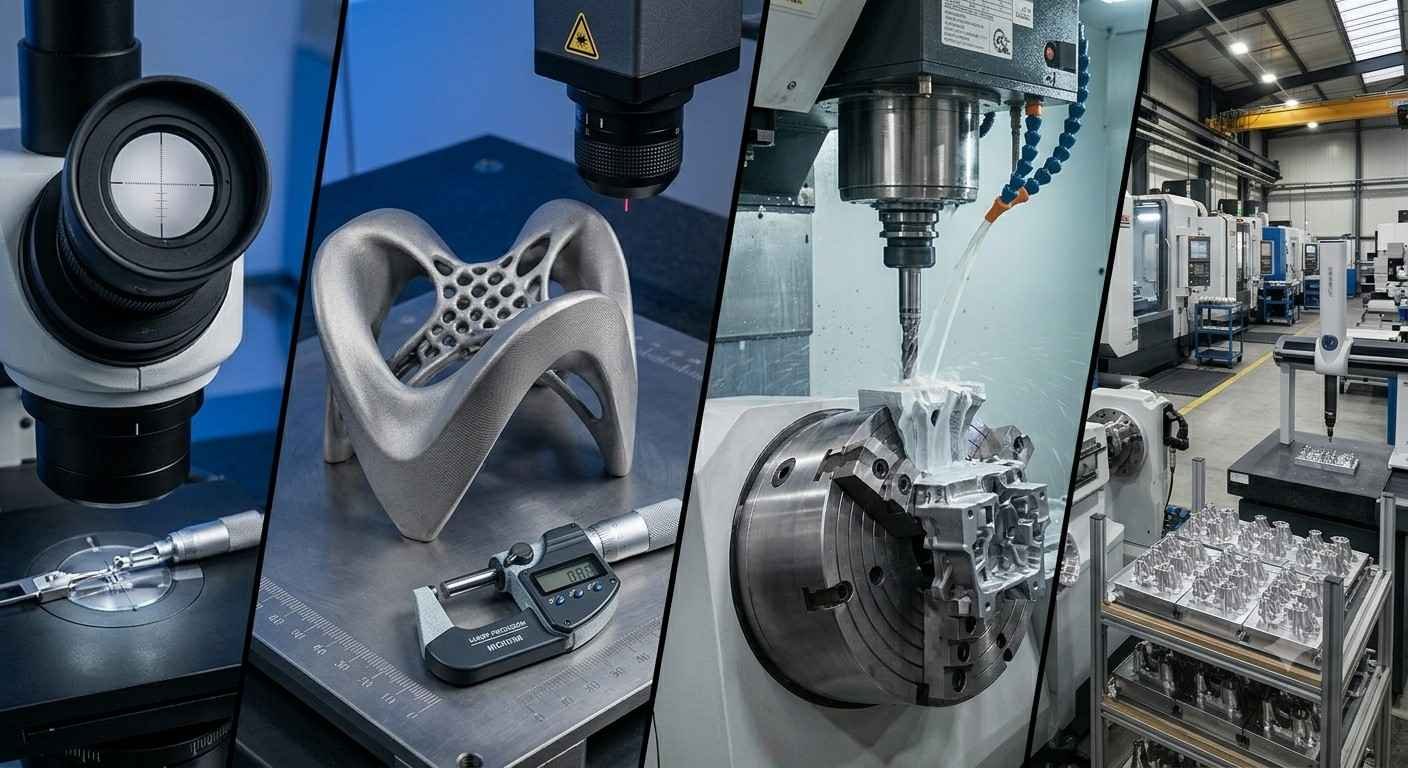
A tight tolerance is not a promise a vendor makes. It is a process they either have or do not have, and the difference shows up on part 300, not on the first article. This guide covers what tight tolerance CNC machining actually costs, which processes hold which numbers, how to write the requirement onto a drawing, and when a tight tolerance is the wrong specification.
Key takeaways
- MW+ holds general machining to ±0.01mm (±0.0004 in) to ISO 2768-m, precision features to ±0.005mm (±0.0002 in), and a floor of ±0.001mm (±0.00004 in).
- Tolerance is an outcome; capability is the promise it repeats. Ask for Cpk on the specific characteristic. MW+ targets Cpk ≥1.67 on critical characteristics.
- Aluminum 6061-T6 has a nominal coefficient of thermal expansion near 23.6 µm/m·°C, so a 100mm dimension moves about 23.6µm across a 10°C swing — more than a ±0.005mm tolerance band.
- State the datum scheme. A tight number without datums to ASME Y14.5 or ISO 1101 is unmeasurable, not tight.
- Every MW+ order ships with a certificate of conformance, a CMM inspection report and material certificates. FAI to AS9102 and PPAP Level 3 are on request, quoted per programme.
- Tightening every dimension to the tightest one on the drawing is the most expensive mistake in precision machining, and the easiest to reverse.
- What counts as tight tolerance CNC machining?
- Which vendors can hold each step down the ladder?
- Which materials make tight tolerances hardest to hold?
- Which process holds which tolerance
- Specify capability, not only tolerance
- How should a drawing communicate a tight tolerance?
- How do you vet a tight tolerance CNC machining vendor?
- When a tight tolerance is the wrong specification
- What MW+ holds, and how it is documented
- Frequently asked questions
What counts as tight tolerance CNC machining?
Tight tolerance CNC machining generally means holding a feature inside ±0.005mm (±0.0002 in) or better, against a general machining class of ±0.01mm (±0.0004 in) under ISO 2768-m. Below roughly ±0.0025mm (±0.0001 in) the work stops being a machining question and becomes a metrology question: the measurement uncertainty starts to consume a meaningful share of the tolerance band.
A tolerance is the total permitted variation between the smallest and largest acceptable size for a feature. A 25.000mm bore at ±0.005mm is acceptable anywhere from 24.995mm to 25.005mm. Use the ladder below to decide the class each feature genuinely needs.
| Tolerance class | Metric | Imperial | Typical application |
|---|---|---|---|
| General, ISO 2768-m | ±0.01mm | ±0.0004 in | Brackets, housings, clearance holes, non-mating faces |
| Precision | ±0.005mm | ±0.0002 in | Bearing seats, sealing faces, hydraulic bores, locating features |
| Fine | ±0.0025mm | ±0.0001 in | Optical mounts, surgical instrument details, connector pins |
| MW+ floor | ±0.001mm | ±0.00004 in | Gauge features, master datums, where geometry and material allow |
Which vendors can hold each step down the ladder?
Each step down the ladder changes the process rather than the effort, and in doing so it changes which shops can honestly quote the part. Finishing passes at reduced feeds, tool wear tracked per part, thermal stabilisation and a heavier inspection routine are capabilities a shop has either resourced or has not. Read the table below as a capability filter: a vendor who cannot describe what changes on the machine and in inspection at your step is quoting a different part. What each step does to the price is a separate question, worked through in our breakdown of the cost of tight tolerances in a CNC quote.
| Tolerance step | What changes on the machine | What changes in inspection |
|---|---|---|
| General class to ±0.01mm | A dedicated finishing pass; tool offsets checked per setup | Hand gauges, sampled through the run |
| ±0.01mm to ±0.005mm | Reduced feeds, tool wear tracked per part, coolant and thermal soak controlled | CMM routine on the critical features, sampled at a defined interval |
| ±0.005mm to ±0.001mm | Secondary grinding, jig boring or wire EDM; often a different machine entirely | 100% CMM at a controlled temperature, plus gauge capability study |
Apply the tolerance per feature, not per drawing. Two or three functional features at ±0.005mm on an otherwise general-class part is a normal specification that a competent shop will quote without hesitation. Every dimension at ±0.005mm is a different part, and the list of vendors who will take it on honestly is very short.
Which materials make tight tolerances hardest to hold?
Materials with high thermal expansion and low stiffness are hardest to hold tight, because the part changes size between the cut and the measurement. Aluminum 6061-T6 moves roughly twice as much per degree as Ti-6Al-4V titanium. Materials that work-harden, such as 304 stainless and Inconel 718, add a second problem: the tool wears faster, so the dimension drifts across the batch rather than randomly.
The values below are nominal published coefficients of thermal expansion near room temperature, drawn from standard material property data. Where the property is load-bearing for your tolerance stack, work from the actual mill certificate for the heat you receive rather than a nominal figure.
| Material | Nominal CTE (µm/m·°C) | Movement in a 100mm dimension over 10°C (µm) | Main tolerance challenge |
|---|---|---|---|
| Aluminum 6061-T6 | ~23.6 | ~23.6 | Highest thermal movement; needs measurement at a stated temperature |
| Brass C360 | ~20.5 | ~20.5 | High expansion, but excellent machinability and predictable finish |
| Stainless steel 304 | ~17.3 | ~17.3 | Work-hardens; tool wear drives dimensional drift across a batch |
| Inconel 718 | ~13.0 | ~13.0 | High cutting temperature and rapid tool wear on finishing passes |
| Carbon steel 1018 | ~11.7 | ~11.7 | Predictable, but stress relief needed after heavy stock removal |
| Titanium Ti-6Al-4V | ~8.6 | ~8.6 | Lowest movement, but low stiffness invites deflection in thin walls |
Read the third column against the tolerance you are asking for. A ±0.005mm band on a 100mm aluminum dimension is 10µm wide, and a 10°C shop-floor swing moves that dimension by more than twice the band. That is why an inspection report for a tight-tolerance part should state the measurement temperature, and why a part measured warm off the machine and a part measured cold at goods-in can honestly disagree.

Which process holds which tolerance
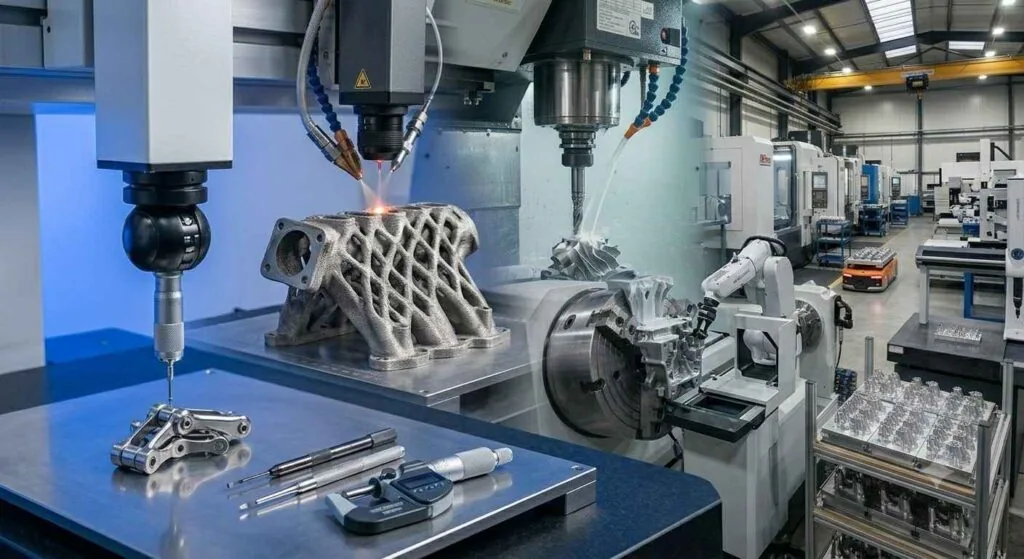
Tolerance capability is a property of the process, not of the shop. A vendor who quotes ±0.001mm on a 3-axis milling machine without a secondary operation is quoting an aspiration. Use this table to sanity-check a quote against the process named on it.
| Process | Tolerance typically achievable | Best suited to | Limitation |
|---|---|---|---|
| 3-axis CNC milling | ±0.01mm (±0.0004 in) | Prismatic parts, pockets, flat faces | Complex geometry needs several setups, each adding positional error |
| 5-axis machining | ±0.005mm (±0.0002 in) | Contoured surfaces and undercuts in one setup | Higher machine rate and longer programming time |
| CNC turning | ±0.01mm (±0.0004 in) | Shafts, bushings, round bodies | Off-axis features need live tooling or a second operation |
| Swiss-type turning | ±0.005mm (±0.0002 in) | Small diameters at high length-to-diameter ratio | Bar stock only, limited part envelope |
| Wire EDM | ±0.005mm and finer | Hardened steel, carbide, sharp internal corners | Slow, and limited to electrically conductive materials |
| Grinding and jig boring | ±0.001mm (±0.00004 in) | Gauge features, bearing seats, master datums | A secondary operation: added cost, added lead time |
For parts under 6mm diameter with a length-to-diameter ratio above 8:1, Swiss-type turning holds concentricity that conventional turning cannot, because the guide bushing supports the stock at the point of cut. For hardened tool steel above roughly 50 HRC, wire EDM holds tolerances that milling cannot, because there is no cutting force to deflect the part.
Specify capability, not only tolerance
Cpk is a process capability index that compares the spread of a machining process to the width of the tolerance band, with a penalty for how far the process mean sits from the middle of that band. A first article proves one part was in tolerance. Cpk estimates how many of the next thousand will be. For a production order, only the second question matters.
The figures below assume a centred, normally distributed process, which is the standard basis for quoting capability indices. Write the required index against the specific characteristic, not against the shop.
| Cpk value | Sigma level (centred process) | Expected nonconforming parts per million | Where it belongs |
|---|---|---|---|
| 1.00 | ±3σ | ~2,700 | Not acceptable on a tight-tolerance feature; expect sorting |
| 1.33 | ±4σ | ~63 | Common commercial minimum on non-critical features |
| 1.67 | ±5σ | ~0.6 | The MW+ target on critical characteristics |
| 2.00 | ±6σ | ~0.002 | Usually reached by widening the tolerance or changing the process |
Cpk calculated from five parts is arithmetic rather than evidence, so ask for the sample size. Cpk also describes one characteristic on one process, so a single figure quoted for a whole facility tells you the vendor misread the question.
How should a drawing communicate a tight tolerance?
A drawing communicates a tight tolerance through four elements: a declared datum reference frame, geometric controls on the functional features, a stated default class for everything else, and a surface texture requirement in Ra. A tight number without a datum scheme is unmeasurable rather than tight, because two inspectors can establish the part differently and both be correct.
Declare the datums and the geometric controls
Position, profile, flatness and runout callouts to ASME Y14.5 or ISO 1101 tell the machinist which surfaces establish the part and in what order. They also usually buy tolerance back: a true position control with a material condition modifier legitimately permits more variation than a stack of tight linear dimensions, while controlling function better.
Use fits and finish callouts instead of bare numbers
An H7 bore called to ISO 286 communicates both the limits and the intent in one symbol, and it quotes better than an invented bilateral band. Surface texture belongs in an Ra figure per ISO 21920-2 (superseding ISO 4287), not the word “polished”. MW+ delivers Ra 3.2µm as-machined, Ra 0.4µm fine-machined and Ra 0.1µm polished, and the finish requirement changes the process route as much as the tolerance does.
How do you vet a tight tolerance CNC machining vendor?
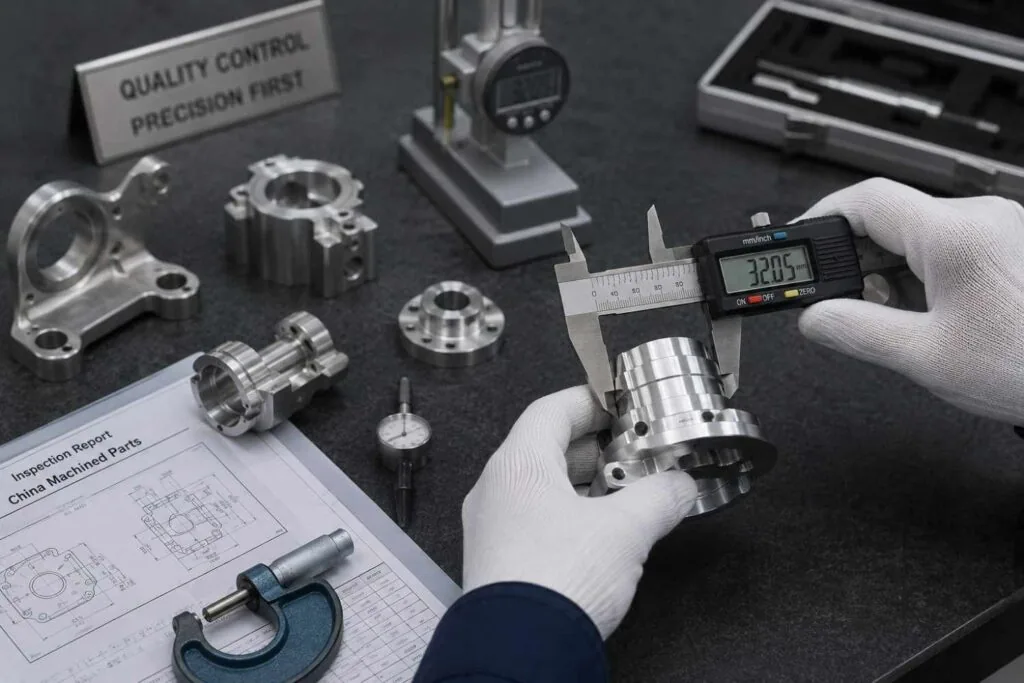
Vet a tight tolerance CNC machining vendor on evidence, not equipment lists. Ask for a CMM report from comparable work with measured values against every characteristic, the Cpk achieved on that job with its sample size, the calibration certificate for the CMM that produced the report, and a paid first article on your own part before committing to volume. Where the shortlist is offshore, the same evidence has to survive a longer feedback loop; our note on quality control when outsourcing CNC machining to China covers the additional gates.
| What to ask | A good answer | Red flag |
|---|---|---|
| Show me a CMM report from a part like mine. | A balloon-numbered drawing with an actual measured value per characteristic | A one-line conformance statement with no numbers |
| What Cpk did you hold on that feature, over what sample size? | An index, a sample size, and the named characteristic | One facility-wide percentage quoted for all work |
| Who calibrates your CMM, and against what reference? | A named laboratory with certificates traceable to national measurement standards | No certificate available, or an expired date |
| At what temperature was the part measured? | A stated temperature recorded on the inspection report | The question is treated as unusual |
| Which process holds the tightest feature on my part? | A specific named process and machine, with a secondary operation if needed | ±0.001mm promised straight off a 3-axis mill |
| What is your certification scope, and at which site? | ISO 9001:2015 and, for aerospace, AS9100D, naming the machining site | A certificate held by a trading entity or another address |
Worked example: can the vendor’s CMM prove the feature?
A measurement system consumes part of the tolerance band before a part is cut. Two ratios are in common use: the gauge-maker’s 10:1 rule, where measurement uncertainty should not exceed one tenth of the band, and a 4:1 ratio treated as the practical minimum. For a feature at ±0.005mm the band is 0.010mm, so 10:1 allows 0.0010mm and 4:1 allows 0.0025mm.
CMM makers state maximum permissible length-measuring error as E = A + L/K micrometres. On a machine specified at E = 1.8 + L/300 µm, measured across L = 100mm: E = 1.8 + (100 ÷ 300) = 1.8 + 0.33 = 2.13 µm, or 0.00213mm.
That machine clears 4:1 (2.13 < 2.5) and fails 10:1 (2.13 > 1.0). It can accept the part, but 2.13 ÷ 10.0 = 21% of the band is consumed by the measurement, so the vendor should be guard-banding to that figure rather than accepting to the drawing limit. Tighten the feature to ±0.0025mm and the band halves: the same machine consumes 2.13 ÷ 5.0 = 43% and fails 4:1 as well. Ask for the MPE figure and the calibration certificate, not the brand name on the machine.
When a tight tolerance is the wrong specification
A tight tolerance is the wrong specification when the function is served by a geometric control instead, when the assembly is adjustable, when the material moves more than the band you are asking for, when the part is a prototype whose geometry is still changing, and when the tolerance is tighter than your own incoming inspection can measure. In each case the tolerance adds cost and removes nothing from the risk.
| Situation | Better specification | Why |
|---|---|---|
| Two holes must line up with a mating part | True position to a declared datum frame, at a wider linear tolerance | Controls the function directly and legitimately returns tolerance to the machinist |
| The joint is shimmed or adjustable at assembly | General class, with the adjustment range documented | The assembly already absorbs the variation you are paying to remove |
| A 200mm aluminum dimension at ±0.005mm | A wider band, or a stated measurement temperature and a controlled environment | Thermal movement across a normal shop swing exceeds the tolerance band |
| Design still iterating; parts needed in days | General class prototypes now, tighten at design freeze | Tight tolerances on a geometry that will change is money spent twice |
| Your goods-in has hand gauges only | A tolerance your own metrology can resolve, or an agreed source inspection | A tolerance you cannot verify is a tolerance you cannot enforce |
This conversation usually shortens the drawing. Most parts have two or three features that carry function and twenty that do not, and separating them is the highest-return hour an engineer spends before releasing an RFQ.
What MW+ holds, and how it is documented
MW+ is a precision CNC machining supplier founded in 2015, operating a 15,000 m² facility in the Guangming of Shenzhen with 60+ machining centres and 120+ engineering and quality professionals, serving customers in 50+ countries across 70+ material grades. MW+ is certified to ISO 9001:2015, AS9100D, ISO 13485 and IATF 16949 at that site.
General machining is held to ±0.01mm to ISO 2768-m, precision features to ±0.005mm, and critical features to ±0.001mm where geometry and material allow, targeting Cpk ≥1.67 on critical characteristics. Every order ships with a certificate of conformance, a CMM inspection report and material certificates. FAI to AS9102 and PPAP Level 3 are available on request and quoted per programme.
Quotes are returned within 24 hours, standard prototypes in 3–5 business days with a 48-hour express route, and volume production in 10–15 business days scaling to 1,000,000+ units, with no minimum order quantity. The inspection routine is described on the MW+ quality assurance page; to price a specific tolerance, send the model and drawing through contact us.
Frequently asked questions
Why is one ±0.005mm feature quoted far higher than the ±0.01mm features around it?
A ±0.005mm feature is quoted higher because it changes the process route. It typically requires reduced feeds and a dedicated finishing pass, tool wear tracked per part rather than per setup, thermal stabilisation before the finishing cut, and a CMM routine instead of hand gauges. If that feature also needs grinding or wire EDM, a second machine and a second setup enter the price and the lead time.
My supplier’s report says the part passed, so why did it fail our incoming inspection?
Two conforming measurements of the same part usually mean two different measurement setups. The common causes are a different datum order, a different probing strategy on the same surface, measurement at a different temperature, or a fixture that constrains a flexible part differently. Agree the datum scheme, the probing method and the inspection temperature before the first production part, and require the report to reference the drawing balloon numbers.
Which materials are hardest to hold a tight tolerance on?
Aluminum 6061-T6 is hardest for thermal reasons, with a nominal coefficient of thermal expansion near 23.6 µm/m·°C, so a 100mm dimension moves about 23.6µm across a 10°C swing. Inconel 718 and 304 stainless are hardest for tool-wear reasons, because they work-harden and push the dimension steadily across a batch. Ti-6Al-4V moves least thermally but deflects readily in thin sections.
Should I ask for a first article inspection on every order or only the first?
Request a full First Article Inspection to AS9102 on the first order, on any drawing revision, and after any change of machine, tooling or subcontracted process. Repeating a full FAI on unchanged repeat orders adds documentation cost without adding information. What repeat orders need instead is in-process capability data on the critical characteristics, which shows whether the qualified process is still behaving.
Can I specify a tolerance tighter than my own inspection equipment can measure?
You can specify it, but you cannot enforce it. If your incoming inspection cannot resolve the band, a dispute becomes a contest between two reports rather than a question of fact. Either specify a tolerance your metrology can verify, or agree in advance that the supplier’s calibrated CMM report is the accepted record, with the calibration certificate and measurement temperature attached to it.
Does a tight tolerance on a drawing guarantee the parts will fit?
No. Fit depends on the tolerance stack across the assembly and on the datum scheme, not on any single tight number. A part with every dimension held to ±0.005mm from an undeclared datum can still fail to assemble, while a part with a true position control at a wider linear tolerance fits every time. Control the relationship between features, not just their sizes.
What lead time should I expect for tight tolerance parts?
MW+ returns a quote within 24 hours, delivers standard prototypes in 3–5 business days or 48-hour express, and runs volume production in 10–15 business days. Add time where a feature needs a secondary operation such as grinding or wire EDM, and where 100% inspection is specified rather than sampling. Both are schedule items rather than machining time, and both should appear as separate lines on the quote. Explore the full route on the CNC machining services and CNC precision parts pages.