Material choice is the largest single cost lever a design engineer controls on a CNC part, and it is almost never the billet price that moves the number. What you pay per part is machining time, tool consumption, secondary finishing and inspection — and the material specification fixes all four before a single chip is cut.
This guide covers cost-reduction levers only. Each section names one lever, states what it changes in the quote, and states when pulling it is the wrong decision.
Key takeaways
- Raw stock is usually a minority of the quoted price. Compare quoted part price between two grades, never price per kilogram.
- Four material levers move a CNC quote: grade substitution, stock form, surface finish requirement and tolerance class.
- Nominal tensile strength is 310 MPa for aluminium 6061-T6 against 572 MPa for 7075-T6. If peak stress sits under 310 MPa with margin, 6061-T6 is the cheaper grade.
- A general tolerance of ±0.01mm to ISO 2768-m costs less than a blanket ±0.005mm. MW+ applies ±0.005mm to the features that carry it and ±0.01mm elsewhere.
- Surface finish is a step function, not a slider: Ra 3.2µm as-machined, Ra 0.4µm fine-machined, Ra 0.1µm polished. Each step adds an operation.
- Never substitute material on a part qualified under ISO 13485 or released against an AS9100D approved-material list.
- Which four levers does material choice pull?
- Why does a cheaper billet often produce a more expensive part?
- Which grade substitutions cut cost without losing function?
- Stock form: the metal you pay to remove
- Worked example: how stock form and grade change the metal you remove
- How does material choice change finishing cost?
- Where material and tolerance multiply each other
- When switching material is the wrong way to cut cost
- What should a drawing say so the shop can quote the cheaper option?
- Material cost review at MW+
- Frequently asked questions
Which four levers does material choice pull?
Material cost reduction in CNC machining means changing the specified grade, stock form, finish requirement or tolerance class so the part costs less to cut, without moving any property the part depends on. It is a specification exercise, not a purchasing exercise. The table shows where the money sits and which lever reaches each element.
| Cost element | What sets it | How material choice moves it | Lever to pull |
|---|---|---|---|
| Raw stock | Grade, form, mill certificate | Direct, but usually the smallest share | Grade substitution |
| Machine time | Cutting speed, feed, volume removed | Large — aluminium and free-machining grades run faster | Grade and stock form |
| Tool consumption | Abrasiveness, work hardening, heat | Large on stainless and titanium; small on aluminium | Grade substitution |
| Secondary finishing | Ra callout, plating or coating | Sets which finishes exist — anodizing needs aluminium | Finish requirement |
| Inspection | Controlled features and tolerance class | Indirect — unstable grades need more gauging | Tolerance class |
Why does a cheaper billet often produce a more expensive part?
A cheaper billet often produces a more expensive part because raw stock is typically a minority of the quoted price. Machine time, tooling, setup and inspection make up the balance. A carbon steel blank can cost less per kilogram than aluminium 6061-T6 and still lose on total part cost, because it runs at lower cutting speeds and consumes more tool life for the same removed volume.
The share shifts with part size. On a small turned pin with little stock removal, material price matters more; on a large milled housing where most of the billet becomes chips, the grade that cuts fastest usually wins. Ask the shop for that split when you compare quotes for CNC machining services: it tells you which lever is worth pulling on this geometry.
Which grade substitutions cut cost without losing function?
The grade substitutions that cut CNC cost without losing function are the ones that drop a property the part does not use. Aluminium 7075-T6 to 6061-T6 gives up tensile strength you may not need. Stainless 316L to 304 gives up chloride corrosion resistance that matters only in marine or chemical service. Alloy steel 4140 to a cold-finished carbon steel gives up through-hardening depth on a part that is never heat treated.
| Specified grade | Lower-cost substitute | Property you give up | Substitution is safe when |
|---|---|---|---|
| Aluminium 7075-T6 | Aluminium 6061-T6 | Roughly half the tensile strength | Peak stress sits well under 310 MPa with margin |
| Stainless 316L | Stainless 304 | Chloride pitting resistance from molybdenum | No salt water, chlorides or de-icing chemicals |
| Stainless 304 | Stainless 303 | Weldability and some corrosion resistance | Machined, not welded; dry indoor service |
| Alloy steel 4140 | Carbon steel 1045 | Hardenability after heat treatment | Part ships as-machined, not quench-and-tempered |
| Carbon steel 1018 | Free-machining 12L14 | Weldability; lead addition is restricted in some products | Not welded, no lead restriction downstream |
Check the substitution against published property data
Work from nominal published values first, and from the mill certificate whenever the property is load-bearing. Nominal data for these grades is published in the MatWeb material property database, and the mill specifications are ASTM B221 for aluminium extruded bar, ASTM A108 for cold-finished steel bar and ASTM A276/A276M for stainless bar. Quoting the ASTM designation on the drawing removes a round of supplier questions.
| Grade and condition | Nominal tensile strength | Typical use of the margin |
|---|---|---|
| Aluminium 7075-T6 | 572 MPa | Structural airframe and high-load fittings |
| Aluminium 6061-T6 | 310 MPa | General brackets, housings, fixtures |
| Stainless 304, annealed | 505 MPa | General corrosion service |
| Stainless 316L, annealed | 485 MPa | Chloride and pharmaceutical service |
| Alloy steel 4140, annealed | 655 MPa | Shafts and gears intended for heat treatment |
| Carbon steel 1045, cold drawn | 625 MPa | Shafts and pins shipped as-machined |
| Carbon steel 1018, cold drawn | 440 MPa | Weldable general-purpose parts |
| Free-machining 12L14, cold drawn | 540 MPa | High-volume turned parts, no welding |
Free-machining grades and what the additive costs you
A free-machining grade is a standard alloy with a chip-breaking additive — sulfur in stainless 303, lead in 12L14 — that cuts faster and produces shorter chips. The additive buys the cycle time and is also what you give up: sulfur reduces corrosion resistance and weldability, and lead makes the grade unsuitable wherever lead content is regulated. These grades pay off on high-volume turned work such as Swiss machining, where cycle time repeats across thousands of parts. On a few dozen prototypes the setup dominates and the saving barely registers.
Stock form: the metal you pay to remove
Stock removal ratio is the ratio between the starting blank volume and the finished part volume. A part cut from a rectangular block when round bar would do, or from 50mm plate when 25mm clears the envelope, pays twice: once in material and again in cutting time. Pick the stock form before you finalise the model, because the geometry usually locks it in.
| Stock form | Suits | Effect on machine time | Choose it when |
|---|---|---|---|
| Round bar, bar-fed | Turned and Swiss-turned parts | Lowest — stock feeds automatically between parts | Rotationally dominant, fits a standard bar diameter |
| Plate or flat bar | Brackets, plates, manifold bodies | Moderate — use the nearest standard thickness above finished size | One dominant flat datum, modest depth |
| Rectangular block | Housings and multi-face parts | Highest — most of the block becomes chips | Material is genuinely needed on all six faces |
| Extruded profile | Constant-section aluminium | Low — the profile already carries the section | A standard profile matches, or volume justifies a die |
| Near-net casting or forging | High-volume structural parts | Lowest per part, highest tooling entry cost | Volume amortises the pattern or die |
Two rules follow. Round dimensions to standard stock sizes: a 24.6mm boss cut from 25mm bar wastes almost nothing, while 25.4mm forces the next size up. And for prismatic parts, count how many faces need access before choosing a block: every extra setup in CNC milling services adds fixturing time and a repositioning error budget, a mechanism covered in depth in how part geometry shapes production cost.
Worked example: how stock form and grade change the metal you remove
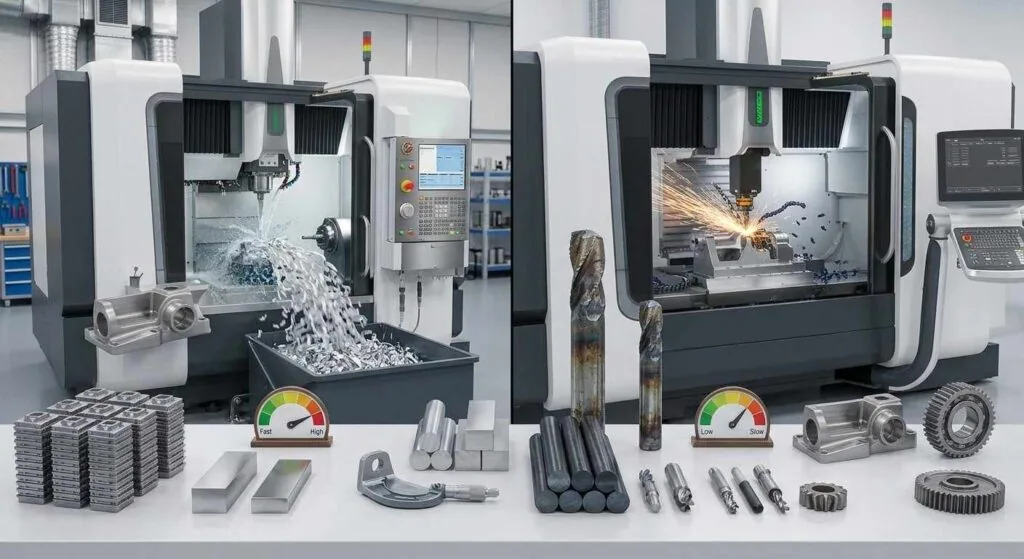
Take a bracket with a finished envelope of 100 × 60 × 20 mm and a finished solid volume of 72 cm³ after its pockets are cut. Two questions decide the roughing time: what blank it starts from, and how fast that grade lets the cutter remove metal. The removal rates below are assumptions — substitute your supplier’s figures; the arithmetic is what matters.
- Blank volume from a rectangular block. A 105 × 65 × 25 mm block is 105 × 65 × 25 = 170,625 mm³ = 170.6 cm³.
- Metal removed from the block. 170.6 − 72 = 98.6 cm³, a stock removal ratio of 2.37 : 1 — 58% of the blank becomes chips.
- Blank volume from 22 mm plate. 105 × 65 × 22 = 150,150 mm³ = 150.2 cm³, because the part is only 20 mm thick and the nearest standard plate above it clears the envelope.
- Metal removed from the plate. 150.2 − 72 = 78.2 cm³ — 20.4 cm³ less, or 21% less roughing volume, for the identical finished part.
- Convert volume to time. Assume a roughing rate of 25 cm³/min in 6061-T6 on this machine. Block: 98.6 ÷ 25 = 3.94 min. Plate: 78.2 ÷ 25 = 3.13 min. Saving 0.81 min per part.
- Scale it to the order. Across 500 parts that is 405 minutes — about 6.8 hours of spindle time removed by one line on the drawing.
- Now change the grade. Assume the same machine roughs 316L at 8 cm³/min. The block route becomes 98.6 ÷ 8 = 12.3 min, roughly 3.1 times the aluminium figure on identical geometry.
Two things fall out of the arithmetic. The stock-form decision and the grade decision multiply rather than add, so the plate-versus-block choice is worth most on the grade that cuts slowest. And the per-kilogram price of the billet never entered the calculation, which is why comparing material prices between suppliers answers the wrong question.
How does material choice change finishing cost?
Material choice determines which finishes are physically available and how many operations reach a given roughness. Anodizing requires aluminium, passivation requires stainless, black oxide requires ferrous material. Roughness moves in steps: MW+ delivers Ra 3.2µm as-machined, Ra 0.4µm fine-machined and Ra 0.1µm polished, each a separate operation quoted separately.
Roughness parameters including Ra were defined in ISO 4287:1997, which has since been superseded by ISO 21920-2:2021; drawings in circulation still cite both. Call out a roughness only on the faces that need it — the full mechanics of a compliant callout are covered in specifying surface finish in Ra.
| Finish requirement | Available on | Extra operations required | Cost effect |
|---|---|---|---|
| As-machined, Ra 3.2µm | All grades | None | Included in the machining price |
| Fine-machined, Ra 0.4µm | All grades; easiest on aluminium | Dedicated finishing pass | Adds cycle time on the same machine |
| Polished, Ra 0.1µm | All grades, subject to hardness | Polishing after machining | Adds a labour-based secondary operation |
| Anodize Type II or hard anodize | Aluminium only | Masking, racking, process queue | Grows dimensions — allow for it in the tolerance |
| Passivation | Stainless only | Chemical bath | Low cost, usually mandatory on medical stainless |
| Black oxide, zinc or nickel plating | Steel and stainless | External process queue | Adds a step and a dimensional allowance |
Where material and tolerance multiply each other
Tolerance and material are not independent cost drivers. The same ±0.005mm band is cheaper to hold in a stable, easily machined grade than in one that work hardens or moves during stress relief. Specify a tight band on an unstable material and you pay for the choice twice, in scrap and inspection.
Under ISO 2768, the general tolerance standard most drawings default to, class m assigns a band by dimension range rather than by feature. MW+ holds general machining to ±0.01mm to ISO 2768-m and applies ±0.005mm to the features that carry it, with a ±0.001mm floor available on CNC precision parts where function requires it. Applying the tightest band to every dimension is the most common and most expensive specification error; what that costs by band is set out in budgeting for ±0.005 mm.
Thermal expansion and the tolerance you can actually hold
Aluminium expands roughly twice as much as steel per degree of temperature change — nominal coefficients of thermal expansion are about 23.6 µm/m·K for 6061-T6 against about 11.5 µm/m·K for carbon steel. On a 200mm aluminium feature, a 10 °C difference between shop floor and inspection room moves the dimension by about 47 µm, several times a ±0.005mm band. State the measurement temperature on the drawing when you need micron-level control on a large aluminium part, and check differential expansion between mating parts before substituting an aluminium housing for a steel one.
When switching material is the wrong way to cut cost
Material substitution is the wrong lever whenever the paperwork attached to the part costs more than the machining. On a qualified medical device, an aerospace part released against an approved-material list, or an automotive part with a submitted PPAP, changing the grade restarts a validation programme. The saving is real and also irrelevant.
| Situation | Recommendation | Why |
|---|---|---|
| Device qualified under ISO 13485 | Do not substitute; cut cost through stock form and tolerance instead | Change control and biocompatibility requalification exceed the saving |
| Aerospace part on an AS9100D approved-material list | Do not substitute without an approved deviation | The material is part of the released configuration |
| Fatigue-loaded part with cyclic stress | Keep the higher-strength grade | Endurance limit governs, not ultimate tensile strength |
| Service temperature above roughly 150 °C | Keep steel or a heat-resistant alloy | Aluminium alloys lose a substantial share of strength as temperature rises |
| Sliding or wear surface | Keep the hardenable grade | A softer substitute wears out and replacement dwarfs the saving |
| Part joined by welding | Avoid free-machining grades | Sulfur and lead additions make 303 and 12L14 unweldable |
| Dissimilar metals in a wet assembly | Keep the original couple | Swapping one member can create a galvanic cell |
One more case: if the part is already hardened, no substitution makes it cheaper to mill, and the honest answer is a different process — wire EDM services cut hardened material with no cutting force at all.
What should a drawing say so the shop can quote the cheaper option?
A drawing that lets a shop quote the cheaper option states the requirement rather than the solution: material specification with its ASTM designation, a named general tolerance class, a tighter band only on the features that need one, and roughness only where it matters.
- State the general tolerance as ISO 2768-m in the title block, then flag the critical features individually.
- Give the material as a specification and grade — “ASTM B221, 6061-T6” — not as a trade name.
- Where the grade is not functionally fixed, add “or approved equivalent” and name the critical property.
- Apply a roughness callout per surface, not as a blanket note, and say whether plated dimensions are before or after coating.
- Send the STEP file alongside the PDF so the supplier quotes the geometry you modelled.
Material cost review at MW+
MW+ operates a 15,000 m² facility at No. 39 Xishi Road, Hewan Community, Guangming, Shenzhen, founded in 2015, with 60+ CNC machining centres and 120+ engineering and quality professionals. MW+ machines 70+ material grades for customers in 50+ countries, with no minimum order quantity and volumes to 1,000,000+ units.
Quotes are returned within 24 hours, and MW+ will price two material options side by side on request so you see the machining delta rather than infer it. Express prototypes ship in 48 hours, standard prototypes in 3–5 business days and volume production in 10–15 business days.
Every order ships with a certificate of conformance, a CMM inspection report and material certificates, under a quality system certified to ISO 9001:2015, AS9100D, ISO 13485, IATF 16949 and NADCAP. First article inspection to AS9102 and PPAP Level 3 are available on request, quoted per programme. Send a drawing in STEP, IGES, DXF, DWG, SolidWorks or PDF to request a CNC machining quote with a material review attached.
Frequently asked questions
Why did my quote barely change when I switched from 7075-T6 to 6061-T6?
Because the part is dominated by machine time and setup rather than material price, and both grades cut at similar speeds. Substitution within one alloy family moves stock cost but not cycle time. The saving from 7075-T6 to 6061-T6 shows up on parts with a high stock-removal ratio and large billets, not on small parts with many setups.
Should I let the supplier choose the material to get the lowest price?
Only within a boundary you define. State the property that is actually critical — tensile strength, corrosion environment, service temperature, conductivity — and allow an equivalent grade that meets it. An open “cheapest available” instruction transfers a design decision to a shop that does not know the load case, and that is how a welded assembly ends up specified in free-machining 303.
Is stainless steel always more expensive to machine than aluminium?
Generally yes, because austenitic grades work harden at the cut, run at lower cutting speeds and consume more tool life. The gap narrows on parts with little material removal, such as short turned components where stock cost and setup dominate. It widens sharply on large milled parts where most of the billet becomes chips.
Can I cut cost by loosening tolerances instead of changing material?
Often, and it can be the larger saving. Moving non-critical features from a blanket ±0.005mm to ±0.01mm to ISO 2768-m removes finishing passes, in-process gauging and inspection points across the whole part. Material substitution touches stock cost and cutting speed; tolerance touches machine time, scrap rate and inspection at once.
Does a cheaper material change my lead time?
Mainly through stock availability, not machining. Common grades held in standard sizes ship on the normal schedule; an unusual grade or a non-standard section adds a procurement wait before machining starts. MW+ quotes within 24 hours and runs volume production in 10–15 business days on stocked grades, with 48-hour express and 3–5 business day prototype options.
How do I compare two material options fairly across suppliers?
Send both suppliers the same drawing package with both options on it, ask for a price for each at the same quantity, and ask each to state the setups assumed. Comparing a per-kilogram material price tells you nothing, because the machining assumption behind it differs. Quoted part price at a fixed quantity and setup count is the only fair test.
Will MW+ tell me if my specified material is over-specified?
Yes. MW+ reviews the drawing at quote stage and flags where the specified grade, tolerance class or roughness callout exceeds what the described function needs, with the cost effect of each. A released specification is never changed unilaterally — the recommendation goes back with the alternative priced, and the decision stays with the design owner.