Complex Components:
A Precision CNC Machining Guide
The global manufacturing landscape is shifting toward higher complexity and tighter tolerances. As industries like aerospace, medical technology, and renewable energy evolve, the demand for intricate parts that meet exacting specifications has never been higher. For procurement managers and engineers, navigating the world of CNC machining is no longer just about finding a vendor; it is about understanding the technical nuances that ensure project success.
This guide explores the critical factors involved in sourcing custom machine parts and how modern machining standards are redefining quality in the metalworks industry.
Understanding the Complexity of Modern CNC Machining
Computer Numerical Control (CNC machining) has transitioned from basic milling and turning to highly sophisticated multi-axis machining operations. A “complex component” typically involves intricate geometries, internal features that are difficult to access, and the requirement for extreme dimensional accuracy—often within microns.
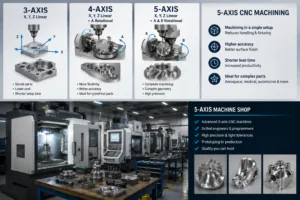
When evaluating a project, buyers must consider the “machinability” of their design. Complexity often dictates the type of machinery required. For instance, while a 3-axis machine is suitable for simpler parts, 5-axis CNC machining allows for the creation of organic shapes and deep undercuts in a single setup. This reduces the margin for error that occurs when moving a part between different machines.
📦 Material selection & compatibility
| Material | Typical use | Machinability |
|---|---|---|
| Aluminum 7075 | Aerospace structural | Excellent |
| Stainless 17-4 PH | Medical / high-strength | Good (heat treated) |
| Inconel 718 | Turbine blades, high‑temp | Difficult, requires specialist |
| Titanium Grade 5 | Implants, racing | Fair (needs rigid setup) |
🔹 Tip: Always verify material certs (MTR) and confirm the shop’s experience with your alloy.
🔍 Tolerance & quality checklist
- ✔ First Article Inspection (FAI) with CMM reports
- ✔ In‑process gauging & laser scanning
- ✔ Surface roughness (Ra) measurement
- ✔ Material traceability + batch trace
- ✔ GD&T verification per ASME Y14.5
Every MW+ order ships with a certificate of conformance, a CMM inspection report and material certificates. First article inspection to AS9102 and PPAP Level 3 are quoted per programme — see CNC machining quality control.
⚙️ Surface finish & post‑processing
- Passivation: for stainless medical parts
- Electropolishing: lowers Ra, improves cleanability
- Anodizing (type II/III): wear & corrosion protection
- Bead blasting: uniform matte appearance
Specify Ra values early to avoid secondary delays.
Key Considerations for Sourcing Precision Parts
Buying intent starts with a clear understanding of your technical requirements. To get the best ROI from a CNC machining partner, consider the following pillars of production:
1. Material Selection and Compatibility
The choice of material affects everything from tool wear to the final structural integrity of the part. Whether you are working with aerospace-grade aluminum, stainless steel, or exotic alloys like Inconel, your partner must have the specialized tooling to handle the material’s specific properties.
2. Tolerance Requirements
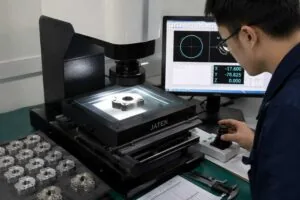
Not every part requires aerospace-level tolerances, and over-specifying them is the most reliable way to inflate a quotation. For complex components a ±0.001 mm floor on a handful of functional features is often non-negotiable, but the rest of the drawing belongs on the ±0.01 mm general class of ISO 2768-1:1989; where a general rule for geometrical tolerances is also needed, ISO 22081:2021 replaces the withdrawn ISO 2768-2:1989. A reliable shop verifies the tight features on a coordinate measuring machine; our guide to tolerance standards for precision machined parts covers how to mark them up.
3. Surface Finish and Post-Processing
Precision doesn’t end when the part leaves the machine. Buyers should look for integrated services such as anodizing, heat treatment, or bead blasting. A seamless transition from machining to finishing ensures that the component meets both aesthetic and functional standards.
Technical Comparison: Standard vs. Precision CNC Machining
| Feature | Standard CNC Machining | Precision CNC Machining |
|---|---|---|
| Typical Tolerances | ±0.1 mm to ±0.05 mm | ±0.01 mm to ±0.001 mm |
| Axis Capability | 3-Axis (Standard) | 4-Axis, 5-Axis, & Swiss Lathes |
| Geometry | Simple to Moderate | Highly Complex / Multi-faceted |
| Common Use Cases | Brackets, Simple Housings | Surgical Tools, Turbine Blades |
| Material Range | Common Metals/Plastics | Hardened Steels, Superalloys |
Why a DFM Review Matters More on Complex Components
On a simple bracket a design-for-manufacture review saves a little money. On a complex component it decides whether the part can be made at all at the tolerance asked for. The questions are always the same: can every critical feature be reached with a tool rigid enough to hold the band, does the part offer somewhere to be clamped that is not also a critical surface, and does the order of operations leave the datum intact until the last critical dimension has been cut?
Raised before the drawing is frozen, those questions cost an email. Raised after the first setup, they cost a fixture, a programme and a scrapped billet. That is why a DFM review is worth insisting on even when it is offered free, and why the useful response to one is an engineering conversation rather than a revised quotation. For the cost side of the same decision see what actually drives CNC machining cost; for the production side, CNC machining services.
📊 Essential Checklist for Procurement Officers
- Equipment Versatility: Do they possess multi‑axis machines capable of handling your specific geometry?
- Quality certifications: ISO 9001:2015 is the baseline; AS9100D for aerospace, ISO 13485 for medical devices and IATF 16949 for automotive. Verify the certificate with the registrar rather than taking the logo at face value.
- Prototyping Capabilities: Can they produce a “first‑article” inspection report before moving to high‑volume production?
- Technical Support: Do they offer engineering feedback to help lower costs or improve part performance?
- Lead Time Reliability: Precision takes time, but a professional shop should provide accurate timelines and stick to them.
The Role of Automation and Industry 4.0
The future of CNC machining is deeply rooted in automation. Precision components now benefit from “lights-out” manufacturing, where robotic loaders allow machines to run 24/7 with minimal human intervention. This technology doesn’t just increase speed; it increases consistency. What automation removes is the variation that comes from manual handling; what it does not remove is tool wear, so the first part and the thousandth still differ unless the process is monitored and tooling changed on schedule. That is what capability indices are for, and why a stated process capability of Cpk ≥1.67 is a more meaningful commitment than any claim about uptime.
For buyers, this means that even the most complex orders can be scaled efficiently. Working with a provider that invests in these technologies ensures that your production line remains future-proof and competitive.
Cost vs. Value in Precision Machining
It is tempting to choose a vendor based solely on the lowest quote. However, in the realm of complex components, the “cost of failure” often far outweighs the initial savings. A part that is slightly out of spec can lead to assembly line shutdowns or, worse, field failures.
True value in CNC machining is found in the intersection of technical expertise, high-end machinery, and rigorous quality assurance. By focusing on these elements, buyers can ensure their complex components perform exactly as intended, regardless of the environment they are deployed in.
Frequently asked questions
Do I actually need 5-axis machining, or will 3-axis do?
Count the faces that carry a critical feature. If every critical feature can be reached from one or two orientations, three-axis is enough and cheaper. Five-axis earns its place when features sit on compound angles, when an undercut cannot be reached, or when the tolerance between features on different faces is tighter than the repeatability of re-fixturing. That last case is the one buyers miss: the question is not whether a feature can be cut, but whether the relationship between two features survives a setup change. Our comparison of 3-axis vs 5-axis CNC machining works through the trade.
Is a 0.001 mm band available on every feature?
No, and asking for it on every feature is the most expensive mistake a complex-part drawing can carry. The tightest band applies to individual critical features, in a suitable material, on the right machine, in a controlled environment. General features belong on the medium class of ISO 2768. Mark the handful of dimensions that are genuinely functional and let everything else fall to the general class.
What documentation should I insist on before the first article ships?
A first article inspection report to AS9102 against a ballooned drawing, a CMM report covering every toleranced dimension, and material certificates traceable to the heat number. Ask for a redacted sample of each before placing the order rather than after. A shop that cannot produce one on request does not have the quality infrastructure for complex work.
How long does a complex component take?
A prototype in a stocked material is 3 to 5 business days, with a 48-hour express route for simpler geometry, and volume production runs 10 to 15 business days once the design is frozen. Complexity affects those figures mainly through setup count and material availability — Inconel and titanium are normally bought in against the order, and that wait sits in front of the machining rather than inside it.
Should I qualify one supplier or split the work?
For a complex component, split sourcing usually costs more than it saves. Each supplier develops its own fixturing and its own reading of the drawing, so you end up qualifying two processes and reconciling two sets of inspection data on a part whose whole difficulty is repeatability. Split the work when capacity risk genuinely threatens the programme, not to create price tension on a part where qualification is the expensive part.
When is precision machining the wrong process?
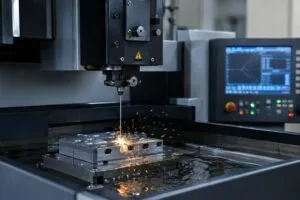
When the geometry is better served by something else. A thin-walled part that will distort under cutting loads may be better cast or fabricated. A sharp internal corner that no end mill can produce belongs to wire EDM services. A high-volume part with no critical tolerance is usually cheaper moulded. Precision machining is the right answer for complex, tightly toleranced, low-to-medium volume parts — not for everything with a drawing attached.