Medical device CNC machining uses the same lathes, mills and cutting tools as any precision shop. What makes it different is everything around the machine: controlled implant-grade materials, validated processes, cleaning, traceability from bar to device, and a quality system certified to ISO 13485. This guide explains what those controls are, which standards set them, how the common medical materials machine, and the seven checks that separate a real medical machining supplier from a general shop with a certificate on the wall.
Key takeaways
- The device maker is the legal manufacturer. The machine shop is a controlled supplier under clause 7.4 of ISO 13485:2016, and its job is to prove the parts were made the way the device file says.
- In the United States, the FDA’s Quality Management System Regulation has incorporated ISO 13485 by reference since 2 February 2026, so one quality system now serves both the US and EU markets.
- Implant materials are specified by standard, for example ASTM F136 for Ti-6Al-4V ELI and ASTM F138 for 316LVM, and the mill certificate is the first link in the traceability chain.
- Processes whose results cannot be fully verified by inspection, such as cleaning and passivation, must be validated through IQ, OQ and PQ.
- MW+ runs medical work under ISO 13485, holding ±0.005mm as a precision band and ±0.001mm on selected features, with Cpk 1.67 or better on controlled characteristics.
What makes medical device CNC machining different?
A medical part and an industrial part can come off the same machine with the same tolerance. The difference is what the supplier can prove afterwards. In medical machining, every part must be traceable to its material, every process must be shown to produce the same result every time, and nothing about the process may change without the device maker knowing.
| Area | General precision machining | Medical device CNC machining |
|---|---|---|
| Material | Certificate on request, equivalent grades often accepted | Exact grade to a named standard, certificate with every lot, no substitution |
| Process changes | Supplier’s decision | Change control, customer notified and often approval required |
| Records | Inspection report per order | Lot record linking material, machine, programme, people and results |
| Cleaning | Cosmetic | Specified and often validated, residues controlled |
| Validation | First article | IQ, OQ and PQ where output cannot be fully verified |
| Nonconformance | Rework or scrap | Documented disposition, customer involvement, CAPA |
Which regulations and standards apply to medical machining?
A machining supplier does not register devices or hold a CE mark. It supports a device maker who does. Knowing which standard belongs to whom saves a lot of confusion in supplier audits.
| Standard or regulation | Owned by | What it means for the machine shop |
|---|---|---|
| ISO 13485:2016 | Both | The supplier’s own quality system, certified by a registrar |
| FDA QMSR (21 CFR 820) | Device maker | Supplier controls flow down through purchasing requirements |
| EU MDR 2017/745 | Device maker | Notified bodies may audit critical suppliers, including machine shops |
| ISO 14971 risk management | Device maker | Critical characteristics on the drawing usually come from this analysis |
| ISO 10993-1 biological evaluation | Device maker | The supplier must not change material or processing in ways that invalidate it |
Two practical consequences follow. First, a supplier’s ISO 13485 certificate should list the manufacture of components for medical devices within its scope. Second, the device maker’s purchasing controls, not the supplier’s preferences, decide what records and approvals are required. The supplier’s job is to meet them without exception.
How do medical materials machine?
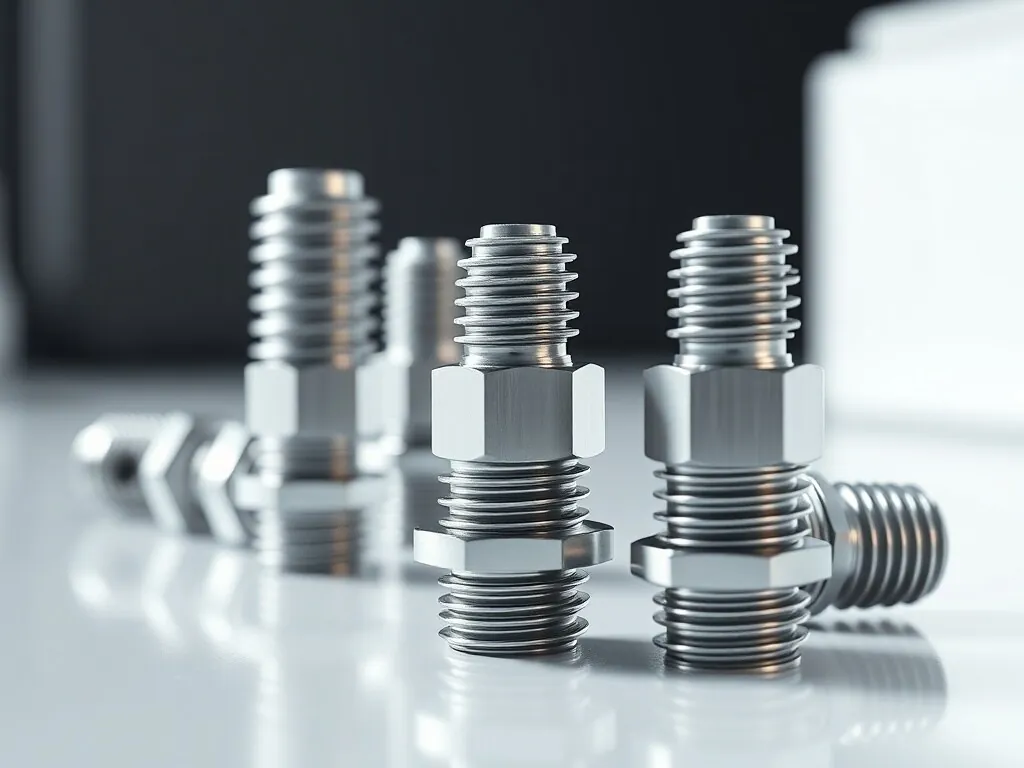
Implant and instrument materials are specified by standard, and each has its own machining behaviour. The table covers the most common ones.
| Material | Standard | Typical use | Machining behaviour |
|---|---|---|---|
| Ti-6Al-4V ELI | ASTM F136 | Bone screws, plates, spinal and dental implants | Low thermal conductivity, heat at the edge, needs sharp tools and good coolant |
| CP titanium, Grades 1–4 | ASTM F67 | Dental and craniofacial parts | Gummy, burrs and built-up edge |
| 316LVM stainless steel | ASTM F138 | Implants, temporary fixation | Work-hardens, needs positive tools and consistent feed |
| Cobalt-chromium-molybdenum | ASTM F1537 | Joint components, bearing surfaces | Hard and abrasive, low speeds, high tool wear |
| 17-4PH stainless steel | ASTM A564 | Surgical instruments | Machines well in condition A, then aged |
| PEEK | ASTM F2026 | Spinal cages, instrument parts | Large thermal expansion, residual stress, contamination-sensitive |
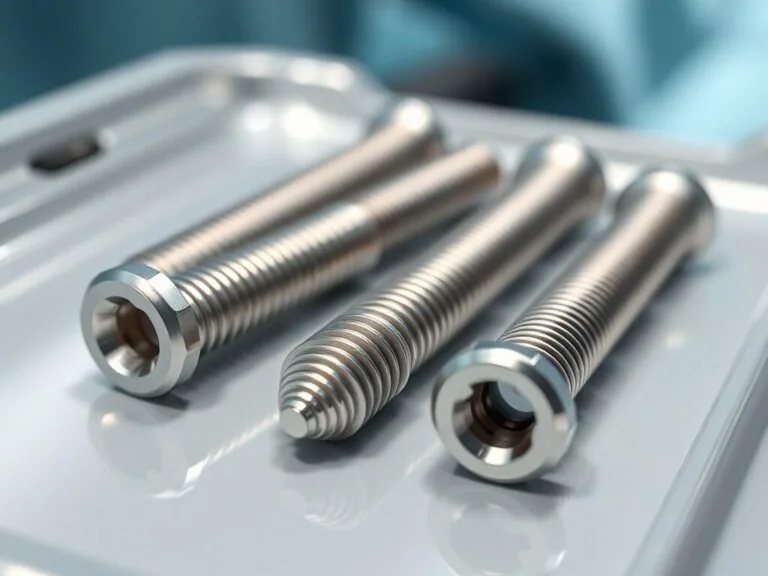
Two of our case studies show these materials in production: Swiss-turned titanium bone screws at ±0.001mm for a Class III device, and 10,000+ PEEK medical parts with full ISO 13485 traceability.
Process validation in medical device CNC machining: IQ, OQ and PQ
Clause 7.5.6 of ISO 13485 requires validation of any process whose output cannot be, or is not, verified by later monitoring or measurement. Dimensions can usually be measured, so machining itself is often verified rather than validated. Cleaning, passivation, anodising, laser marking and some deburring steps cannot be fully verified on the finished part, so they are validated. Many device makers also ask for machining to be validated when the part is high-risk or produced in large volumes.
| Stage | Question it answers | Typical evidence |
|---|---|---|
| IQ, installation qualification | Is the equipment installed, calibrated and maintained correctly? | Machine records, calibration certificates, utilities checks |
| OQ, operational qualification | Does the process work across its allowed operating window? | Runs at the limits of key parameters, results within specification |
| PQ, performance qualification | Does the process produce good parts consistently under normal conditions? | Several production lots, capability studies, all results conforming |
Worked example: reading a capability result
In practice, process validation of machining usually rests on capability studies. Take a critical diameter of 5.000mm ±0.010mm. A PQ run of 30 parts gives a mean of 5.002mm and a standard deviation of 0.0012mm.
- Distance from the mean to the upper limit: 5.010 − 5.002 = 0.008mm
- Distance from the mean to the lower limit: 5.002 − 4.990 = 0.012mm
- Cpk = the smaller distance ÷ (3 × standard deviation) = 0.008 ÷ 0.0036 = 2.22
A Cpk of 2.22 is comfortably above the 1.33 many device makers require and the 1.67 we target on controlled characteristics. Notice what limited it: the mean sat 0.002mm above nominal. Centring the process would raise Cpk to 0.010 ÷ 0.0036 = 2.78 without any improvement in the machine. Capability is as much about aim as about precision.

Cleaning, passivation and surface finish
Finishing steps change the surface that touches the patient, so they matter more in medical device CNC machining than anywhere else. Each has its own specification.
| Step | Purpose | Common specification |
|---|---|---|
| Passivation of stainless steel | Removes free iron and restores the passive oxide layer | ASTM A967 |
| Surface preparation of implants | Cleaning, descaling and passivation of metallic implants | ASTM F86 |
| Titanium anodising | Colour coding, wear and anti-galling | AMS 2488 or the device maker’s specification |
| Electropolishing | Smooth, clean surface, removes micro-burrs | Device maker’s specification |
| Bead blasting | Uniform matte finish, glare reduction on instruments | Media and pressure defined and controlled |
| Final cleaning | Removes machining fluids, particles and residues | Device maker’s validated cleaning specification |
Surface roughness is part of the same picture. Instrument surfaces commonly call for Ra 0.4 to 0.8 µm, and our finish ladder runs from Ra 3.2 µm as-machined to Ra 0.4 µm fine-machined and Ra 0.1 µm polished. The CNC surface finish chart explains what each value means in practice.
Traceability and records
Traceability is where medical machining suppliers are most often found wanting in audits. ISO 13485 covers it in clause 7.5.8 for identification and clause 7.5.9 for traceability, with clause 7.5.9.2 adding specific requirements for implantable devices. The practical test is simple: pick any shipped part and reconstruct its history.
- Material: heat or lot number, mill certificate, receiving inspection.
- Manufacturing: machine, programme revision, tools, operators, dates.
- Inspection: first article, in-process and final results, instruments used and their calibration status.
- Finishing: cleaning, passivation or anodising lots.
- Release: certificate of conformance and the quantities shipped per lot.
Marking is part of traceability too. Many devices must carry a unique device identifier under the FDA’s UDI system and its EU equivalent, and laser marking of lot codes or UDI carriers is often done at the machining supplier. Measurement traceability matters as well: gauges should be calibrated against national standards, as NIST describes for the United States.
7 critical ISO 13485 checks for a machining supplier
A certificate proves a quality system exists. These seven checks show whether it works for your part.
1. Certificate scope
Read the scope line on the ISO 13485 certificate, not just the logo. It should cover the manufacture of components for medical devices, and the certificate should be current and issued by an accredited registrar.
2. Material control
Ask how incoming bar is verified and quarantined, and how the heat number follows the material. A good supplier can show you a receiving record and the traveller it links to.
3. Validation evidence
Ask for an example validation for cleaning or passivation, with its IQ, OQ and PQ. If the answer is that inspection covers it, the supplier has not understood clause 7.5.6.
4. Change control
Ask what happens when a machine, programme, tool supplier or finishing vendor changes. The answer should include notifying you before the change is used.
5. A mock recall
Give the supplier a lot number and ask for its full history. Time how long it takes. Minutes is good; days is a warning.
6. Measurement capability
Check that the gauges and CMMs can measure your tightest tolerance with uncertainty well inside the band, and that they are calibrated and controlled for temperature.
7. Nonconformance and CAPA
Ask to see how a nonconforming lot was handled: containment, root cause, corrective action and verification. A supplier with no nonconformance records is not a perfect supplier. It is one that is not recording.
For a wider version of this audit, our checklist on how to verify CNC part quality covers the inspection side in detail.
Design for manufacturability on medical parts
Many of the costs in medical device CNC machining are designed in before a supplier is chosen. A short DFM review at the drawing stage usually pays for itself, because medical parts add a constraint most industrial parts do not have: every surface must be cleanable, and every feature must be inspectable.
| Feature | Why it causes trouble | Better practice |
|---|---|---|
| Sharp internal corners | Stress concentration and residue traps | Specify a radius that a standard tool can cut |
| Deep blind holes | Chips and cleaning fluid collect at the bottom | Through-holes where function allows, or a defined cleaning route |
| Narrow slots and cross-holes | Burrs at intersections are hard to reach and inspect | Agree a burr standard and the inspection method up front |
| Undefined surface finish on contact zones | Supplier chooses, and finishes vary between suppliers | Give an Ra value for patient-contact and sealing surfaces |
| Tolerances tighter than the function needs | Inspection time and scrap rise sharply below ±0.005mm | Reserve ±0.001mm for the few features that mate or seal |
| Marking location left open | Marking can land on a functional or sealing surface | Dimension the marking zone and content on the drawing |
These points also shorten process validation. A part with fewer hidden features and fewer ultra-tight tolerances needs fewer characteristics in its capability studies, fewer cleaning challenges in its cleaning validation and a simpler inspection plan. In medical machining, the cheapest validation is the one the design made easy. Our general guide to DFM in CNC machining covers the wider principles.
When is a general machine shop enough?
Not every medical project needs a fully ISO 13485-controlled supplier. Using one where it adds nothing just adds cost.
- Early prototypes for bench testing that will never contact a patient can be made by any competent precision shop.
- Test fixtures, assembly jigs and inspection gauges for your own line are production tools, not device components.
- Packaging and handling tooling is controlled by your own processes rather than by the device file.
The line is crossed when parts go into clinical use, into verification builds used for regulatory submissions, or into production. From that point, the supplier’s controls become part of your device’s evidence.
How MW+ runs medical device CNC machining
MW+ is a precision CNC machining company in Shenzhen, certified to ISO 13485 alongside ISO 9001:2015, AS9100D and IATF 16949. Medical parts run through the same 15,000 m² facility as our other work, with the controls described above applied to every medical lot.
- Swiss machining for bone screws, pins and small implant components.
- 5-axis CNC machining for joint components, housings and instrument bodies.
- Micro machining for features too small for conventional tooling.
- Every order ships with a certificate of conformance, a CMM report and material certificates, and first article inspection to AS9102 or PPAP Level 3 is available on request.
Our quality assurance page sets out the inspection system in full.
Frequently asked questions
Is ISO 13485 certification enough to supply implant components?
It is necessary, not sufficient. The device maker will also qualify the supplier against its own purchasing requirements, often with an on-site or remote audit, a first article and validation of any special processes. Certification opens the door; the qualification decides whether you are approved.
Does the FDA inspect machining suppliers?
The FDA regulates the device maker, who is responsible for controlling its suppliers. Supplier controls are examined through the device maker. Under the EU MDR, notified bodies can and do make unannounced visits to critical suppliers, so medical machining suppliers should be audit-ready at all times.
What tolerances are realistic in medical machining?
±0.01mm to ISO 2768-m is our general figure, ±0.005mm for precision features and ±0.001mm on selected features with temperature-controlled measurement. Put the tightest tolerances only where the function needs them, because inspection cost rises sharply below ±0.005mm.
Do you validate machining processes?
Yes, when the device maker requires it. We run OQ and PQ studies with capability analysis on critical characteristics, and special processes such as cleaning and passivation are validated as a matter of course.
Can you passivate and clean medical parts?
Yes. Passivation of stainless steel to ASTM A967, titanium anodising and final cleaning are run under the same lot record as machining. Send your cleaning and finishing specifications with the RFQ.
How long does a medical machining project take?
Prototypes typically take 3 to 5 business days and production lots 10 to 15 business days. Validation work and first article inspection add time and are planned with you at the start of the programme.
Can you laser mark lot codes and UDI?
Yes. Tell us the content, size and location of the marking and the verification requirements, and it will be included in the route and the lot record.
What to send us
A STEP model, a drawing with critical characteristics marked, the material standard, the finishing and cleaning specifications, your documentation and validation requirements, and the quantities. You will get a quote and written DFM feedback within 24 hours, with a clear statement of which ISO 13485 records ship with the parts and which validation work we propose for your medical device CNC machining programme.