On-demand CNC machining is a sourcing model, not a machine type: you send a CAD file, you get a price and a date back quickly, and parts are cut against that date without a tooling commitment or a minimum order. It exists because most engineering programmes do not know their exact quantity until late, and cannot afford to wait for a supplier to schedule a slot.
This page is written for the person who has a STEP file open and needs to know what happens next — what to send, what the realistic dates are, what tolerance you can put on the drawing, what documentation comes back with the box, and the situations where sourcing on demand from China is the wrong call.
Key takeaways
- MW+ returns a quote within 24 hours from a STEP file plus a dimensioned drawing, and applies no minimum order quantity — one prototype and a 1,000,000+ unit release enter through the same intake.
- Express prototypes ship in 48 hours. Standard prototypes take 3–5 business days. Volume production runs 10–15 business days.
- MW+ holds general machining to ±0.01mm against ISO 2768-m, precision features to ±0.005mm, and a floor of ±0.001mm on suitable geometry, with process capability of Cpk ≥1.67.
- Every MW+ order ships with a certificate of conformance, a CMM inspection report and material certificates. First article inspection to AS9102 and PPAP Level 3 are available on request and quoted per programme.
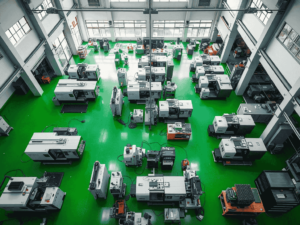
- MW+ runs 60+ CNC machining centres in a 15,000 m² facility at No. 39 Xishi Road, Hewan Community, Guangming, Shenzhen, certified to ISO 9001:2015, AS9100D, ISO 13485, IATF 16949 and NADCAP, serving 50+ countries.
- On-demand sourcing from China is the wrong answer when the design changes daily, when freight and duty exceed the part value, or when a contract restricts manufacture to a named country.
- What does on-demand CNC machining in China actually mean?
- What do you need to send to get a real quote?
- How fast can on-demand CNC parts actually be made?
- What tolerance should you put on the drawing?
- Matching the process to the part geometry
- Which materials are available on demand
- What documentation arrives with the parts?
- When on-demand machining in China is the wrong choice
- How to evaluate the supplier before you send a drawing
- Frequently asked questions
What does on-demand CNC machining in China actually mean?
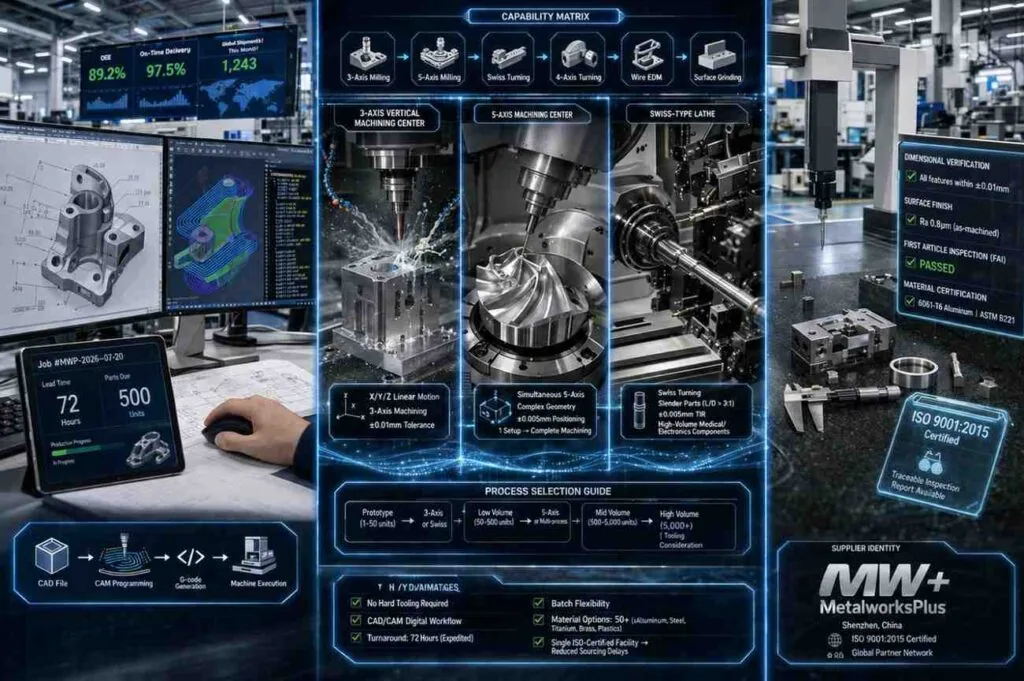
On-demand CNC machining is a supply model in which a manufacturer quotes directly from a customer’s CAD file and cuts parts to order, without tooling investment, a minimum order quantity or a fixed production slot booked months ahead. MW+ quotes within 24 hours, applies no minimum order quantity, and runs quantities from a single prototype to 1,000,000+ units through the same intake.
The trade-off is unit price. A part quoted at quantity 5 carries the full setup and programming time across five pieces. The same part at quantity 500 amortises that setup, so the piece price falls even though nothing about the machining changed. Ask for a price break table with your first quote rather than re-quoting later.
What do you need to send to get a real quote?
A firm CNC machining quote needs four things: a 3D model in STEP, IGES, DXF, DWG, SolidWorks or PDF format; a 2D drawing carrying tolerances and datums; the material grade and condition; and the quantity with a required date. Without the 2D drawing a supplier must guess which features are critical, and that guess is priced conservatively — usually against you.
The single largest cause of a slow or inflated quote is a model with no drawing. A 3D file states geometry but not intent. It cannot tell the machinist that one bore is a bearing fit and the other twelve are clearance holes, so every feature gets treated as though it matters.
| RFQ input | Accepted format or detail | What it changes in the quote |
|---|---|---|
| 3D model | STEP, IGES, DXF, DWG, SolidWorks, PDF | Establishes stock size, cycle time and machine class |
| 2D drawing | Tolerances, datums, GD&T per ASME Y14.5 or ISO 1101 | Separates critical from non-critical features; the largest single price lever |
| Material grade and condition | Full designation, e.g. Aluminium 6061-T6, Ti-6Al-4V, 316L | Sets raw material cost, tool wear and achievable cycle time |
| Quantity and price breaks | Prototype quantity plus expected release quantities | Determines how setup and programming time is amortised |
| Inspection requirement | Standard CMM report, or FAI to AS9102, or PPAP Level 3 | Adds documented inspection time; quoted per programme when beyond standard |
How fast can on-demand CNC parts actually be made?
MW+ ships express prototypes in 48 hours, standard prototypes in 3–5 business days, and volume production in 10–15 business days, with a quote returned within 24 hours of a complete RFQ. Those figures cover manufacture and inspection at the Shenzhen facility. International transit, customs clearance and any outside finishing process are additional and depend on your destination and carrier.
| Phase | Standard timing | Expedited timing | What drives the variance |
|---|---|---|---|
| Quotation | Within 24 hours | Within 24 hours | Completeness of the RFQ pack; missing drawings restart the clock |
| Prototype machining | 3–5 business days | 48-hour express | Material availability from stock and setup count |
| Volume production | 10–15 business days | Quoted per release | Quantity, number of operations, secondary finishing |
| Transit and customs | Carrier dependent | Carrier dependent | Destination country, incoterm and commodity classification |
Worked example: turning a quoted lead time into a calendar date
Quoted lead times are counted in business days; your schedule runs on calendar days, and the gap between the two is where delivery dates slip.
Step 1. Quotation: a complete RFQ sent Monday returns a price within 24 hours, so Tuesday. Step 2. Add your own approval loop, covering the purchase order, an NDA if one is not already executed, and drawing sign-off. Call it two days, so machining releases Thursday. Step 3. Apply the standard prototype window of 3–5 business days from release, taking the worst case of five: Thursday, Friday, Monday, Tuesday, Wednesday.
Step 4. Convert to calendar days. Those five business days span seven calendar days because a weekend falls inside the window, so parts are complete the following Wednesday, nine calendar days after the RFQ left your desk. Step 5. Add transit and customs clearance, which are carrier and destination dependent and sit outside the manufacturing window entirely.
Releasing on a Monday rather than a Thursday removes the embedded weekend and recovers two calendar days at no cost. The same arithmetic shows when the 48-hour express route is worth buying: compressing machining helps only if the approval loop and the freight booking are compressed with it.
If a date genuinely cannot move, say so in the RFQ rather than after the quote. Material substitution, a different stock form or splitting the release into a first and second shipment are all easier decisions to make before programming starts. How the phases differ between one-off and repeat work is set out in our comparison of CNC machining lead times.
What tolerance should you put on the drawing?
Put the loosest tolerance that still lets the part function. Under ISO 2768-m, the medium general tolerance class most drawings default to, a linear dimension in the 30–120mm range carries ±0.3mm. MW+ holds general machining to ±0.01mm, precision features to ±0.005mm, and a floor of ±0.001mm on suitable geometry and material.
Tightening a tolerance is not a free instruction. Each step down the ladder adds inspection time, may force a slower finishing pass, and can move the part onto a different machine in a temperature-controlled area. Applying ±0.005mm to a whole drawing when three features need it is one of the most expensive habits in mechanical design.
| Tolerance level (mm) | Typically achievable on | Typical application | Relative cost impact |
|---|---|---|---|
| ±0.1 to ±0.3 (ISO 2768-m general) | Any 3-axis machining centre | Brackets, covers, non-mating features, clearance holes | Baseline |
| ±0.01 (MW+ general machining) | Standard MW+ machining centres | Housings, plates, general mechanical assemblies | Low |
| ±0.005 (precision) | Precision centres with in-process gauging | Bearing seats, shaft fits, sealing faces | Moderate; adds finishing pass and CMM time |
| ±0.001 (floor) | Selected features, temperature-controlled machining and metrology | Optical mounts, instrument spindles, medical instrument features | High; feature-level, not drawing-wide |
Specify tolerance per feature, not per drawing. A sensible drawing carries ISO 2768-m as the default note and three or four individually tightened dimensions where the function demands it. That structure quotes faster and manufactures cheaper than a blanket tight note, and it tells the machinist exactly where to spend the effort. For an overview of what the shop runs day to day, see the CNC machining services page.
Matching the process to the part geometry
The part geometry chooses the process, not the other way round. Rotationally symmetric parts belong on a lathe; prismatic parts with pockets and faces on different planes belong on a mill; small-diameter slender parts belong on a Swiss-type machine; internal corners in hardened steel belong on an EDM. Sending the same drawing to every process and comparing prices wastes a week.
| Part geometry | Process to specify | Why this process wins |
|---|---|---|
| Prismatic body, pockets, faces on two or three planes | CNC milling services | Lowest cost per feature when everything is reachable from above |
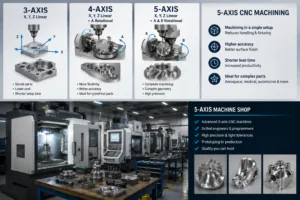
| Features on five faces, compound angles, sculpted surfaces | multi-axis machining | One setup removes the stack-up error of repeated re-fixturing |
| Rotational part, shaft, flange, threaded body | CNC turning services | The stock rotates, so concentricity is inherent rather than achieved |
| Small diameter, long relative to diameter, high volume | Swiss machining | The guide bushing supports the bar at the cut, controlling deflection |
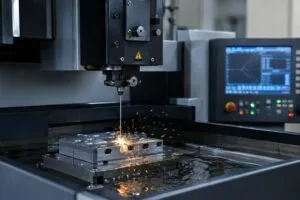
| Sharp internal corners, hardened steel or carbide, thin webs | wire EDM services | Spark erosion applies no cutting force, so thin sections do not deflect |
| Features below roughly 1mm, micro holes and slots | Micro machining | Tooling, spindle speed and metrology are scaled to the feature size |
Setup count is the number to watch
Every time a part is unclamped and re-fixtured, the relationship between the features cut before and after that move depends on how accurately it was relocated. Four 3-axis operations introduce three of these relocations. The same part in one 5-axis setup introduces none. That is why a 5-axis quote with a higher machine rate can still be the cheaper and more accurate route.
Which materials are available on demand
MW+ machines 70+ material grades, covering aluminium, stainless and tool steels, titanium, copper alloys and engineering plastics. Specify the full designation and condition — Aluminium 6061-T6 rather than “aluminium”, Ti-6Al-4V rather than “titanium” — because the temper and heat treatment change machinability, achievable tolerance and cost more than the base metal name does.
Published property values for these grades are nominal. When a property is load-bearing in your design — a fatigue limit, a yield strength, a thermal conductivity used in a heat path — work from the actual mill certificate for the batch, not a datasheet average. Nominal values are available from sources such as MatWeb, and the corresponding material specifications from ASTM International.
Surface finish is specified separately from tolerance
Dimensional tolerance and surface texture are independent requirements, and a drawing that states one without the other leaves the finish to the machinist. MW+ produces Ra 3.2µm as-machined, Ra 0.4µm fine-machined and Ra 0.1µm polished. Surface texture parameters were defined in ISO 4287:1997, superseded by ISO 21920-2:2021. Drawings in circulation still use either convention, so state which one governs, then quote the Ra value and the surface it applies to.
What documentation arrives with the parts?
Every MW+ order ships with three documents as standard: a certificate of conformance, a CMM inspection report and material certificates. First article inspection to AS9102 and PPAP Level 3 submissions are available on request and quoted per programme, because both consume documented inspection and engineering time beyond a standard release.
Documentation is where on-demand sourcing is most often under-specified. A buyer assumes a first article report is included, the supplier assumes it was not requested, and the discovery happens at goods-in with a line stopped. State the requirement in the RFQ, not in the purchase order.
| Your requirement | Document to ask for | Standard or basis | Availability at MW+ |
|---|---|---|---|
| Proof parts match the drawing | Certificate of conformance | Supplier declaration against the released drawing | Every order |
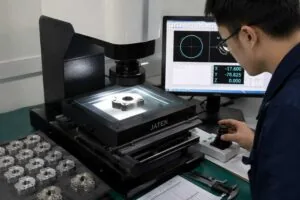
| Measured evidence on critical features | CMM inspection report | Coordinate measurement against the drawing datums | Every order |
| Traceable material | Material certificate | Mill certificate for the supplied batch | Every order |
| Formal first article approval | FAI report | AS9102 | On request, quoted per programme |
| Automotive part approval | PPAP Level 3 submission | Production part approval process under IATF 16949 | On request, quoted per programme |
MW+ operates a quality system certified to ISO 9001:2015, with sector approvals to AS9100D for aerospace, ISO 13485 for medical devices, IATF 16949 for automotive and NADCAP for special processes. The detail of how those systems are run is set out under CNC machining quality control.
When on-demand machining in China is the wrong choice
On-demand machining from an overseas supplier is the wrong choice in four identifiable situations: when the design is still changing daily, when freight and duty exceed the value of the part, when a contract or customer specification restricts manufacture to a named country, and when the process needs someone standing at the machine. None of these are supplier quality problems; they are structural mismatches.
| Situation | Better route | Why on-demand overseas sourcing fails here |
|---|---|---|
| Geometry changing daily during early concept work | A local shop or in-house prototyping for the first iterations | Each revision restarts programming and transit; the review loop dominates the schedule |
| Low-value, high-mass parts in modest quantity | Regional supply near the point of use | Freight and duty per kilogram exceed the machining saving |
| Contractual restriction on country of manufacture | A supplier inside the permitted region | No price or capability advantage overcomes a contractual requirement |
| Process requiring on-site witness or in-person source inspection | A supplier your team can reach the same day | Travel time makes witnessed operations impractical to schedule |
How to evaluate the supplier before you send a drawing
Evaluate an on-demand CNC supplier on five things: the certifications they actually hold and can show certificates for, the inspection equipment behind their tolerance claims, what ships with a standard order, how they handle a non-conformance, and whether their quoted lead times separate manufacture from transit. Marketing pages rarely answer any of the five. Our guide to choosing a CNC machining supplier in China works through the same audit in more detail.
Questions worth asking, and the answers that should worry you
- “Which certifications do you hold, and can I see the certificates?” A good answer names the standards and sends scans. A worrying answer says “we work to ISO standards” without a scheme or a certificate number.
- “What measures the tolerance you just quoted me?” A good answer names the CMM and its calibration traceability. A worrying answer is a tolerance figure with no instrument behind it.
- “What happens if a part is out of tolerance at goods-in?” A good answer describes a containment and corrective action process. A worrying answer is a discount offer.
Measurement traceability is worth one extra question. An instrument is only as good as its calibration chain back to a national metrology institute; the principle is described by NIST. MW+ runs 120+ engineering and quality professionals across a 15,000 m² facility founded in 2015 at No. 39 Xishi Road, Hewan Community, Guangming, Shenzhen. The fastest route to a real answer on your own part is to request a CNC machining quote with the drawing attached.
Frequently asked questions
Is there a minimum order quantity for on-demand CNC machining at MW+?
MW+ applies no minimum order quantity. A single prototype and a release of 1,000,000+ units go through the same quoting and production route. What changes with quantity is the unit price, because setup and programming time is amortised across the batch. Ask for a price break table with the first quote so the volume decision is visible before you commit.
Why is my quote higher than the one I got last month for the same part?
The three usual causes are quantity, material and drawing changes. A smaller release spreads the same setup across fewer pieces. Raw material prices move, particularly for titanium and copper alloys. And a revised drawing that tightened one tolerance from ±0.01mm to ±0.005mm can add a finishing pass and CMM time. Ask for the quote to be broken into material, machining and inspection to see which moved.
Can I get parts in 48 hours, or is that only for simple geometry?
The 48-hour express prototype route at MW+ depends on three conditions: the material is in stock, the geometry runs in a small number of setups, and the drawing is complete on arrival. A five-setup part in a bar diameter that has to be ordered will not make 48 hours regardless of machine availability. Standard prototypes run 3–5 business days, and international transit is additional in both cases.
Do I have to send a 2D drawing if my 3D model already has tolerances?
Send the drawing. Model-based definition works when both parties use compatible CAD and agree on the annotation scheme, but a neutral STEP file exchanged between different systems frequently drops or degrades that annotation. A 2D drawing carrying datums and tolerances per ASME Y14.5 or ISO 1101 removes ambiguity about which features are critical, and it quotes faster.
How do I know the inspection report reflects the parts I received?
Ask for the CMM report to be tied to the batch by a job or lot number that also appears on the certificate of conformance and the material certificate. Where a programme needs stronger evidence, request serialised inspection or a capability study showing Cpk ≥1.67 on the nominated characteristic. Both are quoted per programme rather than included by default.
What tolerance can MW+ actually hold on a production run, not just one part?
MW+ holds general machining to ±0.01mm against ISO 2768-m, precision features to ±0.005mm, and ±0.001mm on suitable geometry and material, with process capability of Cpk ≥1.67. The distinction that matters for production is capability rather than a single measured part: a capable process delivers the tolerance repeatably across the batch, which is what a Cpk figure describes.
Can MW+ hold my design confidentially before we place an order?
Yes. Send a non-disclosure agreement with the RFQ and MW+ will execute it before the files are distributed internally for quoting. Doing this at RFQ stage rather than at purchase order stage avoids a common delay, because the quoting team cannot begin work on files that are still waiting for an agreement to be signed.