Understanding ±0.001 mm Machining: The Science Behind Micron-Level Accuracy
Understanding the implications of ±0.001 mm machining accuracy is easier with a little background: 1 millimeter (mm) is equal to 1,000 micrometers (µm). ±0.001 mm means removing only 1 µm of material to achieve the desired shape – an engineering challenge that requires the highest degree of skill and control.
A number of physical effects can jeopardise this precision in machining:
-
- Thermal Expansion: Steel has a thermal expansion coefficient of 12 µm per meter per 1°C. This means that a 0.1°C change in temperature results in a 1.2 µm error in a 100 mm part – well beyond the tolerance.
-
- Chatter: Nanometers of surface texture are created by high-frequency vibration of the tool at the tool-workpiece interface. Chatter must be eliminated down to the ±0.001 mm level.
-
- Spindle Runout: Runout greater than 0.5 µm from the spindle’s central axis affects dimensional accuracy. High-end air-bearing spindles have run-out of less than 0.1 µm.
-
- Tool Wear: End mills made with carbide lose their cutting edge after 20-30 minutes of machining hard steels, resulting in a dimension shift of 2-5 µm if uncompensated.
MetalworksPlus compensates for all of these factors by using real-time machine compensation, temperature-controlled workshops (20°C ± 0.5°C) and rigorous tool-life management.
| Machining Type | Typical Tolerance | Application | Industry Standard |
| Conventional CNC | ±0.05 – ±0.1 mm | General components | ISO 2768-m |
| High-Precision CNC | ±0.005 – ±0.01 mm | Medical, aerospace | ISO 2768-f |
| Ultra Precision CNC | ±0.001 mm | Optical, semiconductor | ASME Y14.5 |
| Nano Precision | < ±0.0001 mm | Research, photonics | Custom specs |
Table 1: CNC Machining Tolerance Comparison by Type and Industry Standard
Core Requirements for ±0.001 mm Accuracy in CNC Machining
1. Machine Tool Rigidity and Structural Integrity
Stiffness is the key to ultra precision CNC. Machines capable of producing ±0.001 mm work have bases made of polymer concrete or granite, which have 6-10 times greater vibration-damping characteristics than cast iron. Preloaded ball screws and linear guides ensure positioning repeatability of ±0.0005 mm – half the tolerance.
Case Study – Aerospace Bracket Manufacturing: A MetalworksPlus customer needed titanium brackets for an actuator with a ±0.001 mm positioning tolerance on 48 bolt holes. With a 5-axis Mazak Variaxis i-700 granite-based machining centre, the team produced parts with 100% dimensional accuracy for a 500-piece batch, and delivered them 12% ahead of schedule.
2. Cutting Tool Selection and Geometry
Tooling is key for micro machining on the ±0.001 mm level. Polycrystalline Diamond (PCD) tools retain cutting edge sharpness within 0.2 µm across millions of cutting cycles, and coated carbide tools (TiAlN, DLC-coated) have a 300-400% longer life than uncoated tools.
Tool geometry (rake angle, helix angle, edge radius) and surface finish (Ra values) and dimensional accuracy are also directly influenced. Changes of 0.5° in rake angle can lead to 15% changes in cutting forces, resulting in dimensional drift.
3. Metrology and In-Process Measurement
You can’t make what you can’t measure. To achieve ±0.001 mm precision, your metrology equipment must be at least 5-10 times more accurate – or ±0.0001 mm or better.
MetalworksPlus has a full metrology suite for all precision work:
-
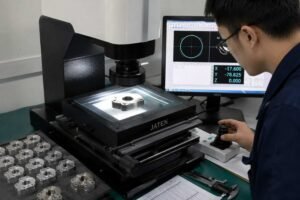
- Coordinate Measuring Machines (CMM): Renishaw CMMs with probe repeatability of ±0.0002 mm for complete 3D dimensional inspection
-
- Laser Interferometry: In-situ axis calibration with Renishaw XL-80 laser interferometers, measuring position errors to 1 nm
-
- Optical Surface Profilometry: White light interferometers for non-contact measurement of surface roughness as low as Ra 0.01 µm
-
- Process Gauging: Touch probes on machining centres enable in-process measurement without part removal
Process Control (SPC) information is gathered on all critical features. Control charts will indicate when processes are drifting within 2 sigma of the tolerance limit – before any defective parts are made. MetalworksPlus typically aims for a Process Capability Index (Cpk) of ≥ 1.67 for all ±0.001 mm features – with less than 0.6 parts per million defective parts.
4. Environmental Control
Ultra precision machining is a controlled environment. MetalworksPlus has dedicated machining bays for precision machining with ISO Class 7 cleanliness, a constant temperature of 20°C ± 0.5°C throughout the year, and vibration pads below all machines. Relative humidity ranges from 45-55% RH to eliminate microcosmic thermal changes in both the workpiece and measuring instruments.
Industries That Depend on Ultra Precision CNC and ±0.001 mm Machining
The worldwide precision machining market was worth USD 80.6 billion in 2023 and is expected to grow to USD 112.4 billion by 2030 at a compound annual growth rate (CAGR) of 4.9% (Grand View Research, 2024). This is driven by five major industries:
-
- Aerospace & Defense: Airfoil sections of turbine blades, actuators for fuel systems, and housings for navigation systems are machined to ±0.001 mm to ensure safe and reliable flight operations. The Boeing 787 Dreamliner aircraft has more than 2.3 million machined parts, many to sub-micron tolerances.
-
- Medical: Orthopedic implants, surgical tool tips, catheter components are machined to ±0.001 mm to allow for biocompatibility and proper function within the body. FDA’s 21 CFR Part 820 quality system regulations require dimensional traceability.
-
- Semiconductor Processing: Wafer stages, optical lens mounts and ion beam apertures in lithography equipment work at ±0.001 mm or better. More than 25 billion transistors can be manufactured on a single silicon wafer, which requires flawless equipment.
-
- Automotive (EV & Motorsport): High performance engine parts, electric vehicle motor shafts and Formula 1 drivetrain components are all machined at MetalworksPlus to ±0.001 mm, leading to performance improvement of 3-8% in powertrain efficiency.
-
- Optics & Photonics: Lens mounts, mirror mounts, and laser mirror holders must be positioned within ±0.001 mm to ensure optical alignment within a fraction of a wavelength of light.
| MetalworksPlus Service | Accuracy Achieved | Tolerance Class | Lead Time |
| 5-Axis CNC Milling | ±0.001 mm | Ultra-Precision | 3–5 days |
| CNC Turning | ±0.002 mm | High-Precision | 2–4 days |
| Micro Machining | ±0.001 mm | Ultra-Precision | 5–7 days |
| Surface Grinding | ±0.0005 mm | Nano-Precision | 3–6 days |
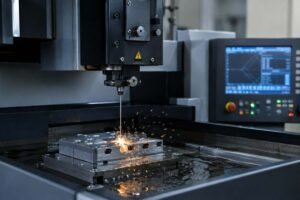
| EDM / Wire Cutting | ±0.002 mm | High-Precision | 4–6 days |
Table 2: MetalworksPlus Ultra Precision CNC Capabilities Overview
How MetalworksPlus Delivers ±0.001 mm Accuracy at Scale
MetalworksPlus has developed a holistic precision manufacturing process that integrates cutting-edge technology with process control to deliver ±0.001 mm machining solutions to industrial customers.
MetalworksPlus starts with Design for Manufacturability (DFM) reviews, where process engineers scrutinise part geometry, material characteristics, and tolerance stack-up prior to machining. Research indicates that 70% of manufacturing costs are determined in the product design phase – early engagement by MetalworksPlus engineers invariably delivers 40-60% fewer rejects through DFM.
Material selection plays a decisive role. Aluminum 6061-T6, the gold standard for aerospace and electronic housings, can be machined to ±0.001 mm and requires climb milling to manage burring. Stainless Steel 316L, often used in medical devices, requires coolant control and reduced feeds to avoid work hardening, which can lead to 3-5 µm dimensional change.
All machined precision components are subject to First Article Inspection (FAI) to AS9102. CMM reports, surface roughness certificates, and material traceability reports are given to customers as standard services – not extras.
The proof is in the results: a defense electronics company using MetalworksPlus for ±0.001 mm tolerance aluminum housings achieved a 34% drop in assembly scrap and a 22% increase in first-pass yield compared to their previous supplier. This resulted in cost savings in excess of USD 280,000 per year.
Micro Machining: When ±0.001 mm Is the Starting Point
Micro machining is the cutting-edge of precision manufacturing – where features and tolerances are measured in micrometers (µm) and sometimes as tight as ±0.001 mm. MetalworksPlus has dedicated micro machining equipment with spindles reaching 60,000 – 80,000 RPM, allowing for features as small as 0.05 mm diameter.
Examples include micro channels (50-500 µm) in microfluidic devices for medical diagnostics, micro lens arrays for AR/VR devices and micro RF connector bodies for aerospace communications. In all cases, the device’s success depends on ±0.001 mm positional accuracy.
The micro machining industry is projected to reach USD 7.9 billion by 2031 from USD 4.1 billion in 2023 (Allied Market Research), highlighting the need for commercial success in this space. MetalworksPlus is at the forefront of this growth, ensuring its tooling, training and technologies are ready to address new client demands.
Where ±0.001 mm work actually runs
Micron-level accuracy is a function of the room as much as the machine. MW+ holds ±0.001 mm on small and thin-walled geometry in a temperature-controlled cell, at a 98.5% first-pass yield, under ISO 13485 and AS9100D. Send a drawing and an engineer replies within 24 hours.
Dive Deeper – The Intel That Saves You Time & Money
-
Precision Machined Parts: Tolerance Standards & Cost – A complete breakdown of IT grades from IT5 to IT11. What each tolerance tier costs, and how to avoid over-specifying.
-
Tight-Tolerance CNC Parts: Cost Impact of ±0.005 mm Accuracy – What does micron-level precision actually cost? Breaking down the 100–200% price premium – and when it pays for itself.
-
Complex CNC Parts Manufacturing: How Geometry Affects Cost – Why a $15 bracket can become a $500 housing. Real data on how deep cavities, thin walls, undercuts, and tight radii drive cost up by 200–300%.
-
Surface Finish (Ra) Guide for CNC Parts: Standards & Applications – What Ra really means, how it’s measured, and why specifying the right finish saves money. Real data across aerospace, medical, and automotive sectors.
-
Material Selection Impacts CNC Machining Cost & Performance – Why does the same part cost 3x more in stainless steel than aluminum? Real data on machinability, tool wear, and total cost across 5 common materials.