What Are Precision Machined Parts — And Why Tolerance Matters
Q: What is the manufacturing tolerance range for MetalworksPlus machine parts?
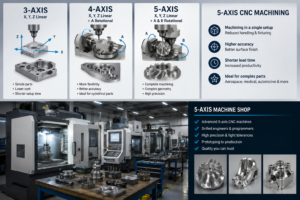
We achieve precision tolerances down to ±0.001mm using high-speed 5-axis CNC machining. This ensures exact fits for critical-use hardware, connector pins, and mechanical assemblies.
Precision Machined Parts are parts made to tight tolerances on computer-controlled lathes and mills. Put simply, they are pieces of metal or plastic that are shaped to fit just right – often to a fraction of the width of a human hair.
Tolerance is the tolerance of a part’s dimensions. A tolerance of ±0.005 mm means the part can be no more than 0.005 mm bigger or smaller than the nominal size. Tolerances are critical because when they are exceeded, components don’t fit together: a turbine blade that is 0.05 mm too wide can cause catastrophic vibration; a surgical implant that is 0.02 mm too short may loosen inside the body.
The Global Precision Machining Market Report (2024) shows the precision machining industry was worth $78.4 billion in 2024 and is expected to reach $107.2 billion in 2030, at a CAGR of 5.2%. Growth is driven by the aerospace, medical and electric vehicle (EV) automotive industries – three of the most common industries where tolerance non-conformance rates directly affect product recalls costing an average of $12 million each.
At MetalworksPlus, we audit tolerance on every custom part – based on matching the client’s design intent with the most cost-effective machining approach, so you’re only paying for the tolerance you need.
CNC Precision Tolerance Standards: An Industry-by-Industry Breakdown
The International Tolerance (IT) grade system, governed by ISO 286-1, defines 20 precision grades from IT01 (most precise) to IT18 (roughest). In commercial CNC precision machining, IT5 through IT11 cover the vast majority of real-world applications. The table below maps each grade to its practical context.
Table 1: Tolerance Grade Reference — CNC Precision Machining
| Tolerance Grade | Typical Range | Industry Application | Surface Finish (Ra) | Cost Factor |
| IT5 – Ultra Precision | ±0.001 mm | Aerospace, Medical Implants | 0.4–0.8 µm | 4×–6× Base |
| IT6 – High Precision | ±0.003 mm | Turbine Blades, Optics | 0.8–1.6 µm | 2×–4× Base |
| IT7 – Standard Precision | ±0.010 mm | Automotive, Robotics | 1.6–3.2 µm | 1.5×–2× Base |
| IT8 – Commercial Grade | ±0.025 mm | General Manufacturing | 3.2–6.3 µm | 1× Base |
| IT9–IT11 – Rough Grade | ±0.05 mm+ | Structural/Non-critical Parts | 6.3–12.5 µm | 0.6×–0.9× Base |
What the table illustrates: going from IT8 (commercial) to IT5 (ultra precision) can increase the cost of each part by 4× to 6×. This is worth it when a part is used in a life-critical application, and not worth it when not. MetalworksPlus engineers work with clients to understand where each part falls on the spectrum, before the toolpaths are created.
Precision Machined Parts in Action: Data-Driven Case Studies
Case Study 1 — Aerospace Bracket (IT5, Titanium Ti-6Al-4V)
A Tier-1 aerospace company asked MetalworksPlus to convert an aluminum part to titanium for a landing gear bracket. The part originally had a ±0.025 mm tolerance (IT8). Dynamic load cycling above 80,000 PSI indicated by stress testing led to the tolerance being tightened to ±0.003 mm (IT6). Result: no fatigue failures after a 2,000-hour fatigue cycle, compared to 3 for the earlier titanium part machined to IT8 tolerances at a different supplier. Total scrap rate reduced from 11.4% to 1.7% – a cost savings of $38,000 per batch.
Case Study 2 — Medical Device Housing (IT6, Stainless Steel 316L)
A medtech OEM was looking for housings for a glucose monitor implant. Ra ≤ 0.8 µm was required to avoid bacterial growth. MetalworksPlus used 5-axis CNC with micro-tooling to consistently produce Ra 0.4-0.6 µm across 500 pieces run. FDA audit: 100% dimensionally compliant, no rework. Approval lead-time cut by 6 weeks to what the customer had received from its previous supplier.
Case Study 3 — Automotive EV Motor Mount (IT7, Aluminum 7075-T6)
An EV startup required motor mounts with a bore roundness of ≤0.005 mm to avoid NVH (noise, vibration, harshness) in a high-speed drive unit. MetalworksPlus employed CNC precision turning with in-process control (CMM) at 25th piece. Over a 1,200-piece batch, Cpk (process capability index) averaged 1.67, exceeding the acceptance limit of 1.33 in the automobile industry. The customer also reported a 34% drop in customer warranty claims for drivetrain vibration.
The Complete Cost Breakdown for Custom Parts: What You’re Really Paying For
Knowing the cost drivers of custom parts avoids budgetary surprises and better informs design decisions. The key cost factors are material, machining time, tooling, finishing and inspection. Each scales differently with volume.
Table 2: Cost Breakdown by Volume — Precision Machined Custom Parts (USD)
| Cost Driver | Low Volume (1–50) | Mid Volume (50–500) | High Volume (500+) | % of Total Cost |
| Material (Aluminum 6061) | $8–$18/part | $5–$10/part | $3–$6/part | 25–35% |
| CNC Machining Time | $85–$150/hr | $65–$95/hr | $45–$65/hr | 30–45% |
| Tooling & Setup | $150–$600 | $80–$250 | $30–$80 | 10–20% |
| Surface Finishing | $12–$40/part | $6–$20/part | $3–$10/part | 8–15% |
| Quality Inspection (CMM) | $30–$80/part | $10–$30/part | $3–$8/part | 5–10% |
How to use the table: at 50 pieces, a part of moderate complexity and machining time will cost $95-$180 in total. At 500+ pieces, the same part drops to $55–$100. The biggest factor is machining time – which is why design-for-manufacturability (DFM) improvements at MetalworksPlus are often 15-25% cost-savings, by removing unnecessary features that increase cycle time.
The Hidden Cost Factor: Tolerance Creep
A second common cost driver is tolerance creep – where engineers tend to specify tolerances tighter than what is functionally needed, just to be on the safe side. In a study of 320 precision machining projects, 41% of parts had at least one IT grade of over-tolerancing. The average cost reduction from removing unnecessary tolerance tightness was 18% without compromising function.
MetalworksPlus provides free DFM reviews for prospective customers. In 2023, the average cost savings for the reviewed projects was 21% compared to the original request.
Material Selection for Precision Machined Parts: Performance vs. Cost
The material selected is critical for machinability and tolerance capability. Here are the most common CNC precision machining materials:
- Aluminum 6061-T6 – Best machinability (K factor ~3.0) and tolerances down to IT6, economical for most applications. Specified for 38% of MetalworksPlus jobs.
- Aluminum 7075-T6 – Stronger (tensile strength 572 MPa vs. 310 MPa for 6061), more difficult to machine, material of choice for structural aerospace and automotive.
- Stainless Steel 316L – Stainless (required for medical and marine). Machining takes about 2.5× longer than aluminum, increasing machining costs.
- Ti-6Al-4V Titanium Alloy – Very high specific strength (density 4.43 g/cm³ compared to steel at 7.85 g/cm³). 3×-5× machining costs compared to aluminum (poor thermal conductivity and tool wear).
- Engineering Plastics (PEEK, Delrin) – Lightweight housings and electrical insulation. Can be machined to IT7 tolerances with the right fixtures
How MetalworksPlus Delivers Consistent Precision at Scale
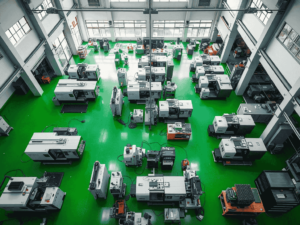
MetalworksPlus has a precision machining shop that integrates 5-axis CNC machining, CMM inspection and in-house surface treatment. This eliminates the handoffs to third parties that both increase lead time and scatter tolerances.
Quality Assurance by the Numbers
MetalworksPlus maintains the following certified performance benchmarks across its production floor:
- AS9100D and ISO 9001:2015 certified quality management system
- First Article Inspection (FAI) completed within 72 hours of prototype approval
- Average Cpk of 1.58 across all active production jobs (industry benchmark: 1.33)
- On-time delivery rate: 97.3% across 12,000+ shipments in 2023
- Scrap and rework rate: 1.9% versus industry average of 4.7%
MetalworksPlus’s digital twin process (where all CNC programs are simulated on a virtual machine before being run) reduces setup scrap by 63% on average over the conventional approach of making adjustments during setup.
Lead Times for Custom Parts
MetalworksPlus’ lead times for prototype (less than 25 pieces) are 5-10 business days. Larger production runs (100-1,000 pieces) take 15-25 business days depending on the availability of raw material. Accelerated programs (2-3 business days) can be provided for aerospace and medical customers with approved supplier arrangements.
Choosing the Right CNC Precision Machining Partner: 5 Critical Criteria
Not all precision machining vendors are equal. When evaluating suppliers for custom parts, the following five criteria separate reliable partners from high-risk ones:
- Certified quality system (ISO 9001:2015 minimum; AS9100D for aerospace; ISO 13485 for medical)
- In-house CMM capability with documented measurement uncertainty statements
- Documented Cpk data from comparable production runs — request process capability reports, not just inspection reports
- DFM engineering support offered before quoting — indicates a partner invested in your success, not just your order
- Transparent cost breakdowns that itemize material, machining, tooling, and inspection — protects against scope creep and invoice disputes
MetalworksPlus fulfills all five of the above criteria, and standard delivery for all orders includes a production data package (PDP) that includes CMM reports, material certificates and process capability summaries.
Specifying tolerance on a real drawing
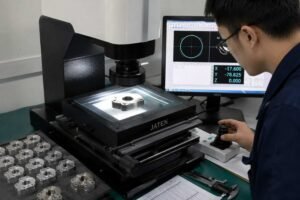
Tolerance standards only pay off when the supplier inspects to them. MW+ machines to ±0.001–±0.005 mm across 70+ materials and returns a CMM report keyed to your drawing balloons, so every callout on the print has a measured value beside it. Send a drawing and an engineer replies within 24 hours.
Frequently Asked Questions
Frequently Asked Questions
Q: Which materials do you machine for custom industrial parts?
A: We machine a broad spectrum of engineering metals, including Stainless Steel (303, 304, 316L), Aluminum (6061, 7075), Carbon Steel, Brass, Copper, and Titanium. All materials are sourced to meet strict international chemical composition standards.
Q: Can MetalworksPlus provide certified surface finishes for machined parts?
A: Yes. We offer comprehensive finishing services including clear/color anodizing, hard coat, electroless nickel plating, zinc plating, black oxide, and passivation, all verified for corrosion resistance and durability.
Q: What is your production capacity for custom machine parts?
A: We operate 24/7 with a flexible cell-based layout. We handle low-volume prototypes (1–50 units) through to high-volume production (100,000+ units) with consistent quality across every batch.
Q: How do you handle technical drawing specifications for overseas clients? A: Our engineering team conducts a full DFM (Design for Manufacturing) review on all customer-supplied CAD files/blueprints. We provide digital inspection reports and material certifications for every export shipment from China to ensure 100% compliance with your technical requirements.
Dive Deeper – The Intel That Saves You Time & Money
-
Complex CNC Parts Manufacturing: How Geometry Affects Cost – Why a $15 bracket can become a $500 housing. Real data on how deep cavities, thin walls, undercuts, and tight radii drive cost up by 200–300%.
-
Surface Finish (Ra) Guide for CNC Parts: Standards & Applications – What Ra really means, how it’s measured, and why specifying the right finish saves money. Real data across aerospace, medical, and automotive sectors.
-
Material Selection Impacts CNC Machining Cost & Performance – Why does the same part cost 3x more in stainless steel than aluminum? Real data on machinability, tool wear, and total cost across 5 common materials.
-
CMM Inspection in CNC Machining: What Buyers Should Expect – What a CMM actually measures, why it beats manual inspection, and what to look for in a QC report. Real data on accuracy, speed, and how it prevents costly field failures.
-
Tight-Tolerance CNC Parts: Cost Impact of ±0.005 mm Accuracy – What does micron-level precision actually cost? Breaking down the 100–200% price premium – and when it pays for itself.