The price of one CNC machined part is the sum of six line items: material, setup and programming, machine time, tooling and consumables, secondary finishing, and inspection and documentation. Freight and duty then sit on top as landed cost. This article breaks down each of those lines — what it pays for, how it behaves as quantity rises, and which design decisions move it — so you can read a quote instead of only comparing totals.
Key takeaways
- A CNC part price has six lines: material, setup and programming, machine time, tooling, finishing, and inspection. Only machine time and material scale with every unit; the rest either amortise or step.
- Setup cost per part falls as a pure fraction of quantity: one unit carries 100% of it, 10 units carry 10% each, 1,000 units carry 0.1% each. Beyond a few hundred parts, further setup amortisation stops mattering.
- Material is billed on the billet you start from, not the part you receive. A part that removes 80% of its stock is paying for the chips as well as the component.
- Tolerance is a price lever with steps in it. MW+ holds ±0.01mm under ISO 2768-m as a general class, ±0.005mm on precision features and ±0.001mm on critical features, at Cpk ≥1.67 — but each step down adds passes and inspection.
- Every MW+ order includes a certificate of conformance, CMM inspection report and material certificates in the price. FAI to AS9102 and PPAP Level 3 are on request and quoted per programme.
- Quotes are returned within 24 hours; there is no minimum order quantity, so a genuine one-off is quotable rather than blocked by an MOQ.
On this page
- What line items make up the price of one part?
- Why machine time is usually the largest line
- How much of a part’s price is material?
- How does quantity change the price per part?
- Worked example: where the price curve flattens
- How much does a tighter tolerance actually add?
- Inspection and documentation on the invoice
- From ex-works price to landed cost
- When the lowest price per part is the wrong answer
- Frequently asked questions
What line items make up the price of one part?
A CNC machining quote is built from six cost lines: raw material including the stock removed as chips, non-recurring setup and CAM programming, spindle time on the machine, tooling and consumables, secondary finishing, and inspection with its documentation. A supplier who returns a single number is not hiding anything sinister, but you cannot negotiate a single number — you can only negotiate lines.
Use the table below to see which line your design decisions actually reach. Most cost-reduction requests fail because they attack a line that was never large on that particular part.
| Cost line | What it pays for | Behaviour as quantity rises | Design lever that moves it |
|---|---|---|---|
| Raw material | The billet or bar bought, including stock cut away | Roughly linear per part | Stock size, grade, near-net starting form |
| Setup and CAM programming | One-time fixture, workholding, toolpath creation, proving | Fixed per lot, so it dilutes per part | Number of setups, datum scheme, part orientation |
| Machine time | Spindle hours at the machine’s hourly rate | Linear per part | Material removed, feature access, tolerance class |
| Tooling and consumables | Cutter wear, special-form tools, coolant | Linear, and steeper in hard materials | Corner radii, pocket depth, material choice |
| Secondary finishing | Deburr, blast, anodise, plate, passivate | Per part, often with a batch minimum | Finish specification and cosmetic zone |
| Inspection and documentation | First article, in-process checks, CMM, certificates | Fixed plus a per-part sampling element | Number of controlled characteristics |
Why machine time is usually the largest line
Machine time is the largest line on most CNC quotes because it is the product of two numbers that both scale badly: the machine’s hourly rate and the cycle time of your specific part. Cycle time is set by how much material has to be removed, how fast the tool can be fed through that material, and how many times the part has to be stopped, re-fixtured and re-referenced.
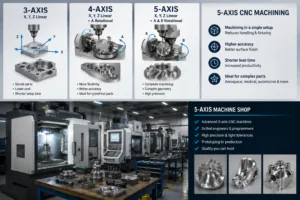
Setup count is the lever most buyers miss. A part that needs four operations on a 3-axis machine carries four fixtures, four programs and four proving runs, plus the positional error each re-fixture introduces. The same part on multi-axis machining may run in one or two setups. The hourly rate is higher; the total is often lower.
| Cycle time driver | Why it lengthens the cycle | What to change on the model |
|---|---|---|
| Volume of material removed | Every cubic millimetre has to be cut and cleared | Start closer to net shape; delete unused mass |
| Small internal corner radii | Forces a smaller cutter and many more passes | Increase internal radii wherever function allows |
| Deep pockets and long reach | Tool deflection forces conservative feeds | Reduce depth-to-width ratio, or split the feature |
| Thin walls | Cutting force deflects the wall, so passes get lighter | Thicken the wall, or add machining ribs |
| Number of setups | Each adds fixturing, re-referencing and proving | Orient features so fewer faces need access |
| Tight tolerance zones | Adds semi-finish and finish passes | Apply tight tolerance only to mating features |
Machine hourly rates differ between shops, regions and machine classes, and any figure quoted without naming a specific machine, region and date is decoration rather than data. Ask a prospective supplier for the rate and the estimated cycle time separately, because the two together are the only version of this line you can actually check. How those rates are built up, and how they differ between regions, is set out in our note on CNC machine hourly rates.
How much of a part’s price is material?
Material is charged on the billet or bar the shop has to buy, not on the finished part, so a component that removes most of its starting stock pays for the chips too. A thin bracket machined from a solid block can carry a material line several times the mass of the delivered part. On soft, cheap alloys that hardly matters; on titanium or a specialist stainless it can dominate the quote.
Machinability is the second half of the material story, and it lands on the machine-time line rather than the material line. Free-machining brass cuts fast and gently; Ti-6Al-4V and hardened stainless demand slow feeds, specific tool coatings and frequent tool changes. Nominal property and machinability data of the kind published on MatWeb is the right place to start a comparison, but where a property is load-bearing, design against the mill certificate for the delivered lot.
| Material | Relative machining ease | Where its cost lands | Typical use in a cost-sensitive part |
|---|---|---|---|
| Free-machining brass C360 | Highest | Material line; cycle time is short | Turned fittings, pins, small fluid parts |
| Aluminum 6061-T6 | High | Balanced; usually the cheapest total | Brackets, housings, plates, prototypes |
| Acetal (POM) | High | Cycle time is short, stock is cheap | Spacers, bushings, non-structural bodies |
| Stainless steel 316 | Moderate | Machine time and tooling wear | Corrosion-exposed parts, fluid contact |
| Titanium Ti-6Al-4V | Low | Material, machine time and tooling together | Only where strength-to-weight justifies it |
MW+ machines 70+ material grades, so the constraint on a quote is rarely availability. It is whether the grade you specified is the grade the part actually needs. Substituting 6061-T6 for a stainless on a part that never sees corrosion is the single largest material saving available on most designs, and it is a five-minute engineering decision.
How does quantity change the price per part?
Quantity changes the price per part by diluting the fixed lines, not by making the machine run faster. Setup and programming are paid once per lot, so the fraction each part carries is simply one divided by the lot size. Machine time and material barely move per unit. That arithmetic is why the price curve is steep between one part and fifty, and nearly flat after a few hundred.
| Lot size (parts) | Share of setup cost carried by each part | What is still moving at this quantity |
|---|---|---|
| 1 | 100% | Everything; the part is effectively a prototype |
| 10 | 10% | Setup dilution dominates the price drop |
| 100 | 1% | Setup is nearly gone; cycle time now dominates |
| 1,000 | 0.1% | Only cycle time, material and finishing matter |
| 10,000+ | 0.01% | Cycle-time optimisation and process choice |
Read that table as a negotiating map. Below about a hundred parts, the productive question is “can we reduce setups?”. Above it, the productive question is “can we shorten the cycle?” — asking for setup savings on a 5,000-piece order is arguing over 0.02% of the price. MW+ applies no minimum order quantity and produces up to 1,000,000+ units, so both conversations are available from the same supplier. The full shape of that curve from one piece to mass production is plotted in our note on the prototype to mass production cost curve.
Why the second order is cheaper than the first
A repeat order of the same part is usually cheaper because the programming exists, the fixture exists and the process is proven. Ask explicitly whether a repeat price reflects that, and whether the fixture is retained. A quote that repeats the first-article price on a second order is quoting a new part, not your part.
Worked example: where the price curve flattens
The price curve can be derived in a few lines, and knowing where it flattens tells you which question to ask. Split the quote into what is paid once per lot and what is paid per piece. Give the fixed block 300 cost units and the recurring block 12. These are placeholders, not MW+ prices; substitute your own and the conclusion holds.
Step 1, divide the fixed block by the lot size and add the recurring block. At a quantity of 1: 300 / 1 + 12 = 312 units per part. At 10: 300 / 10 + 12 = 42. At 100: 300 / 100 + 12 = 15. At 1,000: 300 / 1,000 + 12 = 12.3. At 10,000: 12.03.
| Lot size | Cost units per part | Fall from the previous row | What is actually still moving |
|---|---|---|---|
| 1 | 312 | – | The fixed block, entirely |
| 10 | 42 | 87% | The fixed block, still |
| 100 | 15 | 64% | Fixed block nearly spent |
| 1,000 | 12.3 | 18% | Cycle time and material |
| 10,000 | 12.03 | 2% | Cycle time only |
Step 2, find the crossover. The fixed block and the recurring block contribute equally when 300 divided by the lot size equals 12, which happens at a lot size of 25. That is the number worth carrying into a negotiation: below about 25 pieces you are mostly buying setup, above it mostly cycle time.
Step 3, test a cost-reduction idea against it. Suppose you can shorten the cycle by 10 per cent, worth 1.2 units per part. At a lot of 10 that is 1.2 units against a 42-unit price, under 3 per cent, and not worth the engineering time. At a lot of 10,000 it is 1.2 units against 12.03, or 10 per cent of the entire price, and it is the largest saving available. The reverse holds for deleting a setup: enormous at low volume, almost invisible at high volume. Run this before asking for a price reduction; it tells you which line to attack.
How much does a tighter tolerance actually add?
A tighter tolerance adds cost in steps, not smoothly. Moving a feature from a general class to a precision class typically adds a finishing pass and an inspection step; moving it again can add a separate operation, a different machine, temperature control and 100% inspection. The jump happens where the tolerance passes what the process holds naturally, and that point differs by feature, material and size.
| Tolerance level | MW+ capability (mm) | Reference | Effect on the quote |
|---|---|---|---|
| General machining | ±0.01 | ISO 2768-m general tolerance class | Baseline; no added operations |
| Precision features | ±0.005 | Called out per feature on the drawing | Adds finish passes and feature inspection |
| Critical features | ±0.001 | Called out per feature, CMM verified | Adds process control and inspection time |
| Surface texture | Ra 3.2µm as-machined to Ra 0.1µm polished | ISO 4287:1997, superseded by ISO 21920-2:2021 | Each step down adds a finishing operation |
The cheapest drawing is not the loosest one. It is the one that is tight exactly where function demands and loose everywhere else, with the tight features tied to a datum scheme under ISO 1101 or ASME Y14.5. A blanket tight tolerance forces a quoting engineer to price every feature defensively, and you pay for the ambiguity.
Finishing is priced per batch as well as per part
Anodising, plating and passivation usually carry a batch minimum, because a tank run costs the same whether it holds five parts or five hundred. On small lots that minimum can be a visible share of the total. Specify the finish, the masked areas and the cosmetic zone in the RFQ, or the finishing line will be quoted with padding for the unknown.
Inspection and documentation on the invoice
Every MW+ order ships with a certificate of conformance, a CMM inspection report and material certificates, and those are included rather than quoted as extras. First article inspection to AS9102 and PPAP Level 3 submissions are available on request and quoted per programme, because the effort scales with the number of characteristics and with the customer’s own template.
The variable part of this line is how many characteristics you have asked to be controlled. Every dimension you mark as critical becomes an inspection event on every part or on a sampled fraction of every lot, and that time is real. MW+ works to Cpk ≥1.67 on controlled characteristics under a quality system certified to ISO 9001:2015, alongside AS9100D, ISO 13485, IATF 16949 and NADCAP; the CNC machining quality control process sets out what is captured and reported.
When you compare two quotes, check what documentation each includes before comparing the numbers. A price that excludes material certificates is not lower than one that includes them; it is a different scope.
From ex-works price to landed cost
The per-part price on a quote is not what the part costs you. Landed cost adds packaging, freight, insurance, customs duty and any inbound handling, and which of those the supplier carries depends entirely on the Incoterm agreed. Quotes written to different Incoterms 2020 rules are not comparable until you normalise them.
Freight behaves differently from machining. It is driven by weight and volume, so it punishes large, light parts and barely touches small, dense ones. A small turned component ships almost free per unit; a bulky housing can carry a freight share that rivals its machining content. Work the comparison on your actual part, not on a general rule. A like-for-like landed comparison against domestic supply is in our China versus domestic price comparison.
When the lowest price per part is the wrong answer
Chasing the lowest price per part is the wrong objective when the part is on a short iteration loop, when the quantity is too small for setup dilution to work, when the drawing is not yet stable, or when a failed part costs more than the entire lot. In those cases the correct question is total cost of the decision, and it usually points somewhere other than the cheapest quote.
| Situation | Better objective than lowest unit price | Why |
|---|---|---|
| One or two parts for a design check | Fastest turnaround | Setup dominates at this quantity regardless of shop |
| Drawing still changing weekly | Cheapest change, not cheapest part | Re-quoting and re-fixturing eat any unit saving |
| Large, light, low-value housing | Lowest landed cost | Freight and duty can exceed the machining line |
| Part whose failure stops a line | Documented, capable process | One field failure outweighs the lot’s price delta |
| Quotes with different documentation scope | Like-for-like scope first | The cheaper quote may simply include less |
| Very high volume, simple geometry | Different process entirely | Casting, stamping or sintering may beat machining |
A supplier worth using will say when machining is not the right process for your volume. MW+ quotes CNC machining services on that basis, and returns a quote within 24 hours so the comparison can be made while the design decision is still open.
Frequently asked questions
Why is my one-off prototype so expensive per part?
A single part carries 100% of the setup and CAM programming cost, because those are paid once per lot regardless of quantity. The machining itself may be a small share of the total. That is why the price falls sharply between one and ten parts and then flattens: you are diluting a fixed cost, not buying a faster process.
Why did two shops quote the same drawing so differently?
Two shops quoting the same drawing usually differ on setup strategy, machine class and assumed inspection scope, not on greed. One may plan four 3-axis operations where the other plans one 5-axis setup. Ask both for the number of setups, the machine assigned and what documentation is included, and the gap normally explains itself.
Will loosening tolerances actually reduce my price?
Loosening tolerances reduces price only where the tight tolerance was forcing an extra operation, pass or inspection step. Relaxing a dimension the machine already holds comfortably changes nothing. Ask the supplier which specific callouts are driving cost before you edit the drawing; on many parts it is two or three features out of fifty.
Does MW+ charge extra for inspection reports?
No. A certificate of conformance, a CMM inspection report and material certificates ship with every MW+ order and are included in the quoted price. FAI to AS9102 and PPAP Level 3 are separate, quoted per programme, because their effort depends on the characteristic count and the customer’s submission format.
Is there a minimum order quantity?
No. MW+ applies no minimum order quantity, so a single piece through CNC prototyping is quotable, and the same supplier scales to 1,000,000+ units. Prototypes run in 48-hour express or 3–5 business days as standard, and production lots in 10–15 business days.
Should I supply my own material to reduce cost?
Supplying your own stock removes the material line but transfers the risk: if the bar is undersized, out of spec or arrives late, the machining schedule absorbs it and traceability becomes yours to prove. It is worth doing when you hold a genuine price advantage on a specific alloy, and rarely worth doing otherwise.
How do I get a quote I can compare line by line?
Send 3D geometry with a 2D drawing carrying the datum scheme, the material and temper, the finish specification, the quantity and the documentation level, then ask for setup, machine time, material and finishing to be shown separately. MW+ accepts STEP, IGES, DXF, DWG, SolidWorks and PDF, and you can request a CNC machining quote and have it back within 24 hours.
Which single change usually cuts the most cost?
Reducing the number of setups is usually the largest single saving on a machined part, because it removes fixturing, programming, proving and handling at once. Reorienting features so one face carries most of the work, or accepting a slightly different geometry that a single setup on CNC milling services or CNC turning services can reach in one pass, moves more money than any tolerance edit.