A CNC machining lead time is the elapsed time from a released drawing to finished parts, and it is made of the same phases whether you order one part or ten thousand: quoting, programming and fixturing, material, machining, finishing, and inspection. What changes between a prototype and a production run is which of those phases dominates. On a prototype, setup and programming dominate. In production, they have already been paid, and material, finishing and inspection set the clock.
Key takeaways
- MW+ prototype lead time is 48-hour express or 3–5 business days as standard. Volume production is 10–15 business days. Quotes are returned within 24 hours.
- A prototype is not a small production run. On one part, programming and fixturing are most of the elapsed time; in production those are already done and material, finishing and inspection govern.
- The longest single item on many quoted lead times is not machining at all. It is material procurement for a non-stocked grade, or an outsourced finishing operation with a queue.
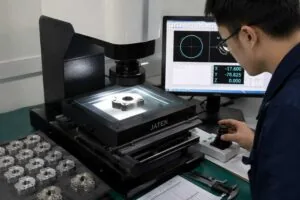
- Documentation changes the schedule. A certificate of conformance, CMM report and material certificates ship with every MW+ order; FAI to AS9102 and PPAP Level 3 are on request and add their own approval loop.
- Tolerance and finish buy time as well as money. Each step from ±0.01mm under ISO 2768-m down to ±0.005mm and ±0.001mm adds passes and inspection events per part.
- Lead time is not delivery date. Transit and customs sit outside the shop’s schedule and depend on the Incoterms 2020 rule you agreed.
On this page
- What actually determines a CNC machining lead time?
- How do prototype and production lead times differ?
- MW+ lead times by stage
- Why the first production lot takes longer than the second
- What adds days to a quoted lead time?
- Which phases can be compressed, and which cannot?
- Planning a programme around both schedules
- When the shortest lead time is the wrong choice
- Frequently asked questions
What actually determines a CNC machining lead time?
A CNC machining lead time is determined by six phases in sequence: quotation and design-for-manufacture review, CAM programming and fixture preparation, material procurement, machining, secondary finishing, and inspection with documentation. Only one of those is spindle time. When a quoted lead time surprises a buyer, the cause is almost always one of the other five, and it is usually material or finishing.
Use this table to locate which phase is setting your schedule, because that is the only phase worth negotiating over.
| Phase | What happens | Weight on a prototype | Weight in production |
|---|---|---|---|
| Quotation and DFM review | Geometry read, manufacturability checked, price built | High relative to total | Low; done once |
| CAM programming and fixturing | Toolpaths written and proved, workholding built | Dominant | Already paid, reused |
| Material procurement | Billet or bar bought, cut and certified | Moderate, unless the grade is exotic | Often the longest item |
| Machining | Spindle time, per part, times quantity | Small in absolute terms | Dominant |
| Secondary finishing | Deburr, blast, anodize, plate, passivate | Moderate; batch minimums apply | Significant; queue-driven |
| Inspection and documentation | First article, CMM, certificates, submissions | Moderate | Ongoing per lot |
How do prototype and production lead times differ?
Prototype and production lead times differ because they are limited by different things. A prototype is limited by preparation: the programming, the fixture and the first proving cut, all carried by a single part. A production lot is limited by throughput and by the phases that repeat per unit — machining, finishing and inspection — after preparation has already been absorbed.
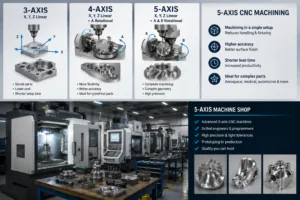
That difference explains a result buyers often find counter-intuitive: a single part and fifty parts can quote nearly the same elapsed time. Fifty parts do not need fifty setups. They need one setup and fifty cycles, and if the cycle is short, the machining adds little to the calendar. This is also why consolidating operations onto 4-axis or 5-axis equipment shortens a prototype schedule more than it shortens a production one.
| Criterion | Prototype run | Production run | Which is better, and when |
|---|---|---|---|
| Limiting phase | Programming and fixturing | Cycle time, finishing queue, material | Prototype wins when you need one part now |
| Effect of adding units | Steep drop in cost per part, small change in days | Near-linear increase in days | Production wins once quantity is committed |
| Fixture | Simple, sometimes soft-jaw or temporary | Dedicated, proven, retained | Production for repeatability across lots |
| Inspection | Full dimensional check on the one part | First article plus sampling per lot | Prototype for design proof, production for capability |
| Tolerance strategy | Proved once on a single part | Held at Cpk ≥1.67 across the lot | Production when consistency is the requirement |
| Response to a drawing change | Hours to days; reprogram and re-cut | Days to weeks; requalify and re-document | Prototype while geometry is still moving |
The practical reading is that a CNC prototype buys you an answer, and a production run buys you consistency. Ordering production quantities before the design is frozen buys neither, because a change forces requalification of a process you have already paid to establish.
MW+ lead times by stage
MW+ returns a quote within 24 hours, delivers prototypes in 48-hour express or 3–5 business days as standard, and produces volume lots in 10–15 business days, with no minimum order quantity and capacity to 1,000,000+ units. Those figures assume manufacturable geometry, a stocked material grade and a finish MW+ performs in house — the table below states what each stage actually requires.
| Stage | MW+ lead time | What has to be true for it to hold |
|---|---|---|
| Quotation | Within 24 hours | 3D geometry plus a 2D drawing with the datum scheme |
| Express prototype | 48-hour express | Stocked material, no outsourced finishing, geometry proven manufacturable |
| Standard prototype | 3–5 business days | Stocked material; in-house finishing; standard tolerance classes |
| Volume production | 10–15 business days | Design frozen, fixture proven, material and finishing scheduled |
| Repeat production order | Shorter than the first lot | Program and fixture retained, no drawing revision since last lot |
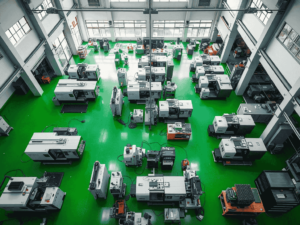
Read the third column as the checklist. Every one of those conditions that is not met moves the date, and it is far cheaper to discover which one is missing at the RFQ stage than after the purchase order. MW+ operates a 15,000 m² facility in Guangming, Shenzhen with 60+ machining centres and 120+ engineering and quality professionals, so machine availability is rarely the constraint; the constraints are the ones listed above.
Why the first production lot takes longer than the second
The first production lot takes longer than every lot after it because it carries the one-time work that production repeats never see again: a dedicated fixture, a proven program, a first article inspection and, where required, a documentation submission. None of that recurs. A second lot of the same part, from the same revision, starts at the machining phase.
The prototype fixture is usually not the production fixture
A prototype can be held in soft jaws or a temporary fixture because it only has to be right once. A production fixture has to load quickly, repeat identically and resist wear across thousands of cycles. Building it is real elapsed time inside the first lot, and it is the item most often missed when a buyer compares a prototype quote to a production quote for the same precision machined part.
Documentation has an approval loop, not just a duration
An FAI to AS9102 or a PPAP Level 3 submission is not only work at the supplier. It is a package that your own quality function has to review and approve, and that review sits on the critical path. Agree who signs it and how long they have before the first lot starts, or the parts will finish while the paperwork is still in a queue.
What adds days to a quoted lead time?
Days are added by non-stocked material, outsourced finishing, tightened tolerance classes, additional inspection scope, drawing revisions after release, and incomplete RFQ information that forces a clarification loop. Machining capacity is rarely the cause. Most schedule slips are procurement or communication events wearing a machining costume.
| Cause of delay | Why it adds time | Who controls it |
|---|---|---|
| Non-stocked alloy, temper or bar size | Mill or distributor lead time sits before machining starts | Buyer, at material selection |
| Outsourced coating or plating | External queue plus transport in both directions | Shared; ask what is done in house |
| Tolerance tightened below the general class | Adds semi-finish, finish and inspection passes per part | Buyer, at drawing release |
| Extra controlled characteristics | Each becomes an inspection event on every lot | Buyer, at drawing release |
| Drawing revision after order | Reprogramming, refixturing, requalification | Buyer |
| Incomplete RFQ package | Clarification loop before the job can be scheduled | Buyer |
| Missing datum scheme | Fixture cannot be designed until datums are agreed | Buyer |
Material choice deserves particular attention because it acts on the schedule twice. A non-stocked grade delays the start, and a difficult-to-machine grade lengthens every cycle after that. Comparative machinability and property data of the kind published on MatWeb is a reasonable place to sanity-check a substitution before you commit, and MW+ machines 70+ material grades across its manufacturing capabilities.
Which phases can be compressed, and which cannot?
Some phases compress and some do not. MW+ offers a 48-hour express prototype route, and compressing a schedule works by reordering a queue and dedicating a machine and an operator rather than by making the physics faster. What cannot be compressed is material that has to be bought, a finishing process with a fixed cure or tank cycle, an approval your own team owes, or international transit.
Before asking for an expedite, check which phase you are actually trying to shorten. Paying an expedite premium on a CNC machining services job whose critical path is a non-stocked alloy buys nothing. Ask the supplier which phase is governing, then decide whether money or a specification change is the better lever — dropping a tolerance class or accepting an as-machined finish often moves the date further than the premium does. Whether a premium is worth paying at all is a separate commercial judgement, worked through in the analysis of the CNC machining cost and lead time trade-off.
Planning a programme around both schedules
The reliable pattern is to run prototypes fast and loose, then freeze and run production slow and documented. That applies equally to milled and turned parts. Use the prototype phase to answer questions with physical parts, and only release the drawing to production once nothing on it is still an open question. Every revision that arrives after the production fixture exists costs more schedule than it saves.
Separate the shop’s lead time from your delivery date
A lead time ends when parts are ready to ship. Your delivery date also includes packing, transit, customs clearance and inbound handling, and which party carries each of those is set by the Incoterms 2020 rule in the contract. Two quotes with identical lead times can land weeks apart if one is ex-works and the other is delivered.
Order the long-lead item first
If a programme needs an unusual alloy or an outsourced coating, place that material or process on order while the drawing is being finalised, so the procurement clock runs in parallel with the engineering clock rather than after it. This one habit removes more calendar time than any expedite fee.
When the shortest lead time is the wrong choice
The shortest lead time is the wrong objective when the design is not yet stable, when the part needs documentation that has its own approval cycle, when a compressed schedule forces a specification compromise you will regret, or when the parts will sit in a store anyway because another item gates the assembly. Speed you cannot use is money spent on nothing.
| Situation | Better objective than shortest lead time | Why |
|---|---|---|
| Drawing still changing between reviews | Cheapest and fastest iteration loop | Production speed is wasted on geometry that will change |
| PPAP or FAI submission required | Schedule the approval, not just the parts | The review loop, not the machining, sets the date |
| Another component gates the build | Match the gating item’s date | Early parts become inventory and risk obsolescence |
| Expedite would force a finish or tolerance compromise | Keep the specification, move the date | A part that misses spec has an infinite lead time |
| Long-term programme with steady demand | Scheduled repeat lots with a retained fixture | Predictability beats a single fast delivery |
| Safety- or compliance-critical part | Documented, capable process first | Rework and re-approval cost more than the days saved |
A supplier that always says yes to a date is not being helpful. Ask which phase is governing and what would have to change for the date to move; the answer tells you whether the commitment is real. The MW+ quality assurance process, operating under ISO 9001:2015, AS9100D, ISO 13485, IATF 16949 and NADCAP certification, is what keeps a fast date from turning into a rework loop.
Frequently asked questions
How fast can MW+ deliver a CNC prototype?
MW+ delivers prototypes in 48-hour express or 3–5 business days as standard, once a manufacturable CAD file is in hand and the material is a stocked grade. Quotes are returned within 24 hours, and there is no minimum order quantity, so a single part is a normal order rather than an exception.
Why is my production lead time longer than my prototype lead time for the same part?
A production lot adds work the prototype never carried: a dedicated fixture built to repeat across thousands of cycles, a proven program, first article inspection and any documentation submission. It also multiplies the per-unit phases — machining, finishing and inspection — by the quantity. The prototype was fast because only one part had to be right, once.
Does ordering more parts always take longer?
No. Below a few dozen parts, quantity often changes the elapsed time very little, because one setup serves the whole lot and short cycles add little to the calendar. Elapsed time starts rising noticeably once total machining hours exceed the setup and finishing content, which happens sooner on long-cycle parts than on short ones.
What is the single most common cause of a missed date?
An incomplete RFQ package is the most common cause, because it delays scheduling before any machine is involved. A missing datum scheme is the specific version of this that stops fixture design entirely. Send 3D geometry, a 2D drawing with datums and functional tolerances, material and temper, finish, quantity and documentation level together. The full package is itemised in the CNC machining quote checklist.
Does a tighter tolerance really add days, or just cost?
It adds both. Moving a feature below the ISO 2768-m general class typically adds finishing passes and an inspection event on every part, and both consume calendar time in production quantities. MW+ holds ±0.01mm generally, ±0.005mm on precision features and ±0.001mm on critical features, but the schedule reflects how many features you have put in the tighter classes.
Does surface finishing change the lead time?
Yes, and the size of the effect depends on whether it is done in house or sent out. An outsourced coating adds an external queue plus transport in both directions. Finish specifications also stack: each step of the ladder from Ra 3.2µm as-machined to Ra 0.4µm fine-machined to Ra 0.1µm polished, measured to ISO 21920-2 (superseding ISO 4287), is an additional operation.
Can I shorten a lead time by supplying my own material?
Sometimes, if you already hold the stock and it is certified and correctly sized. More often it lengthens the schedule, because the machining slot is now dependent on your logistics, and any discrepancy in size or certification stops the job. It is worth doing when you genuinely hold the material, and rarely otherwise.
How do I get a lead time I can plan around?
Ask for the lead time broken into phases, with the governing phase named and the Incoterm stated, rather than a single number of days. Send a complete RFQ package to the MW+ engineering team; MW+ accepts STEP, IGES, DXF, DWG, SolidWorks and PDF, and returns a quote within 24 hours so the date can be built into your plan rather than discovered later.