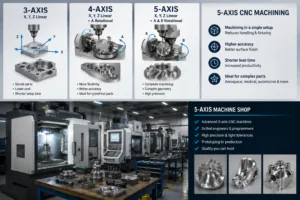
Splitting a part across a prototype shop, a production shop and a finisher feels like buying specialist skill at each stage. What it actually buys is three handoffs — and every handoff resets the design intent, the fixturing and the inspection history that made the previous stage work.
This guide covers when single-sourcing is the right call, when it genuinely is not, what each handoff costs in real time and money, and the questions that separate a manufacturing partner from a job shop with a website.
Key takeaways
- A CNC prototype cut from production material in the production process yields test data that transfers directly to the production part — printed prototypes do not.
- Each supplier handoff typically adds 5–15 business days for re-quoting, re-fixturing and first-article approval, before any part is cut.
- General machining holds ±0.01mm to ISO 2768-m; precision work holds ±0.005mm; the tightest features reach ±0.001mm on 5-axis simultaneous setups.
- Single-sourcing is the wrong call when you need competitive price tension on a commodity part, or when one supplier cannot legitimately cover every process your part needs.
- Ask one question first: is CMM inspection in-house or outsourced? Outsourced metrology means you pay a supplier to find your defects after the parts ship.
On this page
- What single-source CNC machining actually means
- What does each supplier handoff actually cost?
- When is single-sourcing the wrong choice?
- Why machine a prototype instead of printing one?
- What tolerances should you actually specify?
- Material competency: where capability actually shows
- How do you verify a supplier’s quality claims?
- How should you evaluate a CNC machining partner?
- Frequently asked questions
- The fastest way to evaluate a partner
What single-source CNC machining actually means
Single-sourcing means one supplier carries your part from first prototype through production and finishing, rather than splitting those phases across separate vendors. The distinction that matters is not contractual — it is that the same team keeps the CAM programs, the workholding, the inspection history and the accumulated knowledge of which features on your part are difficult.
It is worth separating this from sole-sourcing, which means only one supplier in the world can make the part. Single-sourcing is a choice you make and can reverse. Sole-sourcing is a constraint you inherit. The risks are different, and so is the mitigation.
What does each supplier handoff actually cost?
The cost of a handoff is rarely on the invoice. It shows up as schedule, and as defects that surface later than they should have. Here is what transfers between suppliers and what does not.
| Handoff | What transfers | What resets to zero | Typical delay added |
|---|---|---|---|
| Prototype shop → production shop | CAD model, drawing, material spec | CAM programs, workholding, cutter selection, feeds and speeds, known problem features | 5–15 business days |
| Production shop → finisher | Finished machined part, finish callout | Masking strategy, fixture points, handling damage history | 3–10 business days |
| Finisher → inspection | Coated part | Pre-coat dimensional baseline — post-coat measurement cannot separate plating thickness from a machining error | 2–5 business days |
| Design revision, multi-vendor | New drawing revision | Every stage above, simultaneously | 10–20 business days |
| Design revision, single-source | New drawing revision | Only the affected operations | 2–4 business days |
The last two rows are the whole argument. A revision is not an unusual event — it is the normal condition of a part that is still being developed. The question is what a revision costs you each time it happens.
A worked example: what revisions cost across a programme
Put those two rows into arithmetic. Let R be the number of design revisions before the design freezes, dₘ the elapsed days a revision adds on a multi-vendor route, and dₛ the days it adds when one supplier holds the whole part. The extra elapsed time the split route costs you is:
Extra elapsed days = R × (dₘ − dₛ)
Take four revisions before freeze, which is unremarkable on a new assembly, using the mid-points from the table above as illustrative inputs: dₘ = 15 business days and dₛ = 3.
- Multi-vendor: 4 × 15 = 60 business days of added schedule
- Single-source: 4 × 3 = 12 business days
- Difference: 48 business days, or 48 ÷ 5 = 9.6 working weeks, about two and a quarter calendar months
That gives you a test for whether a single-source premium is worth paying. If the split route offers a unit saving of s and you will buy N parts before the design freezes, splitting is the better decision only when s × N is worth more to you than 48 business days of programme schedule. During development N is usually small and schedule is usually the binding constraint, which is why the answer tends to flip as soon as the sum is written down. Substitute your own R, dₘ, dₛ and N — the arithmetic does not care what the numbers are. How unit cost then behaves as quantities rise is worked through in our piece on the prototype-to-production cost curve.
When is single-sourcing the wrong choice?
Any supplier who tells you single-sourcing is always right is selling, not advising. There are cases where splitting the work is the better decision, and knowing them is what makes the comparison useful.
| Your situation | Better approach | Why |
|---|---|---|
| High-mix development, frequent revisions | Single-source | Revision cost dominates; continuity is worth more than unit price |
| Tight tolerances or regulated documentation | Single-source | One quality system, one traceability chain, no gaps between certificates |
| Mature commodity part, stable design, high volume | Dual-source | Design is settled, so continuity is worth little and price tension is worth a lot |
| Part needs a process your partner does not genuinely own | Split, deliberately | A supplier subcontracting a process they do not control is a hidden handoff you are not managing |
| Supply continuity is business-critical | Single-source primary + qualified second | Keeps continuity while removing single-point-of-failure risk |
| Total spend is small and infrequent | Either | The overhead of managing two suppliers exceeds the benefit |
The honest summary: single-sourcing wins on parts that are still changing and on parts where documentation matters. It loses on settled, high-volume commodity work where a second quote is the cheapest lever you have.
Why machine a prototype instead of printing one?
Most prototyping methods give you something representative. CNC prototyping gives you something you can test and believe.
A machined prototype starts from certified bar or billet stock, so the finished part carries the parent material’s documented mechanical properties — the values published on the mill certificate. An additively manufactured part has properties determined by its build parameters, orientation and post-processing, which is why qualifying a printed part for load-bearing service requires its own test programme. For a form-and-fit check, printing is faster and cheaper. For a part that has to survive a test rig, machining is the process whose data transfers. Our breakdown of rapid CNC prototyping lead times covers what actually determines the turnaround.
Lead times by phase
| Phase | Standard | Expedited | What drives the variance |
|---|---|---|---|
| Quote and DFM review | Within 24 hours | — | Drawing completeness; a model without tolerance callouts cannot be quoted accurately |
| Prototype, 3-axis geometry | 3–5 business days | 48-hour express | Material availability, finish requirement |
| Prototype, 5-axis or assembly set | 5 business days | Case by case | Setup count, fixturing complexity |
| Volume production | 10–15 business days | Case by case | Quantity, secondary operations, inspection scope |
| Design revision, single-source | 2–4 business days | — | Only affected operations are reprogrammed |
What tolerances should you actually specify?
Over-specifying tolerance is the most common avoidable cost on an RFQ. Every tightened callout adds setup time, slower feeds, more frequent tool changes and more inspection. Applying ±0.001mm across a whole part when a single bore carries the function can multiply the price of that part for no functional gain.
The general-tolerance standard most drawings default to is ISO 2768-1:1989, which defines linear and angular tolerance classes (f, m, c, v) so that a drawing does not need an explicit callout on every dimension. Its companion for general geometrical tolerances, ISO 2768-2:1989, has been withdrawn and replaced by ISO 22081:2021; drawings in circulation still call out the old part, so state on the title block which convention governs. Individual geometric characteristics are covered by ISO 1101:2017 and, in North American practice, ASME Y14.5-2018.
| Tolerance level | Achievable on | Typical use | Cost impact |
|---|---|---|---|
| ±0.1mm (ISO 2768-c) | Any milling or turning centre | Non-critical clearance, cosmetic features | Baseline |
| ±0.01mm (ISO 2768-m) | Standard 3-axis machining | General mechanical fit, the sensible drawing default | Baseline |
| ±0.005mm | Precision setups, controlled environment | Bearing seats, sealing faces, mating assemblies | Moderate increase |
| ±0.001mm | 5-axis simultaneous, temperature-controlled | Critical bores, optical mounts, medical instrument features | Significant increase; inspection cost rises with it |
The practical approach is to apply a general class such as ISO 2768-m across the drawing and reserve tight callouts for the features that carry the function. A supplier offering free DFM review should tell you which of your callouts are doing nothing — see our CNC machining services for how that review runs.
Material competency: where capability actually shows
A capable partner is not limited to aluminium and mild steel. The application dictates the material, so the question is whether your supplier has cut yours before — not whether it appears on a list.
| Material | Density (g/cm³) | Thermal conductivity (W/m·K) | Relative machinability | Typical application |
|---|---|---|---|---|
| Aluminium 6061-T6 | 2.70 | ~167 | Excellent | Structural brackets, housings, heat sinks |
| Aluminium 7075-T6 | 2.81 | ~130 | Good | Aerospace structure, high-stress fittings |
| Stainless 316 | 8.00 | ~16 | Moderate — work-hardens readily | Corrosion-critical and medical-grade parts |
| Titanium Ti-6Al-4V | 4.43 | ~6.7 | Difficult — low conductivity concentrates heat at the cutting edge | Implantable devices, high-performance structure |
| Brass C360 | 8.50 | ~115 | Excellent — the machinability reference | Electrical contacts, fluid fittings |
| PEEK | 1.32 | ~0.25 | Moderate — heat cannot escape through the part | High-temperature, chemically aggressive service |
Verified property data for specific grades and tempers is available from MatWeb; always work from the mill certificate for the actual lot rather than a nominal table when the property is load-bearing.
Titanium and PEEK are the two that expose a supplier. Both have low thermal conductivity, so the heat generated at the cutting edge stays at the cutting edge instead of conducting away into the part and the chip. That means specialised tooling, conservative feeds, and process engineers who have made the mistake before. Ask for documented examples before committing. Our machining capabilities cover 70+ material grades.
How do you verify a supplier’s quality claims?
Precision only means something when it is measured and documented. Certification tells you a quality system exists; it does not tell you the system is applied to your part. These are the questions that do.
| What to ask | A good answer | A red flag |
|---|---|---|
| Is CMM inspection in-house or outsourced? | In-house, with named equipment and a controlled environment | “We use a partner lab” — defects are found after parts ship |
| Which certifications, and to what scope? | Certificate numbers and the scope statement, which names the processes covered | A logo on the website with no certificate offered |
| What ships with every order? | COC, CMM report and material certificates as standard | Inspection reports quoted as an extra |
| Can you provide FAI to AS9102? | Yes, on request, quoted per programme | “On every order” — either untrue or priced into everything |
| What is your on-time delivery rate? | A number, and the period it covers | No number available |
| What is your process capability on a tight feature? | A Cpk figure against a stated tolerance | Unfamiliarity with the term |
For regulated work, ISO 9001:2015 is the baseline, though it was withdrawn on 16 September 2026 and replaced by ISO 9001:2026. Existing certificates run through a transition period, so a supplier certified to the 2015 edition is properly certified today; what to ask for is their transition plan and date. AS9100D adds the aerospace requirements, ISO 13485 covers medical devices, and first-article inspection is defined by AS9102. Lot acceptance by attributes is normally indexed to ISO 2859-1:2026. Measurement results mean nothing unless the instruments are traceable to national standards, a chain described by NIST. Our approach to CNC machining quality control sets out how each applies.
What documentation should you expect?
| Document | Availability | Who typically requires it |
|---|---|---|
| Certificate of conformance (COC) | Every order | All customers |
| CMM inspection report | Every order | All customers |
| Material certificates, mill-traceable | Every order | All customers |
| FAI per AS9102 | On request, quoted per programme | Aerospace, defence |
| PPAP Level 3 | On request, quoted per programme | Automotive, IATF 16949 supply chains |
How should you evaluate a CNC machining partner?
Price is a factor. It should not be the filter. The downstream cost of a poor supplier choice — scrapped parts, missed milestones, a programme slip — consistently exceeds the saving from the lowest bid. Four criteria predict outcomes:
- Machine capability. 5-axis machining centres reach complex geometry in a single setup, which removes both the cost of the extra operation and the stack-up error that re-fixturing introduces.
- DFM support before quoting. A partner who reviews your files and flags manufacturability problems before cutting starts is protecting your budget. One who quotes without comment is transferring the risk to you.
- On-time delivery data. Ask for the figure and the period. A supplier who cannot produce it has answered the question.
- Scalability without a new supplier. Can they run a 10-piece prototype now and a 5,000-piece order next quarter on the same fixtures and programs?
Frequently asked questions
Is single-sourcing more expensive per part?
Often slightly, on the first order — you are not running a competitive bid each time. It usually costs less across a programme, because programming and fixturing are one-time costs amortised over your order history rather than repaid to each new vendor, and because revision cycles resolve in days instead of weeks. On a settled high-volume commodity part, the price tension of a second quote can outweigh that. On a part still in development, it rarely does.
Doesn’t single-sourcing create supply risk?
Yes, and it should be managed rather than dismissed. The standard mitigation is a single-source primary with a second supplier qualified but not running — you keep the continuity benefit while holding a tested fallback. For business-critical parts, ask your primary to release the CAM programs and fixture drawings as part of the agreement so a transfer is possible without starting from the drawing.
How long does a CNC prototype take?
3–5 business days for most geometries, with 48-hour express available on simpler parts. Volume production runs 10–15 business days. Multi-axis parts and assembly sets sit at the longer end of both ranges.
Is a machined prototype really the same as the production part?
Functionally, when it is cut from production-equivalent material by the same process, yes. The differences that remain are the ones volume introduces — a production run may use different workholding or an automated cell, which can shift surface finish slightly. Ask your supplier to state which production parameters will differ from the prototype, so nothing surprises you at first article.
What tolerance can CNC machining hold?
General machining works to ±0.01mm under ISO 2768-m, precision work to ±0.005mm, and the tightest features reach ±0.001mm on 5-axis simultaneous setups in a controlled environment. Tolerance is not free: each step tighter adds setup time, slower cutting and more inspection.
Why is my 5-axis part quoted higher than a 3-axis equivalent?
Machine hour rate is higher, and programming a simultaneous 5-axis toolpath takes longer. The offset is setup count: a part needing four 3-axis operations may run in one 5-axis setup, which removes three re-fixturing steps and the positional error each would have introduced. Compare total cost per finished part, not hourly rate.
What file formats do you need to quote?
STEP is preferred because it carries the most complete solid geometry. IGES, DXF, DWG, SolidWorks and PDF drawings are also accepted. Include material grade, tolerance callouts, surface finish and quantity — a model without those cannot be quoted accurately, only estimated.
Is there a minimum order quantity?
No. The same quality system, documentation and inspection apply to a single prototype and to a production run.
The fastest way to evaluate a partner
Send a real part, not a questionnaire. A STEP file returns a quote and a DFM review within 24 hours — including the manufacturability problems, if your drawing has any. What a supplier tells you about your own part before taking your money is the most reliable signal you will get.
Request a quote and DFM review, or read more about our CNC machining services and precision machined parts.