Adding two rotary axes does not make a machine more accurate. It removes the need to unclamp the part, and almost every real cost and accuracy difference between 3-axis and 5-axis machining follows from that. This page works through where the money goes, shows the arithmetic for the quantity at which 5-axis starts to pay, and sets out when buying rotary axes wastes your budget.
Key takeaways
- 5-axis buys setup elimination, not spindle accuracy. Positioning accuracy and repeatability are machine properties measured to ISO 230-2:2014, and they do not improve because you added rotaries.
- The saving is in feature-to-feature tolerance. Three independent re-fixturing errors of ±0.01 mm combine to about ±0.017 mm by root-sum-square; in one setup that term disappears.
- Machine minutes are not cost. The worked example below shows 5-axis winning on time at 16 pieces, but only winning on cost if the shop’s 5-axis rate is under about 1.26 times its 3-axis rate at that quantity.
- 3+2 indexed machining locks the rotaries before cutting and is stiffer than simultaneous motion. Most parts that people buy 5-axis for only need 3+2.
- MW+ holds ±0.01 mm generally to ISO 2768-m, ±0.005 mm as a precision band and ±0.001 mm on selected features, with Cpk ≥1.67 on controlled characteristics, on both 3-axis and 5-axis work.
- What the axis count actually changes
- Where does the cost difference come from?
- A worked example: the break-even rate ratio
- Does 5-axis machining produce a more accurate part?
- Is 3+2 indexed enough, or do you need simultaneous?
- Which part types justify the 5-axis premium?
- How does quantity change the answer?
- When 5-axis is the wrong purchase
- What to send so both routes can be quoted
- Frequently asked questions
What the axis count actually changes
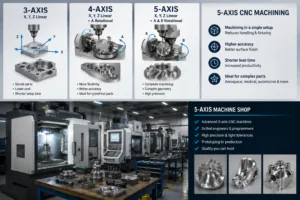
A 3-axis machining centre moves the tool in X, Y and Z against a fixed part. Every surface the tool cannot see from that one orientation requires the part to be unclamped and re-located. A 5-axis machine adds two rotary axes, so the part can be presented to the spindle at any orientation without leaving the fixture.
That is the whole mechanism. The spindle is no more precise and the scales no finer; what has gone is the re-location error that every unclamp-and-reclamp introduces. If all your features are on one face, a 5-axis machine gives you nothing measurable. If tight relationships cross four faces, it changes the answer completely. How that motion is produced is covered in our walkthrough of how 5-axis machining works, and the decision from the geometry side in choosing between 5-axis and 3-axis; this page is about cost and accuracy.
Where does the cost difference come from?
Several cost buckets move in opposite directions when you change axis count, which is why the net answer is rarely obvious from a quote sheet. No currency figures appear below, because a machine rate quoted without the cycle and setup behind it tells you nothing.
| Cost bucket | 3-axis | 5-axis | Which way the money moves |
|---|---|---|---|
| Machine hour | Lower capital and maintenance base | Higher capital, rotary maintenance, calibration | Against 5-axis, every hour |
| Programming and simulation | Shorter; collisions are easy to see | Longer; every move simulated against trunnion, fixture and holder | Against 5-axis, once per programme |
| Fixturing | One fixture per orientation, often several | One fixture, but it must clear the rotary envelope | Usually for 5-axis |
| Setups | One per accessible face, each with a first-off | One, sometimes two | Strongly for 5-axis |
| Cutting time | Longer tools reaching into cavities, lighter cuts | Shorter tools by tilting, heavier cuts possible | Usually for 5-axis |
| Handling and WIP | Parts queue between operations | Part completes in one flow | For 5-axis |
| Inspection and rework | Stack-up across setups must be verified | Fewer contributors to verify | For 5-axis |
The buckets counting against 5-axis are largely fixed; those favouring it are per-setup or per-part. That structure produces a crossover quantity rather than a universal answer, which is why the same part can honestly be cheaper on either route depending on how many you order.
A worked example: the break-even rate ratio
Take a prismatic housing with features on four faces and a tight positional relationship between two of them. The figures below are illustrative process-sheet inputs of the kind your supplier can give you for your own part; they are not published benchmarks. Substitute their numbers and the method is unchanged.
- 3-axis route — four setups at 25 min each, so fixed time F₃ = 100 min. Per part: 12.8 min cutting across the four operations plus 4.5 min re-fixturing and handling, so variable time V₃ = 17.3 min.
- 5-axis route — one setup, but 190 min of setup, programming and collision simulation, so F₅ = 190 min. Per part: V₅ = 11.5 min, shorter because the tool reaches by tilting instead of extending.
Machine minutes per part for a batch of Q pieces are M(Q) = F ÷ Q + V. Setting the two routes equal gives the quantity at which 5-axis stops costing more machine time:
- 100 ÷ Q + 17.3 = 190 ÷ Q + 11.5
- 17.3 − 11.5 = (190 − 100) ÷ Q
- 5.8 = 90 ÷ Q, so Q = 15.5, rounded to 16 pieces
That is where most comparisons stop, and where they go wrong. Machine minutes are not money. A 5-axis hour costs more, so the honest question is how much more before the time saving is cancelled. Call that ratio k: the 5-axis route is cheaper when M₃(Q) > k × M₅(Q), so the break-even ratio is k = M₃(Q) ÷ M₅(Q).
| Batch Q | 3-axis min/part | 5-axis min/part | Break-even rate ratio k | Reading |
|---|---|---|---|---|
| 5 | 37.3 | 49.5 | 0.75 | 5-axis cannot win on cost |
| 10 | 27.3 | 30.5 | 0.90 | 5-axis cannot win on cost |
| 25 | 21.3 | 19.1 | 1.12 | Wins only if the 5-axis rate is under 1.12× |
| 50 | 19.3 | 15.3 | 1.26 | Wins if under 1.26× |
| 100 | 18.3 | 13.4 | 1.37 | Wins if under 1.37× |
| 500 | 17.5 | 11.9 | 1.47 | Wins if under 1.47× |
| 1,000 | 17.4 | 11.7 | 1.49 | Ceiling: the ratio flattens here |
Two conclusions fall out. Below roughly 25 pieces no plausible rate structure makes 5-axis cheaper on machining cost alone. And above a few hundred pieces the ratio flattens at about 1.5, because setup and programming have amortised away and only the cycle-time ratio remains — so if a supplier’s 5-axis rate exceeds about 1.5 times their 3-axis rate, this part never gets cheaper on 5-axis at any quantity.
That is not an argument against 5-axis. It is an argument that cost is usually the wrong reason to buy it. The right reason is the next section.
Does 5-axis machining produce a more accurate part?
Not in the sense most buyers mean. Positioning accuracy and repeatability are measured to ISO 230-2:2014, thermal behaviour to ISO 230-3:2020 and the path accuracy of simultaneous interpolation to ISO 10791-6:2014. A 5-axis machine is tested against the same criteria as a 3-axis one, and a well-maintained 3-axis machine can beat a neglected 5-axis one on all of them.
What changes is the number of independent error sources contributing to a feature-to-feature tolerance. Consider a positional callout between a bore on one face and a boss on another, and suppose your supplier’s own fixture data puts each re-location at ±0.01 mm. On a 3-axis route needing three re-fixturings, those errors are independent, so they combine by root-sum-square rather than adding:
- Root-sum-square: √(0.01² + 0.01² + 0.01²) = 0.01 × √3 = ±0.017 mm
- Worst case, if the errors happen to align: 0.01 + 0.01 + 0.01 = ±0.03 mm
- Single setup: the re-location term is zero and only machine repeatability remains
So a ±0.02 mm feature-to-feature callout is comfortable in one setup, marginal across three, and out of reach if the errors align. That is the entire accuracy case for 5-axis, and it is a good one — but it applies only to relationships that cross setups. Tolerances within a single face gain nothing. Stack-up as a discipline is worked through in our article on tolerance stack-up in 3-axis and 5-axis milling.
| Error source | Present on 3-axis | Present on 5-axis | Removed by adding rotaries? |
|---|---|---|---|
| Linear positioning error | Yes | Yes | No — a machine property per ISO 230-2:2014 |
| Thermal drift over a long cycle | Yes | Yes | No — characterised per ISO 230-3:2020 |
| Rotary axis location and squareness | Not applicable | Yes | No — 5-axis adds this one |
| Re-location error between setups | Yes, once per setup | No, single setup | Yes — this is the whole benefit |
| Fixture wear and swarf under the part | Yes, at every reclamp | Once | Largely |
| Tool deflection reaching into a cavity | Worse — long tools needed | Better — tilt instead of extend | Partly |
| Operator error in re-datuming | Yes | Eliminated | Yes |
Note the third row: rotary axis location is a new error source that does not exist on a 3-axis machine, which is why 5-axis needs kinematic calibration on a schedule. A supplier who cannot say when the rotary centreline was last verified is running a looser process with more axes, not a tighter one. Our own verification regime sits under CNC machining quality control.
Is 3+2 indexed enough, or do you need simultaneous?
This distinction is worth more money than the 3-versus-5 question itself, and most enquiries never mention it. In 3+2 indexed machining the rotaries position the part at a compound angle and lock, and cutting is ordinary 3-axis motion in that orientation. In simultaneous 5-axis, all five axes move while cutting.
| Consideration | 3+2 indexed | Simultaneous 5-axis |
|---|---|---|
| Rotary axes while cutting | Locked, so the structure is stiffer | Moving, so stiffness is lower |
| Depth of cut achievable | Heavier | Lighter |
| Programming and simulation effort | Moderate | High |
| Surface finish on a flat face | Usually better | Usually worse |
| Required for | Features on flat faces at compound angles | Tool axis normal to a continuously curving surface |
| Typical parts | Brackets, housings, manifolds, multi-face bodies | Impellers, blades, blended fillets, mould cavities |
| Effect on the break-even ratio | Lower programming cost pulls it in your favour | Higher programming cost pushes it out |
If your features sit on flat faces, even at awkward compound angles, 3+2 is enough and usually the better engineering answer as well as the cheaper one. Ask the quote to state which mode is assumed, because the programming figure above differs substantially between them. Our multi-axis machining page lists the configurations available for each envelope.
Which part types justify the 5-axis premium?
The test is not complexity in the abstract. It is whether a tolerance crosses a setup boundary, or whether the geometry is physically unreachable from a fixed orientation.
| Part type | Setups on 3-axis | Justifies 5-axis? | Why |
|---|---|---|---|
| Flat plate, features on one face | One | No | Nothing to eliminate; 3-axis wins at every quantity |
| Plate with features on two parallel faces | Two | Rarely | A simple flip on a location pin is cheap and accurate |
| Multi-face bracket, loose tolerances | Three to five | Only at volume | Setups cost time, but nothing fails if they stack |
| Multi-face bracket, tight cross-face position | Three to five | Yes | The tolerance cannot survive the stack-up |
| Housing with angled bores | One per bore angle | Yes, 3+2 | Each angle would otherwise need its own fixture |
| Impeller, blisk, turbine blade | Not feasible | Yes, simultaneous | Tool axis must follow a curving surface |
| Deep cavity, high aspect ratio | One, with long tools | Often | Tilting shortens the tool and cuts deflection and chatter |
Where the geometry itself forces the decision rather than the tolerance, our piece on what complex geometry does to manufacturing cost covers the reachability argument in more detail.
How does quantity change the answer?
Quantity moves the cost case but not the accuracy case. If your tolerance needs a single setup, it needs one at a batch of three as much as at a batch of three thousand — you simply pay a higher unit price for it at the low end and should expect to.
| Quantity | What dominates | Usual answer | What to ask for |
|---|---|---|---|
| 1–10, prototype | Programming and setup, unamortised | 3-axis unless tolerance forbids it | Both routes quoted; say which dimensions are critical |
| 10–50, pilot | Setup count | Genuinely contested; run the ratio | The supplier’s own F and V figures for both routes |
| 50–500 | Cycle time and first-off count | 5-axis if the rate ratio is under about 1.3 | Confirmation of 3+2 versus simultaneous |
| 500+ | Cycle time, tool life, utilisation | 5-axis if the rate ratio is under about 1.5 | Sampling plan, tool-life data, unattended running |
When 5-axis is the wrong purchase
A supplier with rotary axes on the floor has a standing incentive to recommend them. Here is when they should not.
When the part is prismatic and single-faced
Plates, covers, single-sided fixtures and simple brackets gain nothing. A 3-axis shop will beat a 5-axis shop on price for this work at every quantity, and the parts will be no worse. Buying rotary axes here is paying for capability you do not use. Straightforward prismatic work belongs on CNC milling services.
When the drawing has no datums
Setup elimination protects relationships between features. If the drawing does not say which features are related to which datums, per ISO 1101:2017 or ASME Y14.5-2018, nobody can tell you whether a single setup is worth paying for. Fix the drawing before you compare routes. Where no individual tolerance is shown, ISO 2768-1:1989 supplies the linear and angular defaults; its geometrical companion ISO 2768-2:1989 is withdrawn, replaced by ISO 22081:2021, and older drawings still call out the old part, so state which convention governs.
When the design is still moving
A simultaneous 5-axis programme is expensive to write and expensive to revise. On a design that will change again, the flexible multi-setup route with standard workholding costs less in total even where it loses the per-part comparison. Buy the consolidated programme when the geometry freezes.
When the real problem is somewhere else
Rotary axes do not fix material instability, thermal growth on a long cycle, or a tolerance band that was never achievable in the first place. If a part fails inspection on a dimension that lies entirely within one face, adding axes will not change anything. Establish which error source is actually biting before you change machine class.
What to send so both routes can be quoted
The comparison in this article is only possible if the supplier is given enough to build both routes. Most enquiries are not.
| What to send | What it decides | Cost of leaving it out |
|---|---|---|
| 3D model in STEP or IGES | Reachability and the number of orientations needed | Quote assumes the most conservative setup plan |
| Drawing with datums and GD&T | Whether any tolerance crosses a setup boundary | No basis to justify or reject 5-axis |
| Quantity now and expected annual volume | Which side of the break-even ratio you sit on | Priced as a one-off; consolidation never proposed |
| Which two or three dimensions are critical | Whether the rest can run to a general tolerance | Every dimension inspected as if critical |
| Whether both routes should be quoted | Gets you the comparison rather than one number | You receive a decision, not a choice |
| Material, temper and acceptable substitutes | Cutting data and cycle time on both routes | Lead time lost sourcing a grade that was never critical |
MW+ runs 60+ machining centres covering 3-axis, 4-axis and 5-axis work at one 15,000 m² facility in Shenzhen, so both routes can be costed against the same rates, fixtures and inspection plan rather than two suppliers’ pricing habits. Every order ships with a certificate of conformance, a CMM inspection report and material certificates; AS9102 first article inspection and PPAP Level 3 are quoted per programme. Quotes come back within 24 hours — request a CNC machining quote and say if you want both routes priced.
Frequently asked questions
Is 5-axis machining always more expensive per part?
No, but it usually is at low quantity. The fixed cost of programming and simulation has to be amortised before the shorter cycle can pay for the higher machine rate. In the worked example above, no plausible rate structure makes 5-axis cheaper below about 25 pieces, while above a few hundred it wins as long as the 5-axis rate stays under roughly 1.5 times the 3-axis rate.
Why is my 5-axis quote so much higher than the 3-axis one for a prototype?
Because on a single part the programming and collision simulation are charged against one piece. That work is genuine — the toolpath has to be proved against the trunnion, the fixture and every holder — but it is a one-off. Ask what the price becomes at ten, fifty and two hundred pieces before concluding the route is wrong.
Can a 3-axis machine hold ±0.005 mm?
On a dimension within a single setup, yes, given a suitable machine, stable material and a proper inspection method. What a 3-axis machine struggles with is holding that band between features that sit on different setups, because the re-location error adds a contributor the tolerance was never budgeted for. Say on the enquiry which dimensions are cross-face and the supplier can answer properly.
Should I ask for simultaneous 5-axis on my drawing?
No. Specify the result and let the supplier pick the mode. Most parts that buyers assume need simultaneous motion only need 3+2 indexed machining, which is stiffer, cheaper to programme and usually gives a better finish. Naming the mode on the drawing removes the supplier’s ability to propose the cheaper one.
How do I check a supplier’s 5-axis claims?
Ask three questions: when the rotary centreline was last kinematically calibrated, which standard the machine’s positioning performance is verified against, and whether they can show a CMM report on a part with a cross-face positional callout. ISO 230-2:2014 and ISO 10791-6:2014 are the references a competent shop will recognise immediately.
Does 5-axis reduce scrap?
It removes one category of scrap cause — parts rejected because a cross-setup relationship drifted out of band — and leaves every other cause untouched. Whether that shows up as a measurable reduction depends on whether re-location error was what failed your parts. Ask what current rejections are attributed to before assuming a machine change fixes them.
What if my part needs both routes?
That is common and often the cheapest answer. Rough the stock on a 3-axis machine where the cut is simple and the machine hour is cheap, then finish the critical faces in one 5-axis setup. This keeps the expensive machine doing only the work that requires it, and the tolerance still lands on a single setup.