

In an acetal vs nylon comparison, acetal is often the better starting candidate when moisture-related dimensional movement is the controlling concern; nylon remains a useful candidate for bearing and wear duties when the selected grade and service conditions support it. This is a screening direction, not a universal material ranking. Ensinger identifies low water absorption for POM and generally higher absorption for polyamides, while Mitsubishi Chemical Group documents nylon bearing and wear applications. [1] [3]
For engineers specifying machine parts, the useful question is not simply “Which plastic is stronger?” It is “Which exact stock grade can meet this component’s dimensional and functional requirements in the stated condition?” This guide separates manufacturer evidence, our recommended review workflow and an explicitly hypothetical tolerance calculation. It is not a customer project or approval of a material substitution.
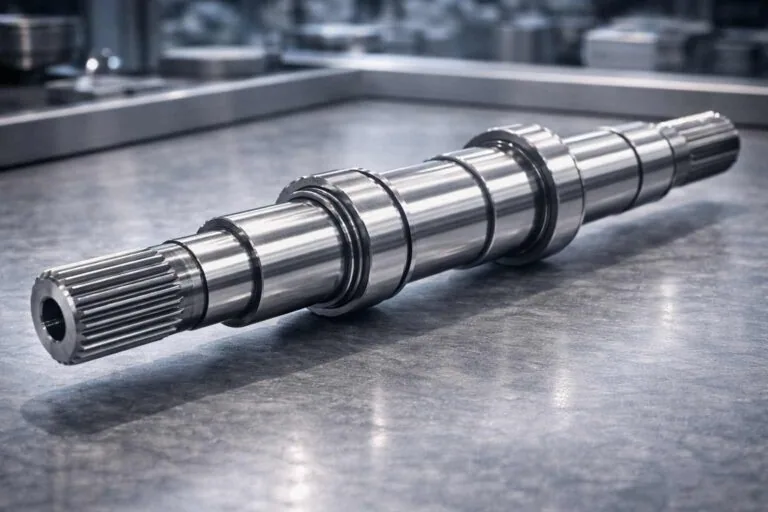
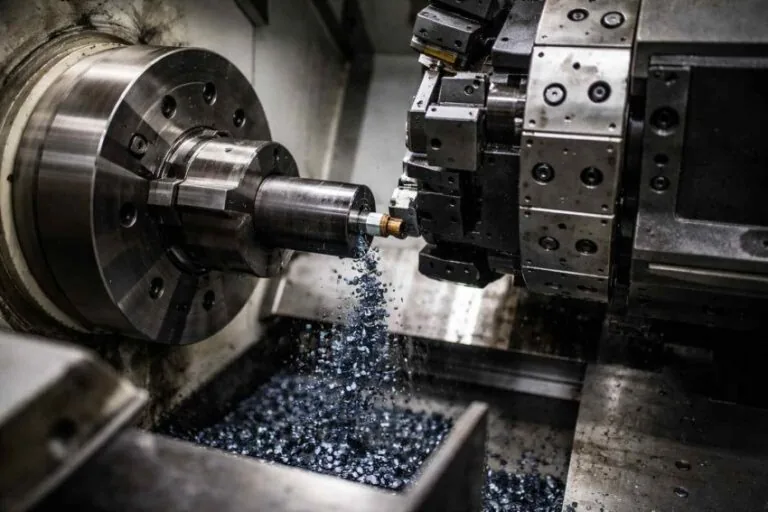
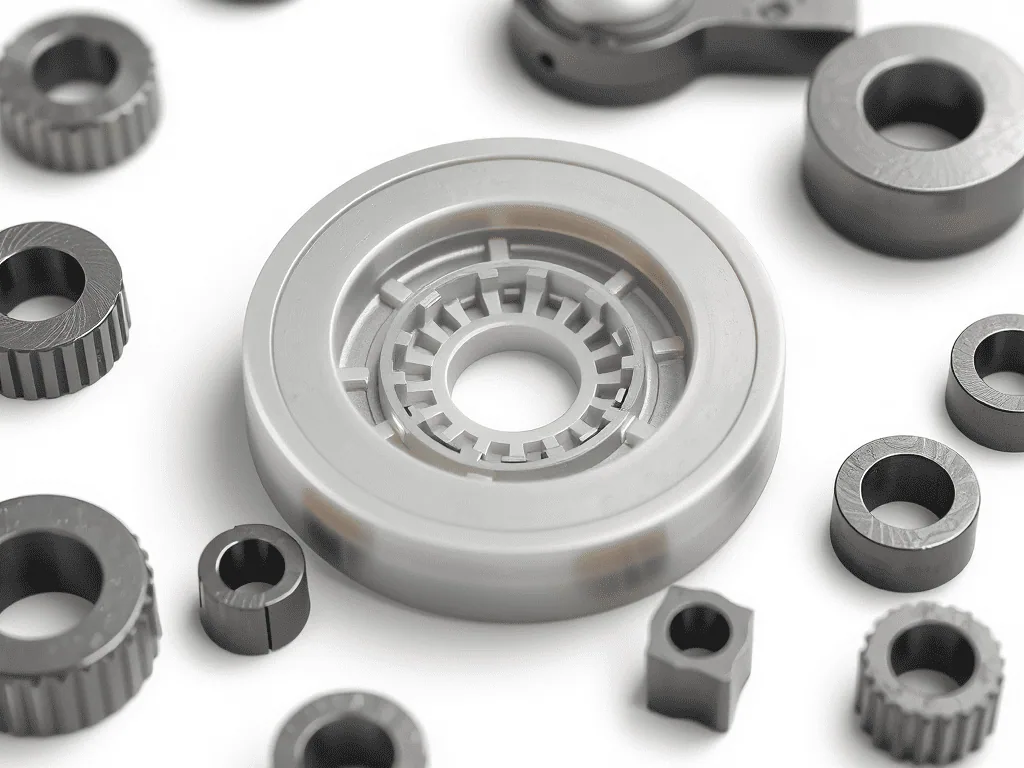
The existing MW+ images below are illustrative component images. Neither their appearance nor their library filenames verifies a resin grade, manufacturing method or measured result.
Contents
Start with the actual polymer and grade
Acetal is the common family name for polyoxymethylene, or POM. Distinguish copolymer POM-C from homopolymer POM-H. Delrin is an acetal homopolymer brand, not the generic name for every acetal. The brand’s technical discussion explicitly distinguishes homopolymer and copolymer rather than treating them as interchangeable resins. [4]
Nylon refers to polyamides, abbreviated PA. PA6 and PA66 are two engineering nylon types, with standard and modified stock-shape grades available. Mitsubishi Chemical Group describes its nylon portfolio as including both families and formulations for bearing and wear applications. A “POM vs PA” comparison therefore still leaves important grade choices unresolved. [3]
Our recommendation is to begin the material field with the polymer family, exact grade designation, filler or modification, stock form and required supplier documentation. If a trade name is required, state the approved substitution process. Do not allow a drawing that says “Delrin or nylon” to pass review without identifying which functional requirements an alternative must demonstrate.
For an early enquiry, list candidate grades as alternatives under evaluation rather than approved equivalents. Keep their datasheets separate. This makes it possible to compare the same property, test method and conditioning state without silently combining values from different formulations.
Acetal vs nylon: compare the governing requirements
Ensinger’s TECAFORM AH natural product page identifies this unfilled POM-C stock grade with low water absorption, dimensional stability, wear properties and machinability. Those are supplier descriptions of that grade, not evidence that every acetal meets the same dimensional limit. [2] The table translates such evidence into recommended review questions; it is not a guaranteed property ranking.
| Governing question | Acetal review | Nylon review | Evidence to request |
|---|---|---|---|
| Will moisture change a critical fit? | POM is a low-water-absorption candidate. [1,2] | Assess the selected PA grade’s moisture response. [1] | Conditioned dimensional evidence for the part. |
| Is the duty primarily sliding or wear? | Review the actual acetal grade and environment. [7] | Bearing and wear grades merit evaluation. [3] | Applicable load, motion and counterpart data. |
| Is thermal movement critical? | Check the grade-specific expansion data. | Check the grade-specific expansion data. | Coefficient, direction and temperature interval. [1,8] |
| Is the part continuously loaded? | Use time-dependent data, not only initial stiffness. | Use the applicable grade and moisture condition. | Creep or relaxation data at relevant conditions. [6] |
| Does the part see cleaning chemicals? | Distinguish POM-H and POM-C. [7] | Check the exact PA formulation. [3] | Compatibility for actual fluid, temperature and exposure. |
We recommend writing one sentence that identifies the controlling requirement before comparing catalog numbers. For example: “The locating diameter must meet the released limits after the agreed moisture conditioning.” If a candidate fails that requirement, a favorable unrelated property does not close the review.
Define moisture condition before accepting dimensions
Moisture uptake depends on polymer type, humidity, temperature and exposure time. It can alter both dimensions and material properties. Ensinger describes polyamides as generally absorbing more water than other engineering plastics and associates this with dimensional and property changes. Low absorption should not be rewritten as zero absorption. [1]
For a drawing review, we recommend defining three states separately: stock as received, finished-part acceptance and intended operation. Record the required moisture-conditioning procedure or the responsible engineer’s reference to it. Avoid an arbitrary instruction such as “wait overnight” unless the chosen material and geometry have an approved basis for that procedure.
Likewise, do not convert a mass-based water-absorption percentage directly into a diameter change. A datasheet absorption result and a required dimensional response are different quantities. Request the applicable dimensional data or an agreed component evaluation rather than inventing a universal conversion factor.
A practical review record should name the critical feature, conditioning state, measurement stage and decision owner. If the application cycles between dry storage and wet operation, make both states explicit. Our suggested approval question is: “Which evidence demonstrates the fit across the states that the assembly will actually encounter?”

Check thermal movement against the tolerance budget
The coefficient of linear thermal expansion describes dimensional change with temperature. Manufacturer values are not interchangeable across grades, test methods and directions. For example, Ensinger’s TECAMID 66 natural page supplies a thermal-expansion value with its test reference; that is grade-specific data, not a constant for all nylon. [8]
A hypothetical length-budget example
The following inputs are assumed solely for arithmetic. They are not acetal or nylon test results. Consider a freely expanding 100.000 mm feature, an assumed constant expansion coefficient α = 100 × 10−6 K−1, and a temperature increase of 3 K. The first-order model is ΔL = α × L × ΔT.
Thus ΔL = 100 × 10−6 × 100.000 × 3 = 0.030 mm, or 30 µm. The predicted free length becomes 100.030 mm. If the illustrative acceptance band is 100.000 ± 0.025 mm at the specified reference condition, this shift exceeds one side of that band. It demonstrates why a measurement condition matters, not why either polymer should be rejected.
| Example item | Assumed input or calculated result | Interpretation |
|---|---|---|
| Initial free length | 100.000 mm | Assumed reference length. |
| Constant α; temperature increase | 100 × 10−6 K−1; 3 K | Hypothetical, not grade data. |
| Calculated expansion | 0.030 mm = 30 µm | Original first-order arithmetic. |
| Illustrative one-sided allowance | 0.025 mm | Assumed comparison limit. |
| Unresolved inputs | Real grade, geometry, restraint and environment | No production acceptance decision. |
Do not use this free-expansion calculation to predict a press-fitted bushing bore or a constrained assembly. For a real part, request the applicable expansion data and a model consistent with its boundary conditions. Keep the thermal question separate from the moisture question so neither is hidden inside an unexplained “plastic allowance.”
Review load, wear and chemical exposure separately
Nylon manufacturers describe useful friction and mechanical behavior for bearing and wear components. That supports considering a suitable nylon grade; it does not establish a pressure-velocity limit or service life for a new part. [3] Our recommended selection sheet should list load, speed, motion, counterpart, lubrication and environment as separate inputs requiring review.
Mitsubishi Chemical Group distinguishes POM-H and POM-C mechanical and chemical behavior and describes different wear behavior in dry and wet environments. This is a reason to compare an applicable material pair and duty condition, not to declare one polymer the universal wear winner. [7]
Time also matters. Delrin’s technical guide distinguishes creep under sustained loading from stress relaxation under sustained deformation and explains that behavior depends on material, stress, temperature and moisture. [6] For a loaded spacer or clamped plastic component, we recommend requesting relevant long-term data rather than approving the design from a short-term tensile value alone.
For chemical exposure, put the actual cleaner, lubricant or process fluid on the review sheet, with concentration, temperature and duration. Ask the material supplier which evidence applies. A general description such as “chemical resistant” should not replace an approved compatibility assessment for the specified conditions.
Plan the machining and measurement sequence
Mitsubishi Chemical Group’s machining guidance identifies heat generation, tool condition and stock removal as potential sources of machining-related problems in plastics. It also discusses intermediate stress-relief treatments for demanding geometries and placing critical finish machining after an applicable annealing step. These are process-planning considerations, not instructions to anneal every part. [5]
For a proposed route, we recommend documenting the starting stock, roughing sequence, any approved conditioning or stress-relief stage, finish operations and final measurement state. Ask the supplier to explain how the route supports the critical feature. Do not prescribe a generic temperature cycle or copy metal-cutting parameters into the plastic order.
Separate an agreed process control from a capability claim. A recommendation to check distortion after roughing does not mean MW+ has completed that check for this design. Likewise, a photo of machining equipment does not establish which material, tool or tolerance was used.
For inspection, identify the feature’s datum setup, method, acceptance limits and reporting conditions before production. We recommend recording the part state and measurement conditions alongside the result. If dimensional behavior remains uncertain, agree a limited validation plan and decision criteria with the design owner rather than concealing uncertainty behind extra decimal places.

Use an application-specific decision record
Consider two hypothetical enquiries. The first is a locating component whose acceptance depends primarily on a close dimension after the agreed environmental exposure. The second is a wear component whose acceptance depends on a specified sliding duty. These are different review problems even if both drawings initially say “engineering plastic.”
For the locating component, our recommended first action is to define the dimensional state and obtain candidate-grade evidence for it. POM’s low absorption is a relevant screening advantage, but it is not an approval. For the wear component, define the actual motion and counterpart before requesting applicable grade recommendations. Keep the eventual acceptance tests tied to the function rather than to a favorite material name.
The decision record should state the selected candidate, rejected alternatives, evidence still missing and owner of each open item. If neither acetal nor nylon meets the confirmed requirements, expand the material review instead of relaxing the requirement without authorization. This article does not supply an approved replacement material or a ranking of all engineering plastics.
Drawing and purchase-order checklist
| Release item | Recommended record | Question that must be resolved |
|---|---|---|
| Material identity | Polymer, grade, modification and stock form | What substitutions require approval? |
| Environment | Humidity, temperature, fluids and exposure sequence | Which condition governs the critical feature? |
| Dimensional acceptance | Limits, datum setup and conditioning procedure | When and how is the part measured? |
| Functional duty | Loads, motion, counterpart and duration | What validates performance beyond initial dimensions? |
| Manufacturing route | Approved processing and finished-state requirements | Which proposed changes need design review? |
| Documentation | Material records and agreed inspection report | Who closes unresolved technical questions? |
Frequently asked questions
Is Delrin the same as every acetal?
No. Delrin is an acetal homopolymer brand. Distinguish it from copolymer acetal and identify the exact grade before approving a substitution. [4]
Is nylon always unsuitable for precision parts?
No. Moisture-related movement is a design consideration, not a blanket prohibition. Review the grade, environment, dimensional state and function together. Manufacturer nylon portfolios include engineering bearing and wear grades. [1] [3]
Does acetal have zero water absorption?
No. The cited POM-C product is described as having low water absorption. That does not mean no uptake or no dimensional movement under every condition. [2]
Can tensile strength predict long-term dimensional stability?
Not by itself. Creep and stress relaxation require time-dependent material information under relevant conditions, rather than only an initial mechanical value. [6]
Can I use one thermal expansion coefficient for all POM and PA grades?
No. Retain the selected grade’s coefficient, units, direction and test conditions. The hypothetical example in this article is a unit-check exercise, not a substitute for a datasheet. [8]
Prepare a useful manufacturing enquiry
When preparing an enquiry for machined mechanical components, include the part’s function and unresolved material questions with the drawing. For broader material-family context, use the MW+ CNC material guide; this comparison focuses specifically on acetal, nylon and dimensional-state decisions.
For a CNC manufacturing review, supply the model, drawing revision, candidate grade, quantities, conditioning requirements and inspection expectations. Ask for confirmation of the proposed scope and exclusions. The MetalWorksPlus company overview provides company context; the quotation still needs to address the actual component requirements.
A useful next step is an agreed evidence list: what the material supplier must confirm, what the machine shop must report and what the application owner must validate. Keep those responsibilities visible before releasing the order.
Technical references
- Ensinger: Dimensionally stable plastics.
- Ensinger: TECAFORM AH natural POM-C.
- Mitsubishi Chemical Group: PA6 and PA66 nylons.
- Delrin: Acetal homopolymer and copolymer differences.
- Mitsubishi Chemical Group: Machinist’s Toolkit.
- Delrin: Creep and Stress Relaxation.
- Mitsubishi Chemical Group: POM plastics.
- Ensinger: TECAMID 66 natural PA66.